6 min
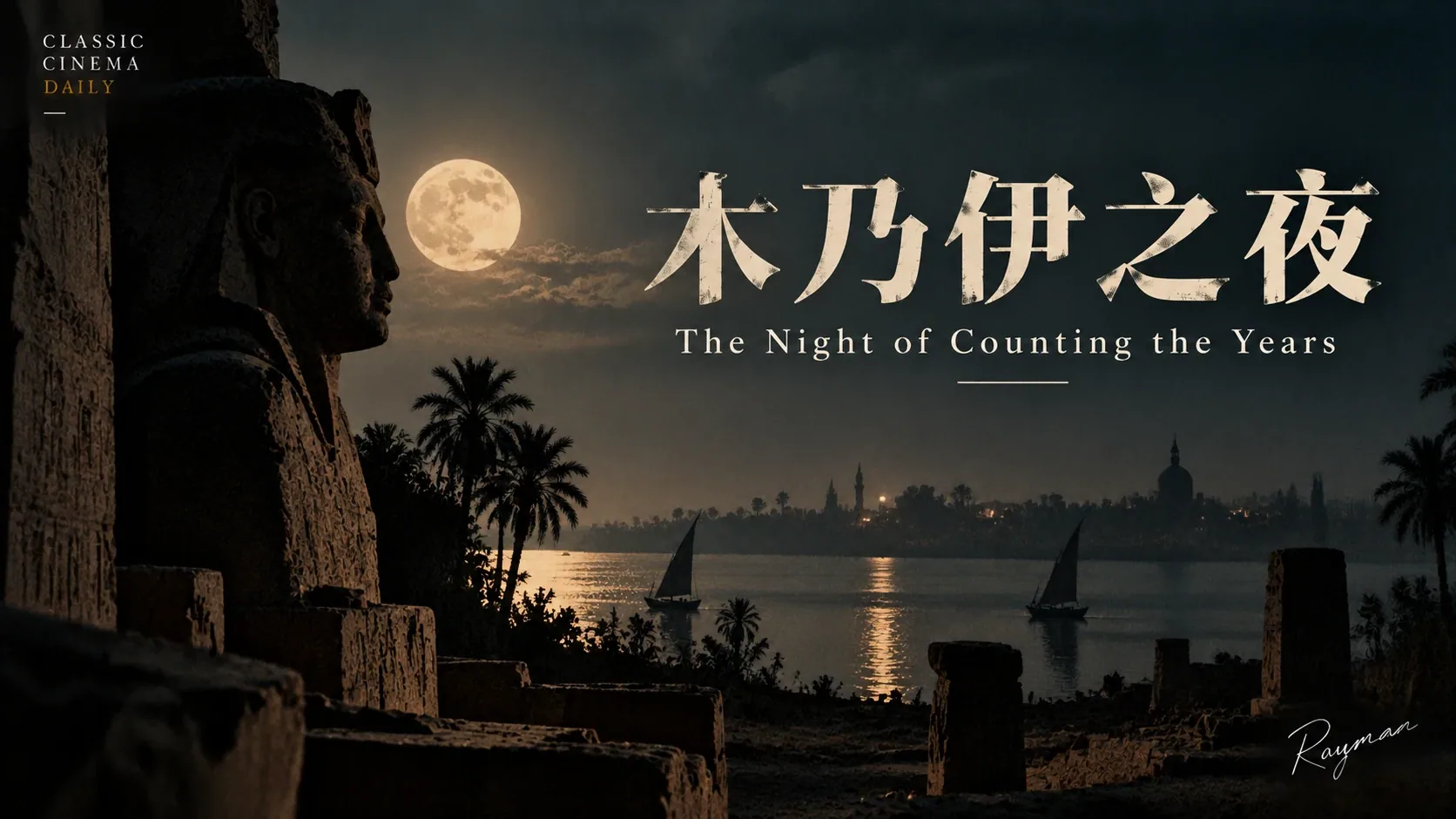
The Night of Counting the Years
木乃伊之夜
1969
Shadi Abdel Salam
Egypt · Historical drama / Drama / Neorealism · 102 min
Upper Egypt, 1881. After their father's funeral, two brothers discover what has kept their clan alive for generations: selling off the royal mummies buried in the mountain above them. Shadi Abdel Salam — an architect by training who directed only one feature — shot it in Classical Arabic and near-static compositions, turning it into a parable about who owns the past.
01Why this film today
Today is 16 October. This month marks forty years since an Egyptian director died; today is a Lebanese playwright's fifty-eighth birthday.
On 8 October 1986 Shadi Abdel Salam died in Cairo at fifty-six — eight days ago, exactly four decades. His real profession was architecture: he graduated from the Faculty of Fine Arts in Cairo in 1955, mentored by Hassan Fathy, and went on to become Egyptian cinema's most exacting costume and set designer, working on historical productions such as Saladin the Victorious and Pharaoh. He directed exactly one feature, tonight's first film. For the last decade of his life he worked on an epic about Akhenaten, insisting that a film about Egyptian history had to be financed entirely by Egyptians. It was still unfinished when he died.
Today would be Wajdi Mouawad's fifty-eighth birthday. Born on 16 October 1968 in Deir al-Qamar, Lebanon, he left the country at eight when the civil war began and settled in Montreal in 1983. In 2003 he wrote the play Incendies; in 2004 Denis Villeneuve saw it performed in Montreal.
Both films begin with a funeral.
In one, the father Selim is buried, two brothers inherit the clan, and their uncle takes them to see the family's real business — the royal mummies in the mountain above them, being sold off piece by piece. In the other, the mother Nawal is buried, and her will forbids a gravestone unless her twins find the father they believed long dead and a brother they never knew existed.
Two inheritances, both buried underground: one is a set of ancestral bodies, the other is two sealed letters. And both films end back at the body — one carries a whole cache of sarcophagi out of the mountain and onto a boat; the other finally gives a mother her headstone.
Why this pairing now: Egypt was a total blank on this list. The 1960s held six films and the 2010s only two; tonight adds one to each. There is a thread too: The Night of Counting the Years was released in the United States by New Yorker Films in 1975, the same distributor behind Landscape in the Mist (1990) and Underground (1997). And Incendies shares with The Battle of Algiers a subject it refuses to look away from — colonisation, civil war and torture across North Africa and the Levant.
02Film details
- Chinese title
- 木乃伊之夜
- English title
- The Night of Counting the Years
- Director
- Shadi Abdel Salam / 沙迪·阿卜杜勒·萨拉姆
- Year
- 1969
- Country
- Egypt / 埃及
- Language
- Classical Arabic
- Genre
- Historical drama / Drama / Neorealism / 历史片 / 剧情 / 新现实主义
- Runtime
- 102 min
03About the film
影片开始于一场葬礼。父亲 Selim 下葬之后,Wanis 和他哥哥成了部族的首领。他们的叔叔很快带他们去看家族的真正营生——这座山里埋着帝王,而部族已经靠它活了很久。兄弟俩第一次意识到:他们从小过的那种日子,是拿祖先换来的。
同一时间,开罗的博物馆学者们在这个通常没人来的酷暑季节赶到了对岸。黑市上出现了来源不明的陪葬品,他们想知道它们从哪儿来;法国埃及学家 Gaston Maspero 的名字出现在他们的谈话里。
Wanis 必须做一个选择,而这个选择没有干净的一边。
04Why it is a classic
It ranks third on the list of the Top 100 Egyptian films, and it is the only feature Shadi Abdel Salam ever directed — a production and costume designer's one and only film.
The language is itself a statement. Egyptian cinema runs on Egyptian dialect; this film insists on Classical Arabic. That choice gives it a monumental distance and turns "Egyptian" into something abstract, ancient, belonging to no present tense.
The images borrow Ancient Egypt's own visual grammar. Abdel Salam was an architect. He sets wide desert vistas and near-rigid facial close-ups against the compositions of temple reliefs — black-robed figures pressed onto white sand, like a mural that moves.
Its subject is sharper now than in 1969. The film asks who has the right to dispose of the past: the clan treats its ancestors as property, the state treats them as antiquities, both sides are moving corpses, and Wanis alone is stuck between them.
Not everyone liked it. In 1975 Richard Eder of The New York Times called it "stupefying grandiloquence" and said the camera "sticks and won't let go"; Time Out London called it "slow-moving but absorbing, and quite beautifully shot." They are describing the same thing.
It was restored in 2009 by Martin Scorsese's World Cinema Foundation and the Egyptian Ministry of Culture at L'Immagine Ritrovata in Bologna; the restored version premiered at the Bibliotheca Alexandrina with Scorsese present. He called it "an astonishing piece of cinema" — "stately, poetic, with a powerful grasp of time and the sadness it carries."
05What to notice
它基于真事。 1881 年,底比斯墓群中德尔巴哈里(Deir el-Bahari)旁的一处墓室被埃及学家接管,里面堆着数十具王室木乃伊。这处窖藏后来被称为王室窖藏(Royal Cache,编号 TT320/DB320);而在那之前,Abd el-Rassul 家族已经零散地卖了很多年。
制片人是 Roberto Rossellini。 这位意大利新写实主义的旗手为埃及国家电影机构(General Egyptian Cinema Organisation)担任制片,并且是他鼓励阿卜杜勒·萨拉姆把这部片拍出来的。
音乐来自意大利,摄影是埃及人。 配乐 Mario Nascimbene(曾为《维京人》《巴拉巴》作曲),摄影 Abdel Aziz Fahmy,剪辑 Kamal Abou-El-Ella。
片中的学者是真人。 银幕上的 Maspero 与 Kamal,对应法国埃及学家 Gaston Maspero 与埃及埃及学家 Ahmed Kamal——演员表里直接标注了这一点。
它曾代表埃及参评第 43 届奥斯卡最佳外语片,未获提名。 1996 年埃及电影百年之际的 CIFF 百佳评选中,它排在第 3 位。2009 年的修复由博洛尼亚 L'Immagine Ritrovata 实验室完成,修复版首映于亚历山大图书馆。
06Before you watch
102 分钟,古典阿拉伯语(不是埃及方言)。这不是一部靠情节推进的电影——它靠构图、沉默和节奏。如果平时习惯快剪,前二十分钟会觉得它几乎不动;这正是它的方法。
建议先知道「1881 年、上埃及、王室木乃伊黑市」这三个词,其余交给画面。片中的人物关系(谁是叔叔、谁是中间商、谁是学者)在前半小时会有点绕,注意父亲葬礼上出现的那几个人。
不要期待一个道德结论。Wanis 的处境没有正确答案,影片也没有给他一个。
07In one line
One sarcophagus after another is carried out of the mountain and onto the boat, and nobody in the film does anything wrong. That is the coldest thing about The Night of Counting the Years: it makes preserving a heritage and selling your own ancestors the same gesture.