9 min
Breathless
精疲力尽
1960
Jean-Luc Godard
France · Crime / Drama · 90 min
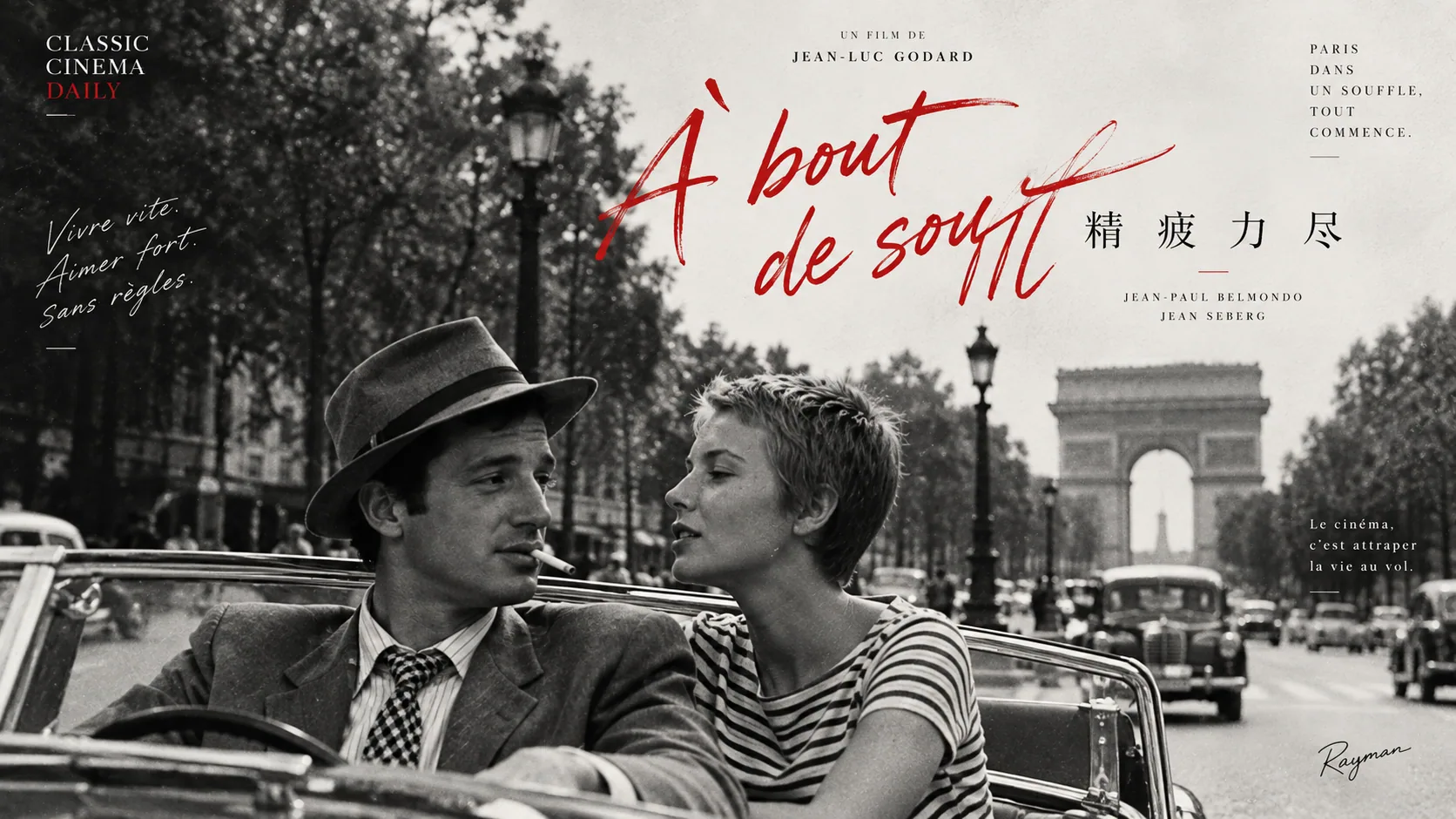
Marseille. A young man who models himself on American gangster pictures steals a car and, on the road to Paris, shoots a policeman. He is going to Paris for an American girl — a student and aspiring reporter deciding whether to stay. Shot handheld on real streets and cut with jump cuts, Godard's debut became the opening statement of the French New Wave.
01Why this film today
This is the archive's first French film.
1960 was a hinge year. The previous year Truffaut's The 400 Blows and Resnais's Hiroshima mon amour had carried a 'new French cinema' to international attention; Breathless opened in March 1960 and pushed the same group's methods to their furthest point — a film made with almost no script, no shooting permits, 23 days of production and entirely post-dubbed dialogue, which became one of the most quoted films of the following sixty years.
It is a deliberate counterweight to today's lead film, Parasite. Both are about young people with no money, no plan and a determination to keep going; but one builds its genre structure with extreme precision, while the other all but dismantles structure altogether. Fifty-nine years apart, one stands for what the film industry can do, the other for what it can break. Seen together, each becomes more legible.
02Film details
- Chinese title
- 精疲力尽
- English title
- Breathless
- Director
- Jean-Luc Godard / 让-吕克·戈达尔
- Year
- 1960
- Country
- France / 法国
- Language
- French, English
- Genre
- Crime / Drama / 犯罪 / 剧情
- Runtime
- 90 min
03About the film
马赛。一个年轻人偷了一辆车,开往巴黎。路上遇到警察盘查,他冲动之下开枪,打死了一名摩托车巡警。
他叫 Michel Poiccard,自称 Laszlo Kovacs。他崇拜美国黑帮片,学的是银幕上的姿态:不停地摸嘴唇、戴帽子、抽烟,用别人电影里的动作来组装自己的人格。
他到巴黎是为了找一个女孩。Patricia Franchini 是美国人,在巴黎读书,同时替报社跑新闻、在香榭丽舍大街卖报纸。两人之前有过一段关系,但 Patricia 并没有打算为它改变自己的计划——她正在决定要不要留在巴黎,还是回美国继续读书。
于是整部电影就悬在这件事上:一个不知道自己想要什么的男人,和一个知道、但不愿意承认的女人,在一间旅馆房间里耗掉了一整个下午。警方在追 Michel。他没有真的打算跑。
影片最后以一句对白收尾,这句台词后来被反复引用——这里不写,看完就懂。
04Why it is a classic
Director and conditions
Breathless (À bout de souffle, literally 'out of breath') was Jean-Luc Godard's first feature. Born in Paris in 1930, Godard had been a critic at Cahiers du cinéma, alongside François Truffaut, Claude Chabrol, Jacques Rivette and Éric Rohmer — the group that wrote criticism first and made films second. The story came from Truffaut, who had found a newspaper report about Michel Portail and his American journalist girlfriend Beverly Lynette (November 1952) and turned it into a treatment which Godard eventually shot.
The conditions were minimal. Producer Georges de Beauregard, budget 400,000 francs (about $80,000), shooting from 17 August to 12 September 1959 — 23 days, and without permits, which only increased the spontaneity Godard wanted.
Camera and sound
Godard asked cinematographer Raoul Coutard to shoot it like a documentary: handheld throughout, with next to no lighting. To work in low light Coutard used Ilford HP5, a film stock not sold as motion picture stock at the time; the often-repeated claim that he spliced 18-metre lengths of 35mm still film into 120-metre rolls is one he himself denied. He push-processed the negative one stop, from 400 to 800 ASA.
The Eclair Cameflex camera was too noisy for synchronised sound, so almost all the dialogue was dubbed in post-production. That matters: it explains why this most 'documentary' of films has a strangely dry, studio-made voice. The bedroom scenes were shot at the Hôtel de Suède with no lighting and a skeleton crew; Godard often pushed Coutard around in a wheelchair rather than renting track, and for some street scenes hid him inside a postal cart with a lens hole cut in it.
Editing and the jump cut
The film was processed and cut at GTC Labs in Joinville by editor Cécile Decugis. The jump cut — a hard excision of a moment inside a single scene, so the image visibly leaps — became its signature. According to Pierre Rissient it was not planned during shooting, nor intended at the start of editing. Coutard's account: 'There is a panache in the editing that has nothing to do with the way it was shot. It gave the film a tone completely different from what we were used to.' The critic Andrew Sarris read the jump cuts as an existential gesture, erasing the meaningless intervals between moral choices.
Performance
Jean-Paul Belmondo plays Michel Poiccard, Jean Seberg plays Patricia Franchini. Seberg agreed to appear in June 1959 for $15,000 — one sixth of the entire budget. Belmondo had never carried a role this large; the film made him a star. Jean-Pierre Melville appears as the writer Parvulesco, Rivette as a corpse, and Godard himself as an informer. There was almost no rehearsal and the dialogue lived in a notebook nobody else was allowed to read; by Coutard's account the film was virtually improvised on the spot.
Reception and legacy
It opened in France on 16 March 1960, won the Silver Bear for Best Director at the 10th Berlin International Film Festival that year (and was nominated for the Golden Bear), took the 1960 Prix Jean Vigo, and was named best French film of the year by the French Syndicate of Cinema Critics, tied with Le Trou.
It is dedicated to Monogram Pictures, a studio known for low-budget B pictures — a dedication Jonathan Rosenbaum read as 'a critical statement of aims and boundaries'. Roger Ebert added it to his Great Movies list in 2003, writing that 'no debut film since Citizen Kane in 1942 has been as influential'. Writing in 2010, fifty years on, A. O. Scott called it both a product of popular culture and a bold work of art: 'still cool, still new... a bulletin from the future of movies.'
Sight & Sound placed it 22nd in 1992, 15th in 2002, 13th among critics and 11th among directors in 2012, and 38th among critics and 15th among directors in 2022. The BBC's 2018 poll of the greatest foreign-language films put it 11th. Rotten Tomatoes records 95% from 82 reviews. Pauline Kael called it the most important New Wave film to reach America, and Belmondo 'the most exciting actor to appear since Marlon Brando'.
A restoration was released in the United States in May 2010 for the film's fiftieth anniversary.
05What to notice
跳切不是设计出来的。据 Pierre Rissient 的说法,它既不是拍摄时的计划,也不是剪辑初期的意图——片子太长,剪辑时硬切掉了多余的时间。电影史上最有名的一种「手法」,起点是一次剪短。
声音是后期配的。Eclair Cameflex 摄影机无法同步录音,全片对白基本都在后期重新配过。这种「画面像纪录片、声音像棚内」的错位是它独特质感的一部分,不是技术缺陷。
胶片本来是拍照片用的。Ilford HP5 当时并不作为电影胶片出售,库塔尔靠推冲(400 → 800 ASA)才拿到可用曝光。低照度、实景、不打灯,是预算逼出来的方法,后来变成了一整套美学。
片头献给 Monogram Pictures。这家制片厂以低成本 B 级片闻名。这不是客套,而是明确站队:它要的是 B 级片的自由,不是大制片厂的规格。
一个美国女孩的片酬占了六分之一预算。茜宝拿到 15,000 美元。整个片子只有 40 万法郎(约 8 万美元),23 天拍完,没有拍摄许可。这些数字是理解这部片子风格的前提,不是花絮。
新浪潮的互相客串。梅尔维尔演作家 Parvulesco,里维特演一具尸体,戈达尔本人演告密者。这批人彼此出现在对方的片子里,是他们共同立场的一种表达方式。
06Before you watch
黑白,90 分钟,法语与英语混用。Patricia 的戏份里有大量英语对白,即使不看字幕也能听懂大部分。
不要找情节。它更接近一部关于两个人与一座城市的纪录片:一个不知道自己想要什么的男人,和一个知道、但不愿意承认的女人,中间隔着一整个下午的对话。
注意跳切。画面会在同一场戏里突然向前跳一下——这不是播放故障,也不是修复瑕疵。第一次看会觉得别扭,第二次看会开始注意它切掉了什么。
注意声音。对白是后期配的,某些地方口型与声音贴合度不高。这是 1959 年的设备条件决定的,全片如此。
结尾不要提前知道。最后一句对白是这部片子最常被引用的部分,提前看到会明显削弱效果。本文也刻意没有写。
版本。2010 年影片完成修复并在美国重映以配合上映五十周年;现在主流平台上的版本基本都是这次修复的延续,直接看即可。
07In one line
Shot in 23 days without permits and dubbed entirely in post, it rewrote the grammar of the next sixty years of cinema.