6 min
Incendies
焦土之城
2010
Denis Villeneuve
Canada / France · Mystery / Drama / War · 130 min
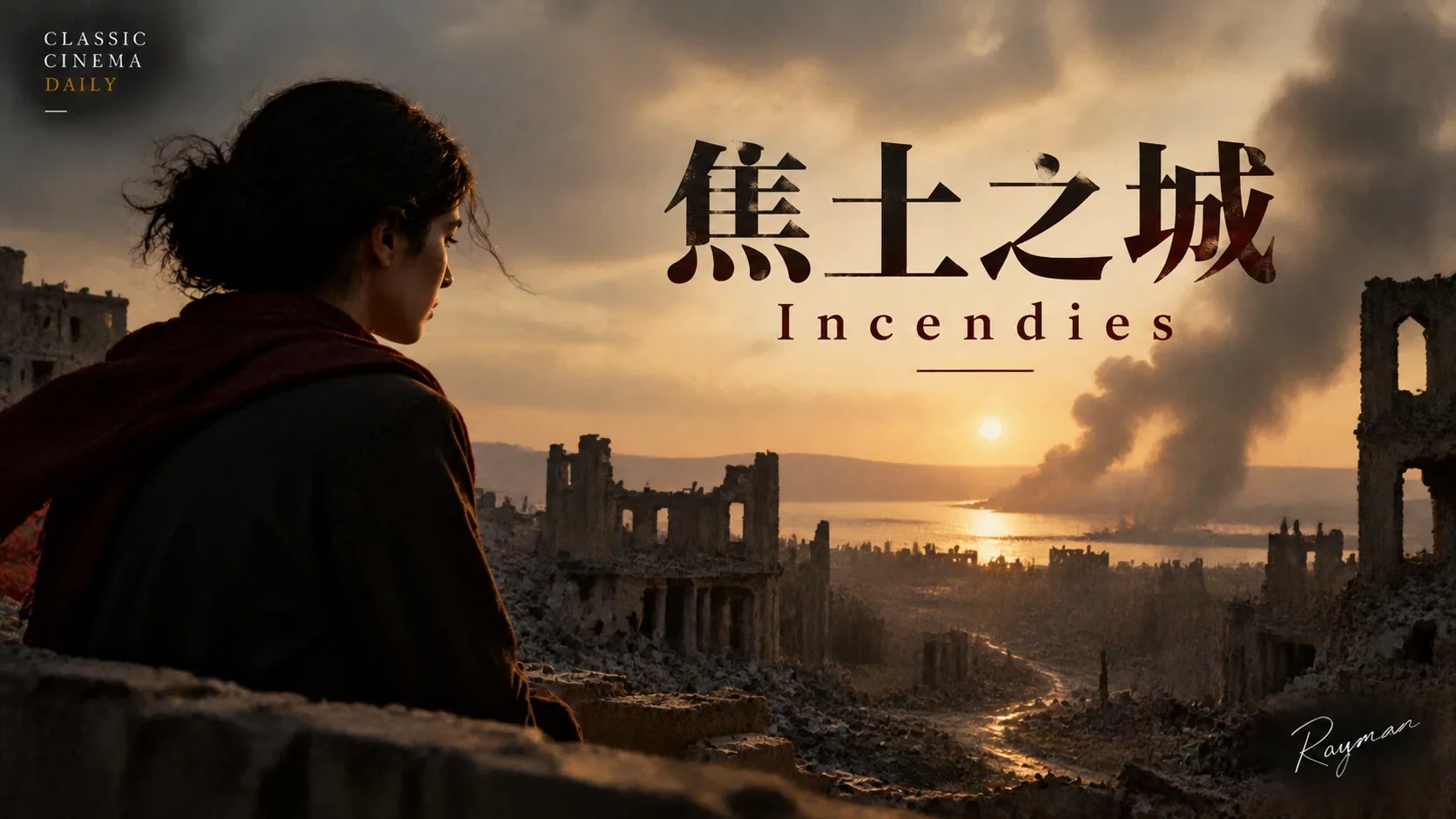
Nawal dies in Canada, and her will refuses her a gravestone or a funeral unless her twins find the father they believed long dead and a brother they never knew existed. Two letters carry the pair back to the Levant and into a civil war. Adapted from Wajdi Mouawad's play; nominated for the Academy Award for Best Foreign Language Film.
01Why this film today
Today would be Wajdi Mouawad's fifty-eighth birthday — born 16 October 1968 in Deir al-Qamar, Lebanon. Tonight's second film is what happened when his best-known play was turned into cinema.
The route runs backwards: stage first, then film. Mouawad wrote Incendies in 2003; in 2004 Villeneuve saw it performed at the Théâtre de Quat'Sous in Montreal and said, "I had this strong intuition that I was in front of a masterpiece." He spent five years on the screenplay, rewriting all of the dialogue while keeping the structure and characters. Mouawad was initially reluctant to grant permission, agreed only after seeing completed scenes, later called the film "brilliantly elegant," and gave Villeneuve full credit.
A playwright handed his country's story to someone who had never lived there — and that fact is part of the film. Villeneuve acknowledged his unfamiliarity with Arab culture and dealt with it by keeping the location deliberately unnamed. His framing is unusually candid: he wrote Radiohead's "You and Whose Army?" into the script from the first draft to make it "clear that [the film] will be a westerner's point of view about this world."
Forty-one years and two continents separate tonight's two films, but both begin with a funeral and both ask the same thing: does the next generation have the right not to look at what it inherited.
02Film details
- Chinese title
- 焦土之城
- English title
- Incendies
- Director
- Denis Villeneuve / 丹尼斯·维伦纽瓦
- Year
- 2010
- Country
- Canada / France / 加拿大 / 法国
- Language
- French / Arabic / English
- Genre
- Mystery / Drama / War / 悬疑 / 剧情 / 战争
- Runtime
- 130 min
03About the film
Nawal Marwan 在加拿大去世。她生前话很少,几乎不谈自己的过去。宣读遗嘱时,她的双胞胎孩子 Jeanne 和 Simon 被告知:母亲不打算要墓碑,也不打算要棺材——除非他们完成她留下的两件事。她留下两封信:一封写给他们的父亲(他们一直以为他早已死去),一封写给他们的哥哥(他们不知道他存在)。
Jeanne 决定去。Simon 不想去。两人对母亲的态度完全不同,而母亲留下的这条线索,只能两个人一起走完。
故事从此分成两条时间线:一条是姐弟在中东的寻找,一条是 Nawal 年轻时在那里的几十年。它们最终会合上,而合上的方式是这部电影最不希望被提前知道的部分。
04Why it is a classic
Villeneuve spent five years on it. After seeing Mouawad's play in Montreal in 2004 he kept the structure and the characters but rewrote all of the dialogue — at one point he considered making it a silent film, abandoning the idea only because of the cost. That adaptation relationship is the film's subtext: a Québécois director filming a Middle Eastern civil war without pretending to be a local.
It treats a civil war as family history rather than news. The country is never named and the location is deliberately kept ambiguous, but the story's skeleton comes from the Lebanese Civil War of 1975–1990, parts of it drawn from a real person's life.
The form is the point. Cinematographer André Turpin and editor Monique Dartonne interleave two timelines so that "the mother then" and "the children now" answer each other; the two Radiohead tracks from Amnesiac function as narrative devices, not score.
The performance carries the weight. Lubna Azabal was thirty when she played Nawal, a role spanning four decades; she won Best Actress at both Canada's Genie Awards and Belgium's Magritte Awards. Villeneuve called the casting the hardest part of the film and had considered using two or three actresses for the one character.
Acclaim and criticism arrived together. 91% on Rotten Tomatoes from 124 reviews and 80 on Metacritic; eight Genie Awards including Best Motion Picture, Best Director and Best Actress; and it remains the only film to have won both the Toronto and Vancouver awards for Best Canadian Film. The criticism is just as clear — charges of melodrama and of orientalism. Roger Ebert gave it three and a half stars, writing that "it wants to be much more than a thriller and succeeds in demonstrating how senseless and futile it is to hate others because of their religion," and picked it to win the foreign-language Oscar. It lost to Denmark's In a Better World.
05What to notice
话剧先于电影。 原著《Incendies》由 Wajdi Mouawad 写于 2003 年。他生于黎巴嫩 Deir al-Qamar,八岁因内战随家人离开,在法国住了五年后于 1983 年移居蒙特利尔;自 2016 年 4 月起任巴黎 Théâtre national de la Colline 院长。
40 天拍完,其中 15 天在约旦。 主体在蒙特利尔,约旦部分在安曼等地完成;为还原贝鲁特,美术指导 André-Line Beauparlant 在安曼的街道上堆出岩石与瓦砾。约旦部分用的是黎巴嫩与伊拉克的剧组。
音乐是 Radiohead。 片中用了《Amnesiac》里的 "You and Whose Army?" 与 "Like Spinning Plates",维伦纽瓦说前者是他从剧本第一稿就写进去的。配乐由 Grégoire Hetzel 完成,摄影 André Turpin,剪辑 Monique Dartonne。
部分情节取自真实人物。 故事骨架是黎巴嫩内战(1975–1990),其中一部分来自黎巴嫩人 Soha Bechara 的经历——她 1988 年试图刺杀南黎巴嫩军领袖 Antoine Lahad,行动失败后入狱。
预算 650 万美元,全球票房约 1600 万美元,仅魁北克一地就收了 300 万加元。2023 年,加拿大 Telefilm Canada 把它列入「Canadian Cinema Reignited」数字修复计划(共 23 部)。
06Before you watch
130 分钟,法语、阿拉伯语与少量英语。影片在两个时间层之间来回切换,前半小时需要留意「现在」和「过去」的区分方式——注意人物的年龄、发型和画面质感。
这是一部结局依赖信息的电影。 看之前请避开剧情简介和讨论帖;它不是那种「知道结局也不影响观看」的片子。
它包含战争暴力、性暴力与酷刑的直接呈现,其中包括一段公共汽车上的屠杀。请按自己的承受度决定是否观看。
如果看完想接着读,维伦纽瓦的访谈比影评更值得找——尤其是他把这部片定义为「一个西方人对那个世界的视角」的那几句,那本身就是理解这部电影的钥匙。
07In one line
A mother uses her will to force her children to look at what she would never speak of. Villeneuve does not explain her; he lets two timelines expose each other. The cruelty of Incendies is not what happened, but that the next generation has to be told.