7 min
Underground
地下
1995
Emir Kusturica
Yugoslavia / Bulgaria / Czech Republic / France / Germany / Hungary · Black comedy / Absurdist / Epic / War · 170 min
Belgrade, 1941: a man hides his best friend's family in a cellar and tells them the war is not over. For the next twenty years he grows rich on that lie while the people below keep manufacturing weapons for a revolution that ended long ago. Kusturica turns half a century of Yugoslav history into a brass-band carnival, with a zoo and a chimpanzee. Palme d'Or, Cannes.
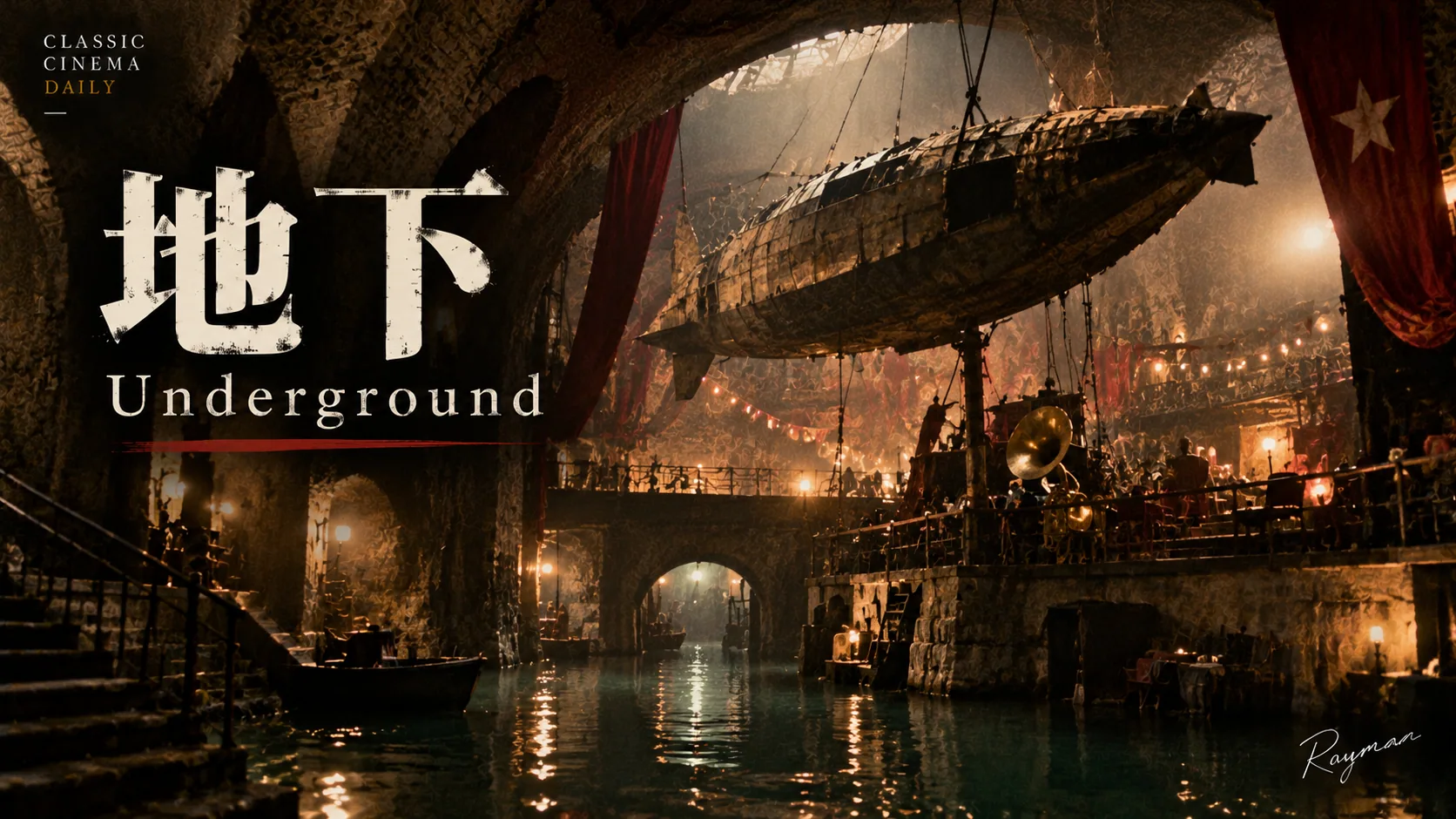
01Why this film today
Today is 15 October. Tonight's second film is the reverse of the first.
In Landscape in the Mist a lie sends two children onto the road; in Underground a lie keeps a whole group locked in a cellar.
On 6 April 1941 German bombs fall on Belgrade. Marko hides his best friend Crni's wife, his brother Ivan and a crowd of others in the cellar of his grandfather's house — meant to be temporary. The war ends and he does not tell them. For the next twenty years he serves as a high official beside Tito, gives speeches, stands on parade, and quietly ships the weapons made in that cellar out of the country by the truckload. To stop the people below from counting the years, he even steals hours from their clock, so that they believe the Second World War has been running for fifteen years rather than twenty.
This is a film about how long a person can stay asleep — and about how much someone else can make from keeping him that way.
On this list it fills in Yugoslavia, the Balkans having been entirely absent, and it fills in the 1990s, which held only two films (Close-Up, 1990; A Brighter Summer Day, 1991). It also answers a standing gap in genre: the archive had no black comedy, and Cannes handed this one the Palme d'Or in 1995 — Kusturica's second, after When Father Was Away on Business (1985).
There is one more counterpoint: the children in Landscape in the Mist walk north toward Germany, the centre of Europe; the country in Underground is disappearing from the map. Both films are shot at Europe's edge — one about departure, one about disintegration.
02Film details
- Chinese title
- 地下
- English title
- Underground
- Director
- Emir Kusturica / 埃米尔·库斯图里卡
- Year
- 1995
- Country
- Yugoslavia / Bulgaria / Czech Republic / France / Germany / Hungary / 南斯拉夫 / 保加利亚 / 捷克 / 法国 / 德国 / 匈牙利
- Language
- Serbian / German
- Genre
- Black comedy / Absurdist / Epic / War / 黑色喜剧 / 荒诞 / 史诗 / 战争
- Runtime
- 170 min
03About the film
1941 年 4 月 6 日清晨,贝尔格莱德。两个游手好闲的好朋友——电工 Crni 和投机分子 Marko——在德军轰炸的警报声里往家赶。
轰炸过后,Marko 把 Crni 临产的妻子、自己的弟弟 Ivan 和一群人藏进祖父家的地窖,说是暂时避一避。Crni 的妻子生下儿子 Jovan 后死去。
Ivan 是动物园管理员。轰炸那天,他从园里只救出一只小黑猩猩,叫 Soni,从此一直带着它。
战争结束了。地窖的门没有打开。
(这里不再往下说。)
04Why it is a classic
Half a century inside one cellar
- An international co-production from Yugoslavia (Serbia), Bulgaria, the Czech Republic, France, Germany and Hungary. 170 minutes, in Serbian and German. Directed by Emir Kusturica, co-written with Dušan Kovačević.
The film falls into three parts named for Yugoslavia's three eras — "War" (1941–1944), "Cold War" (1961), "War" (1992). In 1941 German troops occupy Belgrade; by 1961 Marko is a high official beside Tito; by 1992 the Yugoslav Wars have begun. One country, three dates, three wars, and Kusturica films them as one unbroken brass-band carnival.
It is a comedy and it is a lament
Every scene is loud: the band, the drinking, the weddings, the animals escaped from the zoo, the rows of rifles. Writing from Cannes in 1995, Variety's Deborah Young called it "a steamroller circus that leaves the viewer dazed and exhausted, but mightily impressed", adding that "if Fellini had shot a war movie, it might resemble Underground".
But Janet Maslin in The New York Times located the film's real heart: its most devastating idea is the morning after — a man emerges from a subterranean hiding place after decades in the grip of a political delusion and is told that there is no Yugoslavia any more.
The last shot
The ending is a dreamlike reunion. The dead gather for a dinner on a small peninsula to celebrate Jovan's wedding. Ivan speaks the closing words: they will pass on to their children fairy tales that begin, "Once upon a time, there was a country." Then the ground separates from the peninsula, becomes an island, and drifts away with them still on it.
What it set off
The year it took the Palme d'Or, Underground also detonated one of the fiercest arguments in European intellectual life. The Yugoslav journalist Stanko Cerović publicly accused Kusturica of Serbian propaganda in June 1995; the French philosopher Alain Finkielkraut attacked the film in Libération without having seen it; Bernard-Henri Lévy called Kusturica "a racist genius in the mold of Louis-Ferdinand Céline". Others defended it: writing in Sight & Sound in 1996, the British author Misha Glenny attacked critics who could read the film only through a simplistic pro- or anti-Serb lens.
Notably, Cerović, who fired first, changed his mind in 2012: it was not propaganda, he said, and "it's quite possible that Underground will age well".
The controversy itself proves the point: a film that turns a country's self-deception into comedy is not one everybody leaves laughing.
05What to notice
「从前,有一个国家。」 影片另有一个副标题与五小时电视版片名:《Bila jednom jedna zemlja》——「从前有一个国家」。库斯图里卡说他的原始版本超过五小时,是联合制片方要求删减的。
从时钟上偷走时间。 为了让地窖里的人算不清年份,Marko 每天从他们的时钟上拿掉几个小时,让里面的人以为二战才打了十五年,而不是二十年。这是全片最精确的一个隐喻:独裁不需要禁止时间,只需要调整它。
一头黑猩猩。 Ivan 是动物园管理员,轰炸那天他从贝尔格莱德动物园里只救出一只小黑猩猩 Soni,此后一直带着它。Soni 后来钻进一辆坦克、开了一炮,把地窖的墙打出一个洞——这个荒诞的意外,是整部电影真正开始的地方。
铜管乐。 配乐由 Goran Bregović 负责,铜管乐队在片中反复出现,既是婚礼与葬礼的伴奏,也是这场荒诞史的节拍器。原声专辑里还出现了佛得角歌手 Cesária Évora 的声音。
一段被租来的军队装备。 影片 1993 年秋天开拍,断断续续拍到 1995 年初。塞尔维亚国家电视台参与了少量投资,片中大量军事道具是向当时的南斯拉夫军队租来的——一部讲述「一个国家如何自我欺骗」的电影,用的是那个国家自己的枪。
06Before you watch
它是什么。 1995 年南斯拉夫(塞尔维亚)/ 保加利亚 / 捷克 / 法国 / 德国 / 匈牙利合拍,170 分钟,塞尔维亚语与德语,黑色喜剧 / 荒诞 / 史诗 / 战争。导演埃米尔·库斯图里卡。1995 年戛纳电影节金棕榈;1996 年法国卢米埃尔奖最佳外语片;1997 年美国波士顿影评人协会最佳外语片。
内容提示。 战争与处决、自杀、动物受困、大量饮酒、乐队与性场面。片长 170 分钟,节奏极快、人物极多,建议一次看完,不要分段——它的效果来自持续的过载。
看的时候留意。 三段标题(战争 / 冷战 / 战争)之间的时间跳跃;Marko 每次在地面上发表演说时,镜头怎么把地窖里的人留在画外;以及铜管乐队每次出现的场合——婚礼、葬礼、阅兵、逃亡,都是同一批人。
一句话建议。 别急着给这部片的政治立场下判决。它真正拍的不是「谁对谁错」,而是一件更难受的事:一个人可以靠一个谎话活得很好,只要他确保别人不醒过来。
07In one line
One man makes rifles in a cellar, the other sells them above ground, and the people in between believe the war never ended. Underground films half a century of Yugoslavia as a brass band that will not stop, then lets the whole peninsula drift away.