10 min
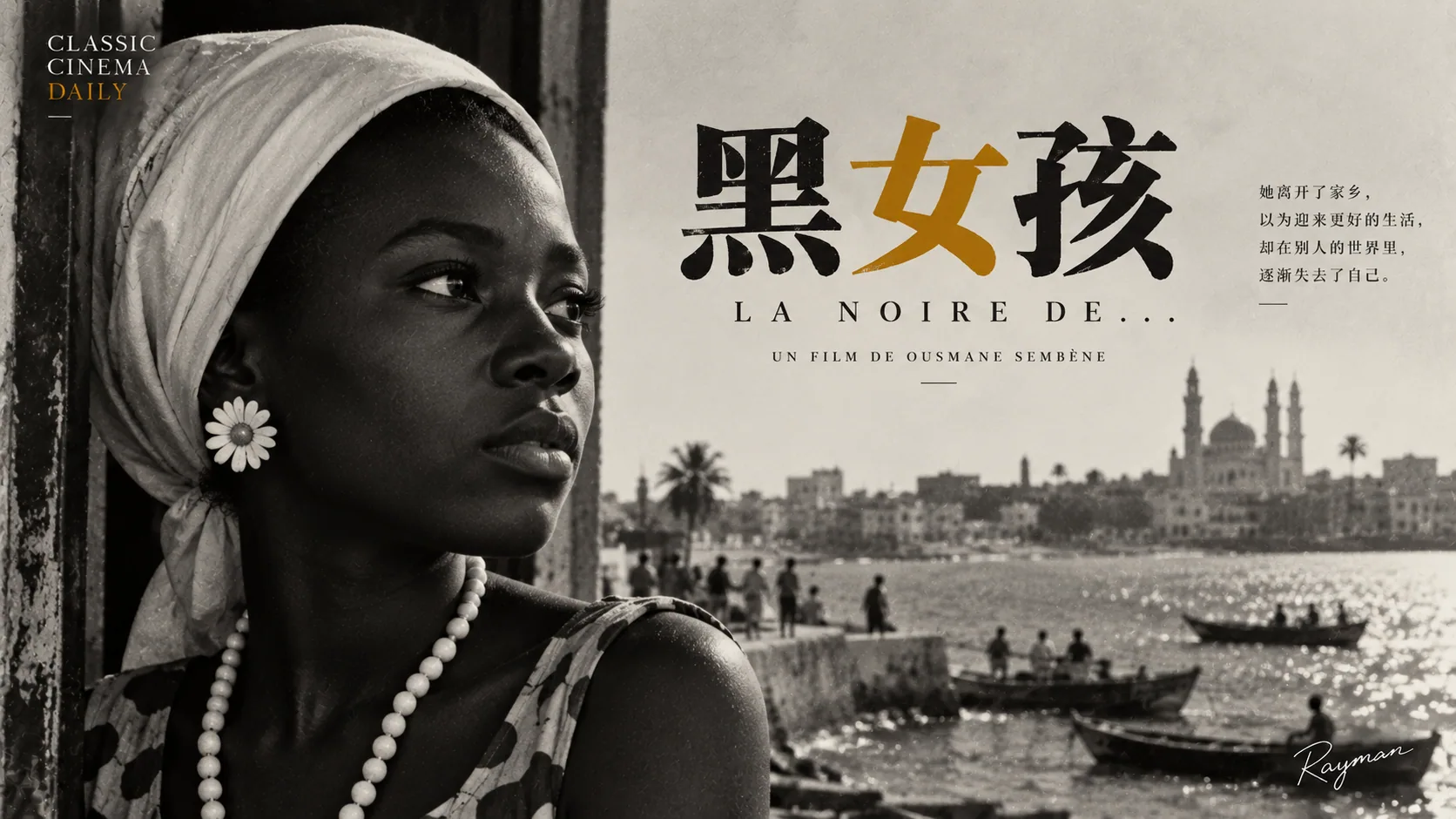
Black Girl
黑女孩
1966
Ousmane Sembène
Senegal / France · Drama / Social realism · 65 min
A young woman from outside Dakar, Diouana, is taken on as a maid by a French couple. She thinks it is the start of a new life; in France she is shut inside an apartment, addressed only as "the maid", and even her letters home are written for her by her employers. Sixty-five minutes, in black and white — the first feature film by a director from sub-Saharan Africa.
01Why this film today
The archive holds fourteen films. Japan, the United States, Italy, Sweden, Hong Kong, China, France, South Korea, Iran, Germany, the Soviet Union, India and Brazil are all represented — and sub-Saharan Africa is not represented at all.
Today fills that gap with the least arguable choice available. In 1966 the Senegalese director Ousmane Sembène made La noire de…, sixty-five minutes long, in black and white. It is generally regarded as the first feature film by a director from sub-Saharan Africa, it won the Prix Jean Vigo that year, and it brought African cinema into international view for the first time.
It interlocks closely with today's first film. In Spirited Away, Yubaba files a child's name away in a contract and leaves her one character of it. Here, Diouana is called "the maid"; she cannot read or write, her mother's letters have to be read aloud to her by the man of the house, and the replies are written for her by the couple. One film turns "your name and your voice are taken from you" into a fairy tale; the other films it in the real world.
In time the two are thirty-five years apart — 2001 and 1966; one is 124 minutes in colour, the other 65 minutes in black and white; one is a child of postwar Japanese affluence, the other of a Senegal six years independent.
One thing should be stated plainly rather than glossed over: this is not an 8-out-of-10 film on IMDb. Its standing rests on two other things — that it is the starting point of a whole cinema, and that the 2016 restoration allowed critics to read it accurately again.
02Film details
- Chinese title
- 黑女孩
- English title
- Black Girl
- Director
- Ousmane Sembène / 奥斯曼·塞姆班
- Year
- 1966
- Country
- Senegal / France / 塞内加尔 / 法国
- Language
- French
- Genre
- Drama / Social realism / 剧情 / 社会写实
- Runtime
- 65 min
03About the film
达喀尔,一栋公寓楼外的空地上,一群女人在等活干。她们大多是文盲,靠替人带孩子、洗衣服换一点钱。
一个法国女人走过来。别的女人都往前挤,只有一个年轻女子站着没动——于是她被选中了。她叫 Diouana。
她先在这家人家里带孩子。她把从一个小男孩手里花五十几内亚买来的一个非洲面具送给了女主人,他们把它摆在家里。
后来这对夫妇要回法国,问她愿不愿意跟他们走,去那边继续做事。Diouana 非常高兴。她告诉男朋友,她要去法国了。
到了法国之后,事情变成另一种样子。她被困在公寓里,只做饭、打扫,不被允许出门。女主人对她刻薄。她开始不太说话。
影片在法国的现在和达喀尔的过去之间来回切。
(这里不再往下说。如果你打算看,请先读下面「观看前应该知道什么」里的强度提示。)
04Why it is a classic
A man who did not start making films until he was forty
Ousmane Sembène was born in 1923 in Ziguinchor, in the Casamance region of southern Senegal, into a fishing family. His first language was Wolof; he taught himself to read and write French. During the Second World War, from 1944 to 1946, he was conscripted into the Senegalese Tirailleurs and served with the Free French Forces.
In 1947 he stowed away to France. He worked first at the Citroën factory in Paris, then moved south to Marseille to work the docks, where he joined the CGT trade union and took part in strikes aimed at stopping the shipment of arms to the colonial war in Indochina. In 1956 he published his first novel, Le Docker noir (Black Docker), drawn from what he had seen on the Marseille waterfront.
Why he put down the pen and picked up a camera
His reason was stated plainly: his written work could reach only the cultural elite, whereas film was "the people's night school" and could reach a far wider African audience.
In 1962–63 he studied filmmaking for a year at the Gorky Film Studio in Moscow under the Soviet director Mark Donskoy. In 1963 he made the short Borom Sarret, about a poor cart driver in Dakar — generally regarded as the first film made by a black African. Three years later came Black Girl, his first feature.
He went on to make films for four decades, from Mandabi (1968, the first feature shot in Wolof) to Moolaadé (2004). He died in Dakar on 9 June 2007, aged 84.
A real event, and the part the newspaper left out
The film adapts his own short story "La Noire de…", collected in Voltaïque (1962), and that story was triggered by a real news report: a Senegalese maid who killed herself in France.
What Sembène does is supply everything the report did not give her — how she was chosen, what she saw, what she thought. In the newspaper she is an outcome; in the film she is a process.
Sixty-five minutes, a tiny budget, and a word he invented
Sembène cut the running time to roughly an hour to satisfy the Centre national du cinéma. The money came from the French Ministry of Cooperation's Cinema Bureau, whose head had rejected the script — most likely because of its subject. The film was completed on a very low budget.
For this he coined a term: mégotage, literally "cigarette-butt cinema" — picking up what others have thrown away and using it anyway. It was not self-deprecation; it was his formal account of how to make films with almost no resources.
The mask: from a row of masks to a bare white wall
The central object of the film is the African mask Diouana buys in Dakar from a small boy for fifty-odd Guinean francs and gives to her employer.
In Dakar it hangs among other masks, with her inside a familiar place and familiar people. In France it is mounted alone on a bare white wall — which is exactly Diouana's position: one person, and a white wall. In the second half of the film she fights with Madame to get it back. The ownership of a gift is the politics of the entire film.
In the final scene Monsieur travels to Senegal to return her suitcase, the mask and her money; her mother refuses the money. As he leaves the village, a boy wearing that mask runs after him. Some critics read it as this: Africa's past will keep following its colonisers, and the future is watching them.
The letters: her life is written by someone else
Diouana cannot read. When her mother writes, Monsieur reads the letter aloud to her — it asks why she has not been in touch, and asks for money. The couple then write the reply, telling her mother that she is happy and well in France. Diouana tears the letter up, but she does not correct them.
The critic Rachel Langford points to what matters in that scene: her life is not authored by her; it is authored for her by the coloniser. Across the whole film, the only expressions she can call her own are silence and stillness.
Her voice, technically, is borrowed too
One production detail lands precisely on the theme: in the finished film Diouana's lines are dubbed into French by a different person. M'Bissine Thérèse Diop's performance lives in her body and her face, but the voice is not hers. A film about a woman deprived of a voice has a protagonist whose voice literally belongs to someone else.
(A note on Diop herself, from her 2016 interview: apart from one polka-dot dress, every costume she wears in the film was her own, because she worked as a seamstress; and her family were strongly opposed to her appearing in a film, to the point that her neighbours mocked her for it.)
Coldly received, then reassessed
Western critics were lukewarm at the time. In 1969 the New York Times found it unevenly weighted; that same year Roger Ebert called it "slow and mediocre"; in 1973 the Village Voice thought it too didactic and melodramatic.
But one early reader got it right. In 1981, writing about domestic workers in Women, Race and Class, Angela Davis observed that "their tragic situation is brilliantly captured in Ousmane Sembène's film La Noire de…".
After the fiftieth-anniversary restoration in 2016 the assessment settled. A. O. Scott, in the New York Times, wrote that the film is "both fiercely of its moment and permanently contemporary", and that the power of Sembène's art — the striking purity of his early work — lies in its humanism. Ashley Clark, writing for the Criterion Collection, called it "an elegant, coolly enraged dramatization of postcolonial pain", noting that in a Eurocentric version of this story Madame would be the protagonist, whereas here the focus shifts entirely onto Diouana.
Where it sits
In Movies as Politics (1997) Jonathan Rosenbaum called it the symbolic beginning of filmmaking in sub-Saharan Africa — at least insofar as its author was himself African. It is also a rare record of the colonised point of view: Senegal had been independent since 1960, but the colonial relationship did not end with the flag.
05What to notice
面具从一排面具走到一面白墙。在达喀尔,Diouana 送出的那个面具和其他面具挂在一起,她在自己熟悉的人和环境中间;到了法国,它被单独钉在一面白墙上。一个人,一堵白墙,不用一句台词。
衣服是她自己的。据 M'Bissine Thérèse Diop 2016 年的访谈,片中她除那条波点连衣裙外的服装都是她本人的,因为她本人是裁缝。这让这个人物看起来不像穿着戏服。
她的声音是别人的。片中 Diouana 的台词由另一个人配成法语。一部关于被剥夺声音的电影,主角的声音在技术上确实是借来的——这个制作限制和主题撞得极准。
剧本被拒的理由。法国「合作部电影局」拒绝了剧本,很可能就是因为题材本身。Sembène 最后以极低预算拍完,并为这种拍法造了一个词:mégotage,「烟蒂电影」。
五十几内亚的面具。Diouana 从一个塞内加尔小男孩手里花五十几内亚买下这个面具,送给女主人。影片后半段她为了要回它和 Madame 争执——一件礼物的归属,就是整部电影的政治。
两句不给余地的台词。Madame 对她说:「别忘了你是个女佣。」晚宴上一位客人按欧洲礼节亲了她的脸颊,说:「我从没亲过一个黑人女孩。」这两句都不需要解释。
06Before you watch
它是什么。65 分钟,黑白,1966 年,塞内加尔/法国合拍,法语,导演 Ousmane Sembène。法语原片名是《La noire de...》——直译是「……的黑女孩」,那个省略号本身就是题眼。
🔴 强度提示,请先看这一段。影片结尾有明确的自杀场面(浴缸,割喉)。画面克制、没有血腥特写,但它就在那里,而且是全片的落点。不要把它当作一部可以在孩子旁边随便放的片子。 除此之外全片没有暴力场面,压迫感来自日常的琐碎。
结构。法国的现在和达喀尔的闪回交替剪辑,不是线性叙事。前十分钟可能会觉得跳,跟着走就行。
人名。Diouana(Gomis Diouana),由 M'Bissine Thérèse Diop 扮演;女主人 Madame 由 Anne-Marie Jelinek 扮演;男主人 Monsieur 由 Robert Fontaine 扮演;Diouana 的男朋友由 Momar Nar Sene 扮演。
版本。看 2016 年五十周年修复版(Criterion Collection 发行)。老版拷贝的对比度和声音都不理想,而这部片很依赖脸部的细微变化。
一句话建议。65 分钟,别当配菜看。它和今天那部 124 分钟的动画讲的是同一件事的两端——一部把被夺走名字的孩子画成童话,一部把被夺走名字的成年女性拍成 65 分钟的黑白片。连着看,效果比分开看强。
07In one line
Colonialism does not have to be told as grand history. It can be a mask on a wall, and a letter home written by someone else.