6 min
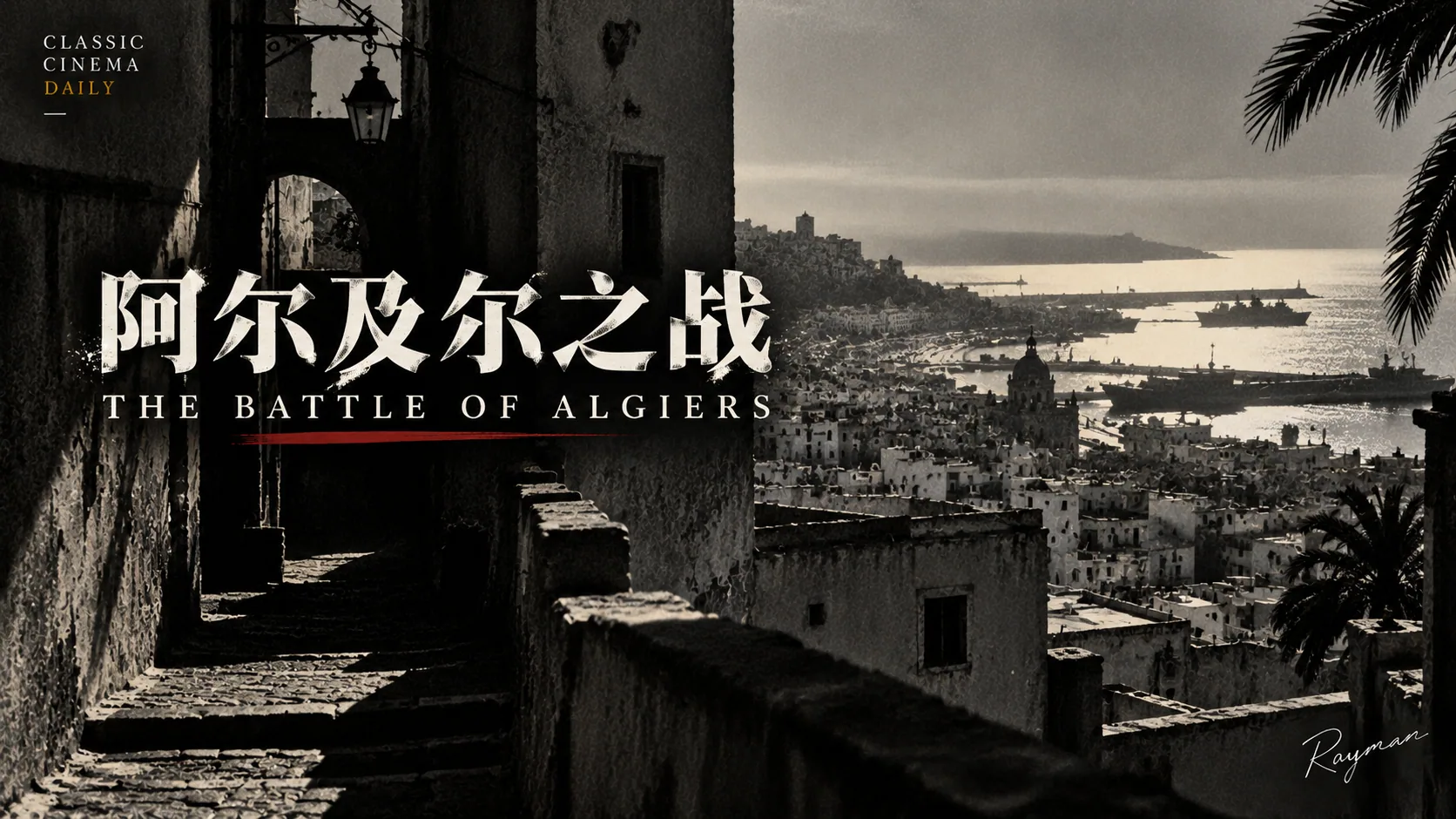
The Battle of Algiers
阿尔及尔之战
1966
Gillo Pontecorvo
Italy / Algeria · War / Historical drama / Docudrama · 121 min
In Algiers between 1954 and 1957, the National Liberation Front and French paratroopers escalate their violence street by street. Pontecorvo uses newsreel-style black-and-white photography and non-professional actors to turn a colonial war into an archive with no narrator. Golden Lion, Venice 1966.
01Why this film today
Today is 14 October, the 120th anniversary of the birth of Hannah Arendt (born 14 October 1906 in Linden, Germany).
Tonight's first film, The Third Man, is about a man who can turn himself into someone who legally does not exist inside a city cut into sectors. This one reverses the question — how does a governed people turn "not existing" into existing?
In November 1954 the National Liberation Front (FLN) began armed action in the city; in 1957 France sent paratroopers into Algiers and sealed off the Casbah. The film records those three years. It gives no narration to either side and refuses to judge on the audience's behalf — which made both sides uncomfortable when it premiered in 1966: France did not allow it to be shown for years, while other viewers read it as propaganda.
In the archive it fills in Algeria — Senegal had been the only African country, and this is the second. The 1960s already held six films, but none that films a contemporary war with the grammar of a documentary, and none that records both sides' methods and leaves the verdict to the viewer.
It forms a diptych with tonight's first film: one searches a divided city for a man who does not exist; the other lets a man who does not exist become a name in a besieged one.
02Film details
- Chinese title
- 阿尔及尔之战
- English title
- The Battle of Algiers
- Director
- Gillo Pontecorvo / 吉洛·彭泰科沃
- Year
- 1966
- Country
- Italy / Algeria / 意大利 / 阿尔及利亚
- Language
- Arabic / French
- Genre
- War / Historical drama / Docudrama / 战争 / 历史剧情 / 纪实剧情
- Runtime
- 121 min
03About the film
阿尔及尔,法属阿尔及利亚的首府。城市的一半是欧洲区,宽阔、明亮、有咖啡馆;另一半是卡斯巴——一片顺着山坡长起来的旧城,屋顶连着屋顶,巷子窄得只能过一个人。
一个在街头混日子的年轻人 Ali La Pointe 在监狱里被人拍下一张照片,登在报纸上。从那以后,他有了名字。
1954 年 11 月起,民族解放阵线在城里组织起一套系统:谁负责放炸弹,谁负责掩护,谁负责执行内部裁决。1957 年,法国的伞兵部队开进阿尔及尔,接管了治安。两套系统在同一座城市里开始互相寻找对方的每一个节点。
影片从两边轮流拍摄,谁也不比谁更清楚。
(这里不再往下说。)
04Why it is a classic
A staged film that looks like a newsreel
1966, an Italian-Algerian co-production. 121 minutes, black and white, Arabic and French. Directed by Gillo Pontecorvo, co-written with Franco Solinas.
The grain was designed
Cinematographer Marcello Gatti shot on 35mm and produced the grain and contrast of 16mm newsreel. The editing offers no causal cues; it simply places events side by side in time. The impression is of a documentary — and nearly every shot in it was staged. This is not documentary truth; it is the credibility you get from reassembling the real.
An FLN commander playing himself
One of the producers was Saadi Yacef. He had been one of the FLN leaders in Algiers; the screenplay adapts the memoir he wrote in prison, and he plays a character based on himself. Beyond him the cast is largely non-professional, including Algerians who had lived through the actual battle. A film about a historical event that sends the participants back on set to perform it again.
Colonel Mathieu
The film's principal opposite is played by a professional actor, Jean Martin. Mathieu is a composite of several French commanders, and the film refuses to make him a personalised villain. His most famous scene is a press conference: he does not repent, he simply states the method. It is the coldest scene in the film, and the most Arendtian.
The Casbah is a map
The film turns the Casbah into a vertical labyrinth: you can walk on the roofs, hide inside the walls, and the stairways are the only map. The paratroopers have to learn to read it, which yields the film's finest sequences. The architecture of a city is itself the tactics of this war.
A Golden Lion and three Oscar nominations
In 1966 the film won the Golden Lion at the Venice Film Festival. At the 39th Academy Awards in 1967 it received three nominations — Best Director, Best Original Screenplay, and Best Foreign Language Film for Italy — and won none.
A teaching text cited from both sides
The film was not permitted to open in France until 1971. For decades afterwards both sides used it as a case study: in 2003 the US military organised a screening at the Pentagon to discuss irregular warfare. It is rare for one film to be consulted by both parties to a conflict.
05What to notice
没有一段音乐替你煽情。 配乐由 Ennio Morricone 与 Pontecorvo 共同完成,但它的用法极克制:大规模的暴力场面往往在几乎没有音乐的情况下完成。影片把情绪的位置留空,不让观众有地方安放立场。
两边的方法都拍。 炸弹、审讯、酷刑、处决、内部清算——影片没有只把暴力分配给一方。这种对称是它在 1966 年引发争议的直接原因,也是它几十年后仍然被当作教材的原因。
一张照片如何造出一个名字。 Ali La Pointe 成为「人物」,始于狱中被人拍下、登上报纸的一张脸。影片把这件事拍得很清楚:反抗者的第一件武器不是枪,是被看见。
群众的调度。 片中的示威与骚乱场面动用了大量真实的阿尔及尔居民。Pontecorvo 处理人群的方式是让摄影机待在人群里面,而不是从外面俯拍——观众不是旁观者,是被挤在里面的一个。
结尾的处理。 影片最后一段拍得极其克制,没有胜利的宣告,也没有悲壮的配乐。它只是把一个人的消失拍完,然后把城市留在画面里——这种不表态,本身就是表态。
06Before you watch
它是什么。 1966 年意大利与阿尔及利亚合拍,121 分钟,黑白,阿拉伯语与法语,战争 / 历史剧情 / 纪实剧情。导演吉洛·彭泰科沃,与 Franco Solinas 共同编剧。
内容提示。 全片涉及城市游击战、爆炸、酷刑与处决。镜头不回避,但也不猎奇——它用一种接近档案的冷静来处理这些场面。没有主角光环,也没有任何一方得到安慰。
看的时候留意。 影片如何在两边之间切换视角;暴力场面上的声音处理;卡斯巴的垂直空间;以及全片几乎不给观众任何一个情绪出口——这不是失误,是方法。
一句话建议。 把它当作一份档案看,而不是一部立场宣传片。它最厉害的地方恰恰是:它拒绝替你站队,所以两边都拿它当教材。
07In one line
A war with no front line, a city cut in two by stairways. The Battle of Algiers films both sides' methods and leaves the verdict to you.