6 min
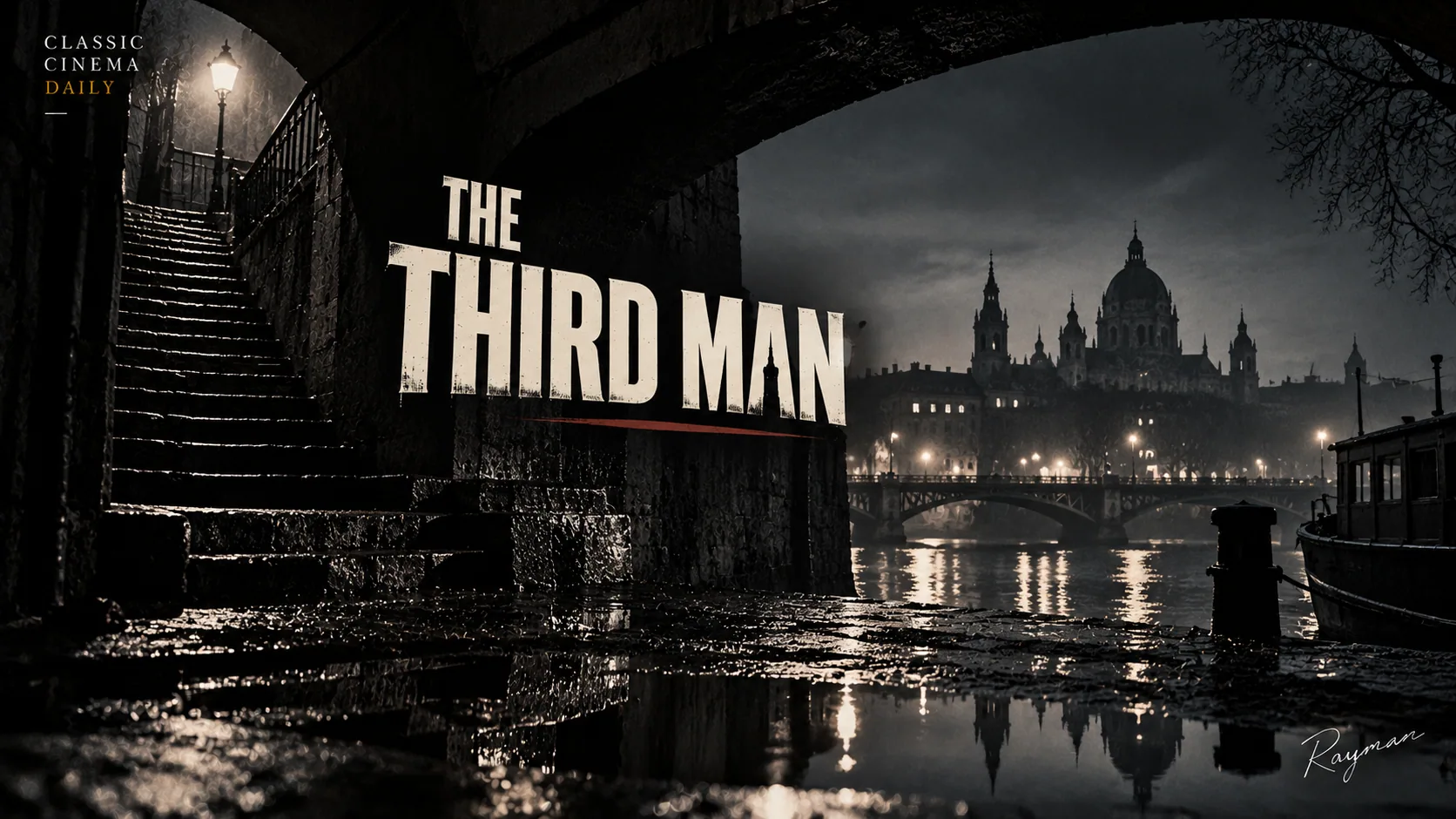
The Third Man
第三人
1949
Carol Reed
United Kingdom · Film noir / Mystery / Thriller · 104 min
Post-war Vienna is carved into four occupied sectors. A broke pulp novelist arrives to take a job from an old friend and arrives in time only for the funeral. Carol Reed and Graham Greene turn a city cut into quarters into the summit of film noir: tilted frames, a chase through the sewers, a single zither. Top prize at Cannes; the Academy Award for black-and-white cinematography.
01Why this film today
Today is 14 October. One hundred and twenty years ago today, Hannah Arendt was born in Linden, now part of Hanover. The question she returned to for a lifetime was not "how does a person become a monster" but a harder one: how does an ordinary person find a justification for what he does inside a system.
Both of tonight's films answer that question, in opposite ways.
The first is a city cut into pieces. In 1949 Vienna is divided into American, British, French and Soviet sectors with an international zone in the middle. Papers matter more than people, the black market outdoes the shops, and a person who does not legally exist can be handed to another occupying power at any moment. This is exactly the post-war Europe Arendt described: not a battlefield but an order that comes after the verdict.
There is an archival reason too. The archive has never held a film noir, and this is the type's definitive specimen; the 1940s previously held only two films (Bicycle Thieves and Spring in a Small Town, both 1948); and the United Kingdom had appeared only twice, both times as a co-production (2001: A Space Odyssey and Alien). The slot has stood empty for a long time.
Tonight's other film moves the camera to a different occupied city: Algiers, 1957. Seventeen years, two continents and two entirely different methods separate them, and they ask the same thing — when power is divided and borders are drawn on a map, is the side a person stands on chosen, or assigned.
02Film details
- Chinese title
- 第三人
- English title
- The Third Man
- Director
- Carol Reed / 卡罗尔·里德
- Year
- 1949
- Country
- United Kingdom / 英国
- Language
- English / German
- Genre
- Film noir / Mystery / Thriller / 黑色电影 / 悬疑 / 惊悚
- Runtime
- 104 min
03About the film
1949 年,维也纳。一个写西部通俗小说的美国作家 Holly Martins 收到老朋友 Harry Lime 的邀请,兴冲冲赶到这座四国共管的城市,准备开始新生活。
他抵达时,Harry 的葬礼刚刚结束。
警方给的版本很简单:一场车祸,两个目击者,没有疑点。Holly 在 Harry 的旧居遇到他的女友 Anna——一个证件有问题的女演员,随时可能被交给苏占区当局。两人开始各自寻找答案,而 Holly 很快就发现,葬礼那天在场的人,说法对不上。
有一个证人提到过第三个抬尸体的人。没有人能说清他是谁。
(这里不再往下说。)
04Why it is a classic
A film about partition
1949, Britain. 104 minutes, black and white, English and German, produced by London Films. Directed by Carol Reed from a screenplay by Graham Greene. It is set in a Vienna divided into four occupied sectors — the city itself is the film's first set, and its most honest one.
A tilted horizon
Cinematographer Robert Krasker leans hard on canted compositions and extreme chiaroscuro: wet cobbles, ruins, doorways, shadows on walls. The device has been imitated endlessly, and what it is doing is rarely mentioned — the city is genuinely crooked. Borders turn at street corners; two halves of one street belong to two countries. The frame is tilted because the world is. Krasker won the Academy Award for Best Cinematography (Black-and-White) at the 23rd Academy Awards in 1951.
One shared sewer
The film's most famous sequence takes place underground. Vienna's sewers are both real civic infrastructure and the film's most precise metaphor: above ground there are sectors, passports and manners; below ground there is a single pipe everyone uses. The climax is staged here, and it is built out of space, not effects.
One zither
The entire score uses a single instrument — the zither of Anton Karas, a Viennese street musician whom Reed reportedly brought into the production after hearing him play at a party. The theme took on a life of its own after release and became one of the most recognisable melodies in film music. A film about division and pretence, scored with the plainest plucked string.
A farewell that refuses to cut
The last shot runs unbroken, turning a goodbye into a distance nobody closes. Reed denies the audience what it wants — the coldest and most mature gesture in the film.
A film ratified again and again
In 1949 it took the top prize at Cannes (then called the Grand Prix, the forerunner of today's Palme d'Or). In 1999 the British Film Institute's poll of the 100 greatest British films placed it first. Its standing has only risen since.
05What to notice
倾斜构图是一种陈述。 Krasker 的摄影机几乎从不放平。这既是黑色电影的语法,也是对这座城市的描述——一条街的两端可能分属两个占领区,画面没有理由端正。后来的影评把这种处理称作「维也纳本身就在歪着」。
下水道那一场。 结尾的追逐完全在地下完成。它是电影史上被研究最多的段落之一:空间狭窄、光线极差、镜头却始终清楚。值得注意的是,这里没有音乐煽情,只有脚步、水声与回声。
齐特琴。 全片配乐只用 zither 一件乐器,演奏者是维也纳琴师 Anton Karas。里德把整部片的声音交给一件街头乐器,效果是让这座被占领的城市听起来像一个还在生活的地方,而不是一个战场。
Orson Welles 的登场。 Welles 饰演的 Harry Lime 出场很晚、戏份不多,但那次从黑暗里被一束光点亮的亮相,是电影史上被引用最多的登场之一。他的台词极少,却撑起了全片的道德重量。
一份小说稿与一个剧本。 Graham Greene 为这部片先写了一份小说稿,作为剧本的准备;影片完成之后,这份小说稿才出版。所以这个故事以两种介质同时存在。
06Before you watch
它是什么。 1949 年英国出品,104 分钟,黑白,英语与德语,黑色电影 / 悬疑 / 惊悚。导演卡罗尔·里德,编剧格雷厄姆·格林,London Films 制作。
内容提示。 涉及黑市、伪造证件、谋杀与一次不给人安慰的结局。没有血腥场面,但道德上不轻松——这部片从头到尾不打算让观众舒服。
看的时候留意。 地平线什么时候是歪的、什么时候是正的;下水道里的空间关系;Anna 每次被叫到名字时的反应;以及最后那个不肯剪断的镜头。
一句话建议。 如果你以为黑色电影就是侦探查案,这部片会告诉你:这个类型真正关心的从来不是案子,是一个人要不要出卖他的朋友。
07In one line
Vienna is cut into four sectors, and the sewers are the one road everyone shares. The Third Man films the moral vacuum of post-war Europe as a tilted frame that needs no explanation.