7 min
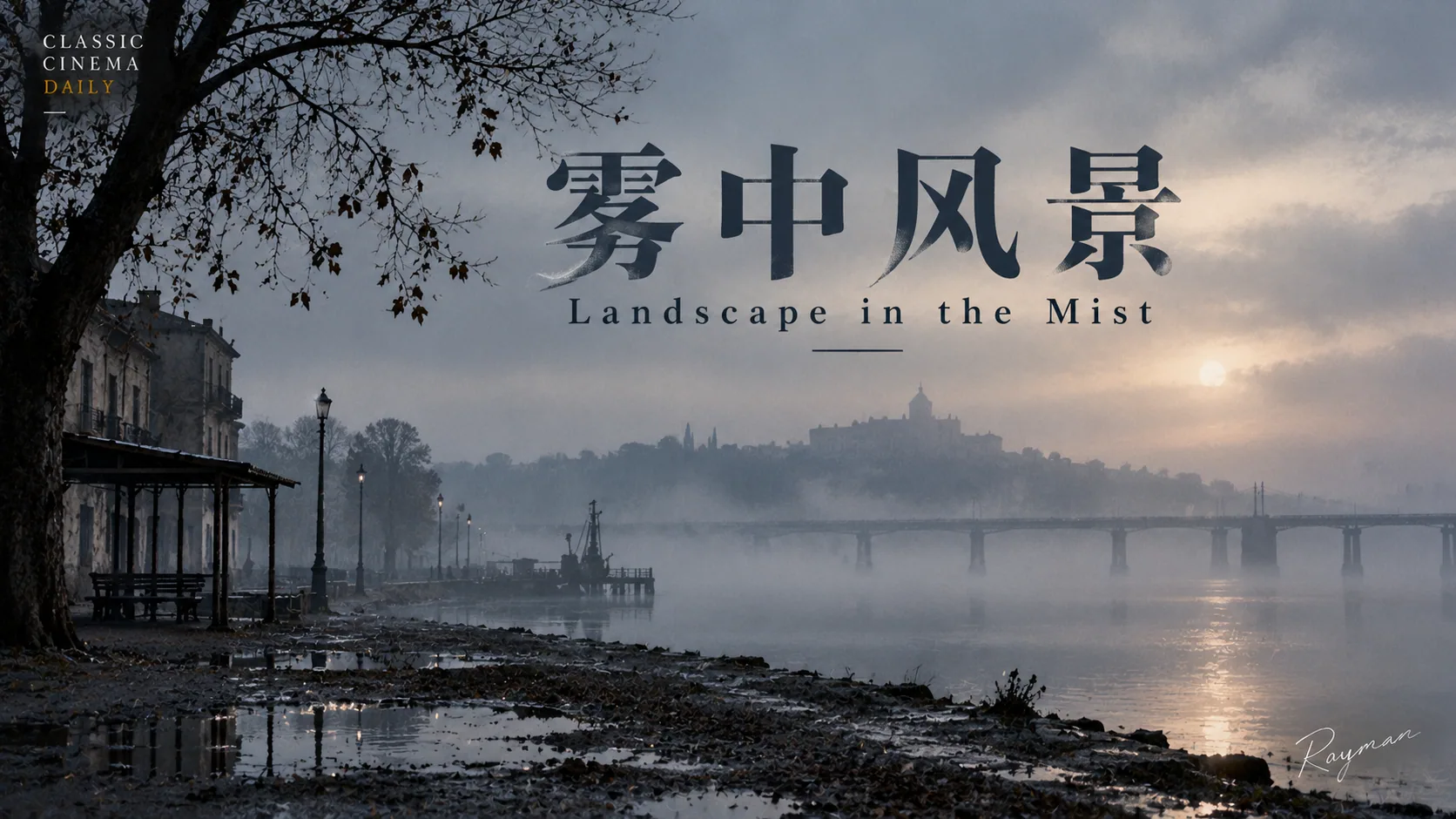
Landscape in the Mist
雾中风景
1988
Theo Angelopoulos
Greece / France / Italy · Road movie / Coming-of-age / Tragedy / Drama · 126 min
Two children are told their father lives in Germany, so they board a night train and cross the whole of Greece to find him. Angelopoulos turns a search for a father into an allegory of twentieth-century Greece in slow long takes: fog, rain, snow, and a broken-fingered marble hand lifted out of the sea by helicopter. Silver Lion at Venice; the European Film Award for Best Film.
01Why this film today
Today is 15 October. Cold Dew fell on 8 October and Frost's Descent does not arrive until 23 October — the fortnight of the year when the fog is heaviest. Tonight's first film is literally called Landscape in the Mist.
But the real link between these two films is not the weather. It is one question: what does a person do when the story he was raised on turns out to be false?
The first film: a mother tells two children their father is in Germany. They believe her, and that belief carries them across the whole of Greece — the wrong train, a police station they escape from, one ride after another, always north. The further they go, the less the father appears.
The second film: a man tells the people in his cellar that the war is still on. Belgrade is bombed in 1941 and Marko hides his best friend's family in the cellar of his grandfather's house. When the war ends, he keeps telling them it has not. For twenty years he grows rich on that lie while the people below keep manufacturing weapons for a revolution that is over.
One lie sends a family onto the road; one lie keeps a whole group underground. Seven years, two countries and two opposite methods separate the films — one is so slow there is barely any dialogue, the other so loud you can hardly hear the lines — and both are about the same thing: how does a person wake up from a story someone else wrote for him?
There is an archival reason for the pairing too. Greece and Yugoslavia were both at zero on this list, and the Balkans is the thickest patch of European cinema the archive had left untouched. The 1980s held only two films (Yol, 1982; Come and See, 1985) and the 1990s only two (Close-Up, 1990; A Brighter Summer Day, 1991) — tonight fills the two thinnest decades in a single evening.
One coincidence worth noting: both films first reached the English-speaking world through the same distributor, New Yorker Films (Landscape in the Mist in 1990, Underground in 1997).
02Film details
- Chinese title
- 雾中风景
- English title
- Landscape in the Mist
- Director
- Theo Angelopoulos / 西奥·安哲罗普洛斯
- Year
- 1988
- Country
- Greece / France / Italy / 希腊 / 法国 / 意大利
- Language
- Greek
- Genre
- Road movie / Coming-of-age / Tragedy / Drama / 公路片 / 成长 / 悲剧 / 剧情
- Runtime
- 126 min
03About the film
希腊,某个山村。姐姐 Voula 和五岁的弟弟 Alexandros 从母亲那里听说:父亲在德国。
一天夜里,两人偷偷离开家,去雅典火车站,想搭上那趟开往德国的车。他们没有票,被赶了下来;被警察送到一位远房舅舅家;趁一场突如其来的暴雪逃走。
之后他们一直在路上。搭上陌生人的车,走进一个正在散伙的巡回剧团,穿过雨、雪,和越来越浓的雾。他们一直往北走,越走越远。
那个父亲,始终没有出现。
(这里不再往下说。)
04Why it is a classic
The last part of the Trilogy of Silence
1988, a Greek-French-Italian co-production. 126 minutes, in Greek. Directed by Theo Angelopoulos, co-written with Tonino Guerra and Thanassis Valtinos. It closes the "Trilogy of Silence", after Voyage to Cythera (1984) and The Beekeeper (1986).
A director who acknowledged only two teachers
Angelopoulos said: "The only specific influences I acknowledge are Orson Welles for his use of plan-sequence and deep focus, and Mizoguchi, for his use of time and off-camera space." He also said that in his shots "time becomes space and space becomes time".
He spent a career making one kind of shot: the camera barely moves, while the people and objects inside the frame keep moving, and a whole scene plays out inside a single view. The Travelling Players (1975) runs nearly four hours and uses roughly eighty shots. This film continues that method, which is why it is at once his most approachable and his least compromised work.
Fog, rain, snow, and a hand with a broken finger
Cinematographer Giorgos Arvanitis was his longtime collaborator. One image in the film is offered without any explanation: an enormous white marble hand, its index finger broken off, lifted out of the sea by helicopter and carried slowly across the sky. It advances nothing, appears once, and is never resolved — and it is the image the film is remembered by.
One oboe
Eleni Karaindrou, another regular collaborator, scored the film. She said the two children reminded her of the romantic escapes of an earlier century, so she wanted traces of Mendelssohn and Franck in the music; and she chose the oboe as the lead instrument because "it is romantic and screams at the same time".
What it won
The Silver Lion at the 45th Venice Film Festival in 1988, along with the Prize of the Students of the Sapienza University and the OCIC Award; Best Film at the 2nd European Film Awards in 1989; the InterFilm Award at the 39th Berlin International Film Festival in 1989. A Village Voice critics' poll placed it among the 100 Best Films of the 20th Century. It was also the first Angelopoulos film to be distributed in the United States.
The director's own father
This is not a metaphor. Angelopoulos was born in Athens in 1935. Around the Greek Civil War his father was taken hostage and did not return until the director was nine. He later said that "the absence of his father" and looking for him among the dead bodies during the Dekemvriana in Athens had a profound effect on his cinema.
The two children searching for a father in Landscape in the Mist did not grow out of screenwriting technique. Angelopoulos took the structure of The Travelling Players — a troupe walking across Greece to ever-smaller audiences — and replaced it with two children's footsteps: the country's modern history is no longer narrated; it is walked.
05What to notice
那只大理石手。 片中有一只巨大的白色大理石手,食指断掉,被直升机从海里吊起来,缓缓移过天空。它不推动情节,全片只出现一次,也没有解释——却是这部电影最被记住的画面。
一个正在散伙的巡回剧团。 孩子们在路上遇到司机 Orestis,他的巴士载着一个巡回剧团在希腊各地演出,观众越来越少。这条线是安哲罗普洛斯对 1975 年《The Travelling Players》(流浪艺人)的自引——那部片里也有一个四处走、不断失去观众的剧团。
一支双簧管。 配乐 Eleni Karaindrou 说,这两个孩子让她想起古典浪漫时期的「出走」,所以配乐里留下了 Mendelssohn 与 Franck 的痕迹;主奏乐器选双簧管,因为「它既浪漫,又同时在尖叫」。
灵感是一则报纸消息。 安哲罗普洛斯说,他在报纸上读到两个孩子出发去德国找父亲,被那种「找父亲的强烈愿望」打动,才有了这部电影。
它是安哲罗普洛斯第一部进入美国的电影。 发行方是 New Yorker Films,1990 年 9 月 14 日在美国公映;希腊首映则是 1988 年 9 月 10 日。它同时是希腊申报第 62 届奥斯卡最佳外语片的影片,但没有进入提名名单。
06Before you watch
它是什么。 1988 年希腊 / 法国 / 意大利合拍,126 分钟,希腊语,公路片 / 成长 / 悲剧。导演西奥·安哲罗普洛斯,摄影 Giorgos Arvanitis,配乐 Eleni Karaindrou。第 45 届威尼斯电影节银狮奖、1989 年欧洲电影奖最佳影片。
内容提示。 片中有一场对未成年角色的性暴力,用省略与留白的方式拍摄,没有直接画面,但仍是全片最难受的一段。另有马匹死亡、警察扣留儿童等情节。
看的时候留意。 注意镜头什么时候切、什么时候不切——这部片有很多场戏是一个镜头拍完的,看摄影机走了多远、把谁留在画面外。以及:雨、雪、雾这三种天气分别出现在哪几段,它们各自对应旅途的哪个阶段。
一句话建议。 不要把它当成「寻父悬念片」看。父亲不是谜底,这部电影也从不打算回答他到底在不在。它要你看的是那条路——一个孩子要走多远,才能不再相信大人讲的那个故事。
07In one line
Landscape in the Mist films a lie as weather: you cannot leave it, but you can walk through it. What Angelopoulos finally gives the two children is not an answer but fog.