10 min
Come and See
自己去看
1985
Elem Klimov
Soviet Union · War / Drama / Historical · 142 min
Belarus, 1943. A boy named Flyora digs a rifle out of the earth and wants to join the partisans. He has not fired a shot before he is swept into the German reprisals: villages emptied, villagers herded into a barn and burned alive. Elem Klimov used live ammunition, Steadicam and a face the war remakes in front of us to make the least forgiving war film ever shot.
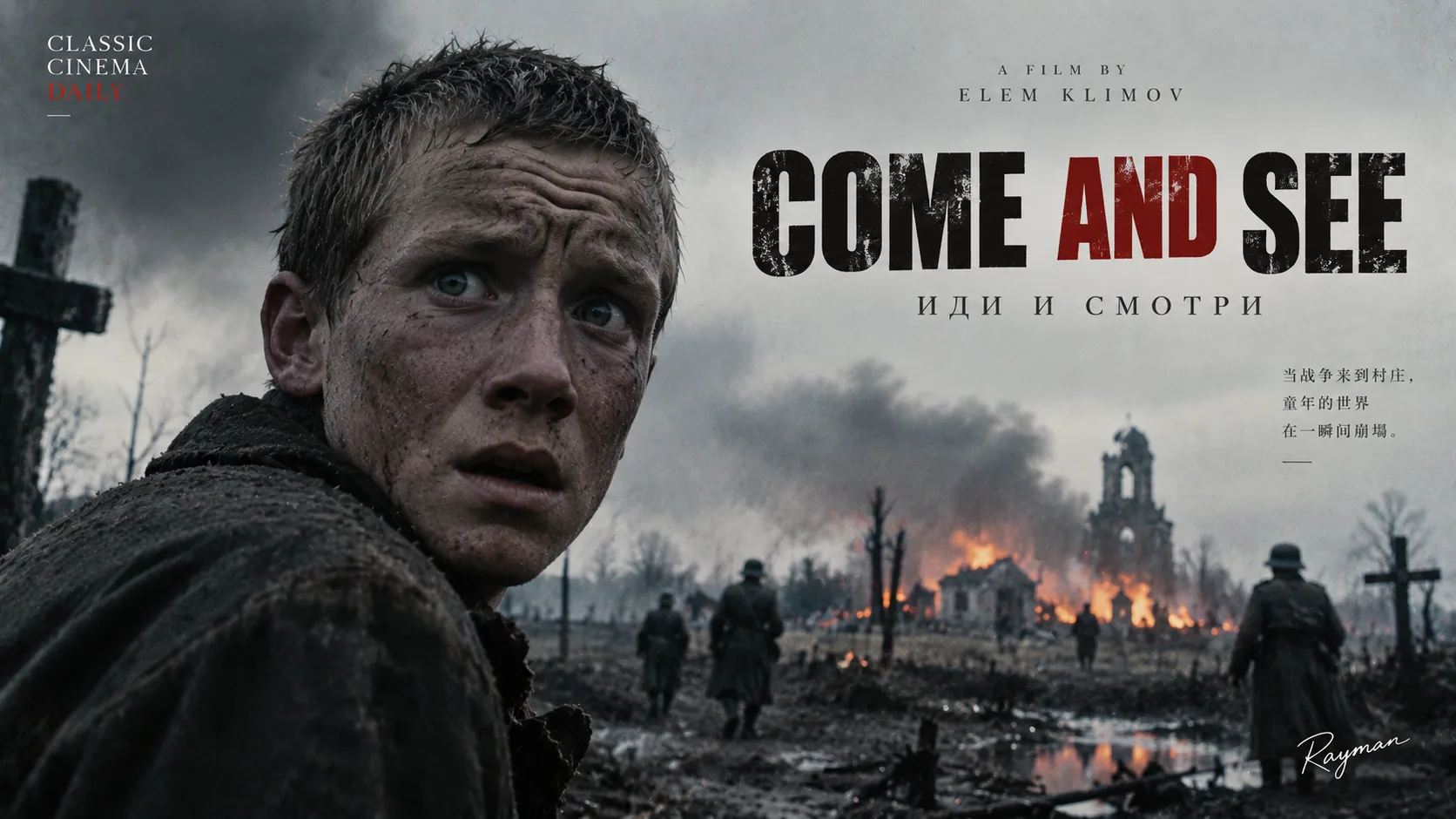
01Why this film today
The 1980s are, along with the 1930s, the only decade in the archive with nothing in it. So is the Soviet Union. So is war as a genre — the archive has Japanese jidaigeki, German expressionist science fiction, Italian neorealism, a Swedish religious allegory, French crime, American gangster cinema, a Hong Kong romance, an Iranian docufiction hybrid and Korean black comedy, but not one film that is directly about war.
Come and See fills all three slots at once: the 1980s, the Soviet Union, war.
It pairs with today's other selection, Pather Panchali: 1955 against 1985, thirty years apart; one following a family through a Bengali monsoon, one following a boy across scorched Belarus. They have more in common than they look — both use a child as their vantage point, both rely on non-professional or first-time performers, and both were very nearly never made. The first was shot on and off for nearly three years; the second was blocked by Soviet film censors for eight.
And there is a sharper reason. Both films ask the same question: when history rolls over an ordinary person, where should the camera stand? Pather Panchali stands back, with long takes and the distance of a whole village. Come and See presses against the face, with Steadicam and extreme close-ups. Put together, today's two films are the most extreme pair of answers to that question.
02Film details
- Chinese title
- 自己去看
- English title
- Come and See
- Director
- Elem Klimov / 依莱姆·克里莫夫
- Year
- 1985
- Country
- Soviet Union / 苏联
- Language
- Belarusian / Russian / German
- Genre
- War / Drama / Historical / 战争 / 剧情 / 历史
- Runtime
- 142 min
03About the film
1943 年,白俄罗斯。
一个叫 Flyora 的少年和另一个男孩在战壕里挖东西,挖出了一支步枪。他们想加入游击队。第二天游击队真的来了,Flyora 被带走,编进林中的民兵营地。他在名单上写下自己的名字,还没开过一枪。
游击队主力出发作战之后,营地里只剩下他、一个叫 Glasha 的少女护士和少数几个人。德军俯冲轰炸机和伞兵来了。Flyora 在爆炸和泥水里往回跑,跑回自己的村子——村子已经被清空了,房子还在,人没了。
从这里开始,影片把他带进一次比一次更深的场面:抢粮、被围,以及一座被赶满了人的谷仓。
(剧情到这里为止。这部片子的结构和它的力量是同一件事:你跟着他一步一步走,不提前知道下一步是什么。)
04Why it is a classic
A script blocked for eight years
Elem Klimov was born in Stalingrad in 1933. His wife was the director Larisa Shepitko. In 1977 he and the Belarusian writer Ales Adamovich began the screenplay — Adamovich had been a Belarusian partisan as a boy and later recorded survivors' testimony in documentary form.
Goskino, the Soviet state film committee, blocked the script for eight years. The objection was not political but aesthetic: the censors called it 'dirty aesthetics' and 'naturalism'. In 1979 Larisa Shepitko was killed in a car crash and Klimov had to finish her last film, Farewell (released 1983), which pushed the project back further. Only in 1984 was he allowed to shoot — and by his account he made no substantive concessions.
The one enforced change was the title. Klimov had wanted Kill Hitler; it became Come and See. The title comes from Revelation 6, where a voice says 'come and see' as the seals are opened and the horsemen bring war, famine, plague and death.
Aleksei Kravchenko, fourteen years old
Klimov wanted 'a simple boy fourteen years of age'. He cast Aleksei Kravchenko, and before shooting brought in a hypnotist to work with the boy using autogenic training. Klimov later said that handled badly, 'his acting could have had a very sad ending — he could have landed in an insane asylum.'
The shoot lasted nine months and was filmed in chronological order. Kravchenko has said he went through extreme exhaustion and hunger under a strict diet, and that when he returned to school afterwards he was 'not only thin, but grey-haired'.
That last part needs correcting, because the story is widely repeated: his hair was not permanently whitened. The crew used a special silver 'Interferenz' paint over a real silver dye, and because it was so hard to remove he had to keep the colour for a while after filming ended.
Live ammunition
The production used large quantities of live ammunition rather than blanks. Kravchenko has said that in the 'cow' sequence bullets passed within about four inches (ten centimetres) of his head. There was almost no protection on set: for the sequence in which dive-bomber ordnance is detonated, the camera crew had only a concrete slab roughly 1.5 metres high and 5 metres wide.
Klimov's staging is deliberately fragmented and discontinuous, using dolly zooms at moments of revelation to disorient the viewer. The cinematographer Aleksei Rodionov worked in natural tones with heavy Steadicam, giving the image an immediacy and a surreal imbalance at the same time.
Sound
The original score, by Oleg Yanchenko, is rhythmically amorphous — closer to a sustained drone than to music. The film also leans heavily on pre-existing music, used in ways that refuse to console: Johann Strauss II's The Blue Danube, the Soviet wartime song 'The Sacred War', the Russian folk song 'Korobeiniki', the Tannhäuser overture and the Ride of the Valkyries, and, for the scene in which Glasha dances, a song from Grigori Aleksandrov's 1936 film Circus. The partisans' march through the forest at the end is scored with the Lacrimosa from Mozart's Requiem.
This is music that ordinarily belongs to the side of civilisation. Placed next to a massacre, it stops being a comfort.
The ending
The ending is the most discussed passage in the film. Flyora fires at a portrait of Hitler — an image Klimov composited from two photographs, of Klara Hitler and of Adolf Hitler. Then comes reversed archive footage: Hitler's life runs backwards until the image is of him as an infant on his mother's knee. Flyora stops firing and weeps.
A title card follows: '628 Belorussian villages were destroyed, along with all their inhabitants.'
Reception
The film premiered on 9 July 1985 in competition at the 14th Moscow International Film Festival, where it won the festival's Golden Prize and the FIPRESCI prize. It opened theatrically on 17 October 1985 and drew 28.9 million admissions in the Soviet Union, the sixth-highest box office of 1986.
Rotten Tomatoes records 90% from 60 reviews, averaging 9.2/10. In the Sight & Sound polls it placed 104th among critics and 41st among directors in 2022, and 154th among critics and 30th among directors in 2012. Empire's 2008 list of the 500 greatest films put it 60th; its 2010 list of the 100 best films of world cinema put it 24th. Roger Ebert added it to his 'Great Movies' series on 16 June 2010, calling it 'one of the most devastating films ever about anything'.
Klimov said the film's impact was such that ambulances were sometimes called for particularly sensitive viewers.
Come and See was the last film Klimov directed before his death in 2003. In 2001 he said: 'I lost interest in making films… Everything that was possible I felt I had already done.'
In 2017 the film was restored under the supervision of Karen Shakhnazarov and won the Venice Classics award for Best Restored Film.
05What to notice
片名来自《启示录》,原名是《Kill Hitler》。Klimov 原本想让片子叫《杀死希特勒》,被改成《Come and See》——出自《启示录》第 6 章,一个声音说「你来看」,随后四骑士带来战争、饥荒、瘟疫和死亡。这是审查唯一强迫他做出的改动。
剧本被拦了八年,理由是「肮脏美学」。苏联国家电影委员会认为剧本过于写实,称之为「自然主义」的宣传。加上 1979 年妻子 Larisa Shepitko 车祸去世、Klimov 必须先完成她的遗作,影片直到 1984 年才开拍,1985 年才上映。
实弹。影片大量使用实弹而非空包弹。Kravchenko 说,在「牛」那场戏里子弹有时从他头顶上方大约十厘米处飞过;俯冲轰炸机特效镜头的防护,只有一块约 1.5 米高、5 米宽的混凝土板。
头发不是永久变白。这是被反复误传的一点。剧组用的是银色 Interferenz 油彩加一层真银染发,因为极难洗掉,Kravchenko 拍完后一段时间必须保持这个发色——但它是染的,不是真的。
按时间顺序拍了九个月。Klimov 让全片按剧情时间顺序拍摄,所以 Kravchenko 是在真实的九个月里,跟着角色一起一点点被摧毁的。开拍前 Klimov 还请了一位催眠师帮他进入状态。
结尾的希特勒肖像,是两张照片合成的。Klimov 把 Klara Hitler 和 Adolf Hitler 的照片合成在一起。随后的档案影像被倒放,一直放到希特勒作为婴儿坐在母亲膝上的画面——Flyora 在那一刻停止开枪,哭了。
片尾那张字幕卡:「628 个白俄罗斯村庄被摧毁,村民全部遇害。」影片没有用任何统计数字铺垫,这一行字出现在最后。
06Before you watch
它是什么。142 分钟,白俄罗斯语、俄语、德语,1985 年苏联出品(Belarusfilm / Mosfilm),Elem Klimov 生前执导的最后一部电影。故事发生在 1943 年的白俄罗斯。
先说清楚强度。这是一部关于战争罪行的电影。片中有对平民的大规模屠杀、纵火、以及从少年视角看到的一切,没有任何缓冲、没有任何美学上的回避。心理强度极高。它不适合未成年人单独观看,也不适合当作「随便看看」的片子。
叙事方式。你只知道 Flyora 知道的东西,而且影片按时间顺序拍摄,所以这种「不知道下一步」是刻意的结构,不是叙事失误。不要试图提前推断剧情走向。
声音是设计的一部分。持续的嗡鸣、突然的失真、以及把施特劳斯和瓦格纳放在屠杀旁边——这些都是刻意安排,不是设备问题,也不是配乐出错。
版本。2017 年修复版(获威尼斯经典奖·最佳修复影片)是目前素材最好的版本。
强度提示之外的实用信息。片中语言混用:白俄罗斯语、俄语、德语都有,德军对白是德语。人物名字:Flyora(少年)、Glasha(少女护士)、Kosach(游击队长)、Rubezh(游击队员)。
07In one line
It does not film war as a battle but as a boy losing, one by one, every place he could go back to.