12 min
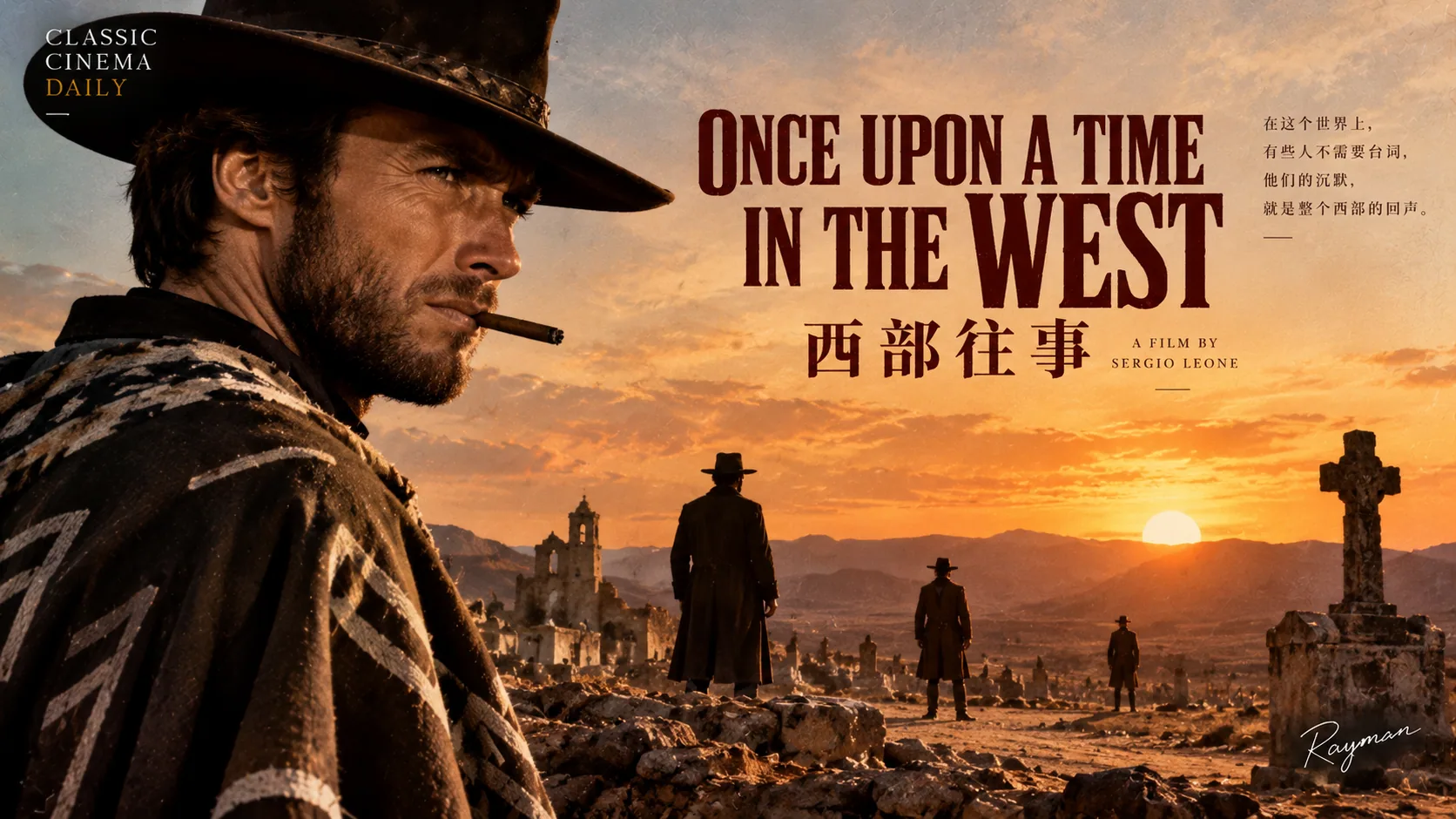
Once Upon a Time in the West
西部往事
1968
Sergio Leone
Italy / United States · Western / Epic / Drama · 165 min
The railroad is pushing west, and a widow who has just stepped off the train inherits a patch of desert — the place where the station and the water will be. Four men are pulled onto the same line: a stranger with a harmonica, an outlaw wanted for something he did not do, a dying railroad man, and a killer with a gentle smile. Leone takes nearly three hours to bury the entire Western tradition.
01Why this film today
Once Upon a Time in the West is about the same thing as today's first film, with the word "sound" replaced by "railroad".
Its central proposition is that the West did not die in a gunfight; it died of infrastructure. Wherever the railroad went, the land acquired a price, and once somebody was willing to pay money for a patch of desert with water on it, guns stopped mattering. The villain of the film is not killing for gold — he wants a route to the Pacific.
And by 1968, when Leone made it, the American Western had itself run out of road. So he did something unusually self-conscious: he brought in Bertolucci and Argento, and the group spent a year at Leone's house watching classic American Westerns (High Noon, The Iron Horse, The Comancheros, The Searchers) before assembling a story out of references to those films. The result is a Western and an elegy for the Western at once — a film that buries its own genre.
Set beside Singin' in the Rain, it shows two different routes to the same conclusion: one film shoots "how an era becomes obsolete" with laughter, the other with silence; one in 103 minutes, one in 165.
The second reason is genre coverage. The archive holds sixteen films, and there is no musical and no Western in it at all — the two largest genre holes on the list, closed today. To be honest about it: today's choice is genre-driven, not region-driven. Both films are rooted in the United States (this one is an Italian-American co-production), and regional coverage does not change today.
The third reason is internal to the archive: the 1968 slot already holds 2001: A Space Odyssey. Also 1968, also a film whose entire scale is established by an opening passage with almost no dialogue — the ten-minute wait that opens this film and the Dawn of Man sequence are the same grammar.
02Film details
- Chinese title
- 西部往事
- English title
- Once Upon a Time in the West
- Director
- Sergio Leone / 塞尔吉奥·莱昂内
- Year
- 1968
- Country
- Italy / United States / 意大利 / 美国
- Language
- English / Italian
- Genre
- Western / Epic / Drama / 西部 / 史诗 / 剧情
- Runtime
- 165 min
03About the film
铁路正在往西修。修到哪里,哪里就变成地图上的一个名字。
Jill McBain 从新奥尔良来到西部一个叫 Sweetwater 的地方。她嫁给了一个叫 Brett McBain 的男人,但她下车的时候,站台上没有人接她——她等来的是一队骑马的人,和一栋刚刚出过事的房子。
Brett McBain 在 Sweetwater 买了一块地。那块地很荒,只有一口水。但铁路要从那里过。
同一条线上还有三个人:一个吹口琴的陌生人(Charles Bronson),一直在等一个叫 Frank 的人;一个叫 Cheyenne 的土匪(Jason Robards),被指控了一件不是他做的事;还有一个眼睛是蓝的、笑起来很温和的男人(Henry Fonda),他叫 Frank。
五个人,一条铁路,一块有水的荒地。
(这里不再往下说。)
04Why it is a classic
A Western assembled out of references
Late in 1966 Leone commissioned Bernardo Bertolucci and Dario Argento to help him develop a treatment. Over the following year the group watched a large number of classic American Westerns at Leone's house — High Noon, The Iron Horse, The Comancheros, The Searchers — and discussed them.
The story they built is almost entirely composed of references to American Westerns. This is not a gesture of homage; it is a method. Leone wanted to use the symbols American cinema had manufactured in order to tell a story about those symbols ceasing to work.
Even the place names come from this process. The town is called "Sweetwater"; Bertolucci said he had looked at a map of the American Southwest, found the name in Arizona, and decided to use it. Both "Sweetwater" and "McBain" appear in The Comancheros.
Putting the screen's best good man in the role of the villain
Henry Fonda refused Leone's first invitation. Leone flew to New York to persuade him, and what he said was this:
"Imagine: the camera shows a gunman from the waist down, drawing and shooting a running child. Then it tilts up to the gunman's face — and it is Henry Fonda."
Fonda had never seen any of Leone's films, including the Dollars trilogy with Clint Eastwood, so Leone had him watch all three. Fonda also consulted his friend Eli Wallach, who had worked on The Good, the Bad and the Ugly; Wallach told him to take it: "You'll have the time of your life."
He arrived on set wearing brown contact lenses and a moustache, thinking dark eyes and a beard would heighten the character's evil. Leone immediately had both removed: he did not want Fonda to look like a stock villain. He wanted that familiar, reassuring face, unaltered, placed inside the least forgivable act in the film.
It is the clearest instance of Leone ironically rewriting the American Western tradition.
The music came before the images
Ennio Morricone composed the entire score before shooting began, at Leone's instruction, and it was played on set for the actors during filming.
There is a symmetry worth noting here: in both of today's films the music predates the film. Singin' in the Rain was built around a catalogue of songs written between 1929 and 1939; Once Upon a Time in the West had its score finished before a foot of film was shot, and Leone staged scenes to it. One film treats music as its subject (how cinema learned to speak); the other treats music as its blueprint (sound first, images after).
The opening ten minutes: nothing happens, and everything happens
The film opens on an almost wordless wait: three men at a derelict station, waiting for a train.
Leone uses natural sound — a windmill turning without stopping, water dripping from the roof onto a hat brim, cicadas, pigeons taking flight, gunshots, and a harmonica (diegetic sound: the characters hear it too). Apart from about a minute of the "Judgment" motif, there is no music at all until the second scene ends and Henry Fonda first appears.
It is one of the hardest treatments of waiting ever put on film. What it wants is not suspense but the weight of time itself.
The railroad is capitalism
The villain's motive does not follow the usual Western logic. Frank is a killer for hire, but behind him stands Mr. Morton (Gabriele Ferzetti), a railroad capitalist who is dying — and what he wants is not gold but a route to the Pacific, and the right to price every parcel of land along it.
The real conflict is therefore not good against evil but a collision between two scales of time: one measured in the speed of a draw, the other in miles of track laid. The second always wins. That is where the film's tragedy lies, and what makes it colder than other Westerns.
A film that failed in America first
It premiered in Rome on 20 December 1968 and opened in Italy on 21 December, in Leone's original 165-minute version.
In Europe it was an enormous success: the biggest film of 1969 in France, with 14.8 million admissions, seventh in French film history; 13 million admissions in Germany, third in German film history. It even triggered a short-lived duster-coat fashion, to the point that department stores in Paris put notices on escalators warning customers to keep their long hems clear of the steps.
In the United States, Paramount cut it to roughly 145 minutes and it failed, taking $2.1 million in North America. The US version removed: the entire Lionel Stander trading-post scene; the Morton–Frank scene at Navajo Cliffs discussing what to do with Jill; much of Morton's death; and Cheyenne's death, cut completely. The only passage that is longer in the US version is Harmonica getting to his feet after the opening duel — Leone had cut it, and the American distributors put it back for fear audiences would not understand.
Roger Ebert gave it 2.5 stars out of 4 in 1969, complaining about the length and the confusing plot. He later changed his mind, calling it "an unqualified masterpiece" in his Great Movies essay on The Good, the Bad and the Ugly.
Where it stands now
- Selected for the Library of Congress National Film Registry in 2009
- Sight & Sound 2012 poll: No. 78 with critics, No. 44 with directors
- Empire's 2008 "500 Greatest Movies": No. 14 — the highest-ranked Western on that list
- Rotten Tomatoes: 96% from 68 reviews, average 9.1/10. Metacritic: 82/100 from 9 critics
- Directors who have cited it as an influence include Martin Scorsese, George Lucas, Quentin Tarantino and Vince Gilligan; Paul Schrader called it "one of the greatest films ever made"
- A 4K restoration was released by the Cineteca di Bologna in 2018
Which "trilogy" it belongs to
This is the first film of Leone's "Once Upon a Time" trilogy, followed by Duck, You Sucker! and Once Upon a Time in America. The three films share no characters. What they share is the proposition: how an era ends.
05What to notice
开场十分钟几乎什么都没发生,也什么都发生了。三个人在一个荒废的车站等火车。莱昂内用的是自然声:转动不停的风车、屋檐上滴到帽檐上的水、蝉鸣、鸽子起飞、枪声,以及口琴的声音。除了大约一分钟的「Judgment」动机,直到第二场戏结束、Henry Fonda 第一次露面之前,全片没有配乐。
音乐先于电影。Ennio Morricone 按莱昂内的要求在开拍之前就写完了整部配乐,拍摄期间在片场播放给演员听。莱昂内是照着音乐来安排场面的。
Fonda 最初拒绝了,而且他到片场时是另一副样子。莱昂内飞到纽约,给他讲了一个镜头:从腰部以下拍一个枪手朝奔跑的孩子开枪,镜头上摇——那是 Henry Fonda。Fonda 此前没看过莱昂内任何一部电影。他咨询了合作过《黄金三镖客》的 Eli Wallach,Wallach 说「你会度过一生中最快乐的时光」。到片场那天他戴着棕色隐形眼镜、留着八字胡,认为这能衬托邪恶;莱昂内立刻让他两样都去掉——他不想让 Fonda 看起来像个刻板的反派。
连地名都是从美国电影里拿来的。「Sweetwater」是 Bertolucci 在美国西南部地图上找来的,在亚利桑那州;这个名字和「McBain」一起出现在《The Comancheros》里。整个故事几乎完全由对美国西部片的引用构成——几个人在莱昂内家里看了一整年西部片之后搭出来的。
美国版被剪掉了什么。派拉蒙把它剪到约 145 分钟:Lionel Stander 的交易所整场戏、Morton 与 Frank 在 Navajo Cliffs 讨论如何处置 Jill 的戏、Morton 死亡戏的大部分,以及 Cheyenne 的死亡——整段删掉。唯一在美国版里更长的段落,是 Bronson 的角色在开场决斗后再次站起(原版莱昂内剪掉了,美国发行方怕观众看不懂才加回去)。
拍摄地。内景在罗马 Cinecittà 制片厂;开场车站戏在西班牙格拉纳达省 Guadix 附近的 La Calahorra 一座废弃火车站;Sweetwater 牧场在西班牙 Tabernas 沙漠(牧场现名 Western Leone);Jill 西行的途中镜头在犹他州 Monument Valley,而 Bronson 角色闪回中的砖拱布景搭在 Monument Valley 以北 15 英里。
英语版的配音是不均匀的。英文对白由旅居美国的演员 Mickey Knox 翻译;英语配音用了 Henry Fonda、Charles Bronson、Jason Robards、Keenan Wynn、Frank Wolff、Lionel Stander 本人的声音,而 Claudia Cardinale 由 Joyce Gordon 配音。
06Before you watch
它是什么。165 分钟(国际版),彩色宽银幕,1968 年意大利与美国合拍。Sergio Leone 导演,故事由 Leone、Bernardo Bertolucci、Dario Argento 共同构思,剧本由 Sergio Donati 与 Leone 执笔,Tonino Delli Colli 摄影,Nino Baragli 剪辑,Ennio Morricone 配乐。意大利语原片名 C'era una volta il West。
🔴 版本警告。看 165 分钟的版本。意大利导演版是 171 分钟,美国 1969 年公映版约 140–145 分钟——那一版删掉了整场戏和 Cheyenne 的结局,那不是莱昂内的电影。如果片长明显短于 160 分钟,你拿到的是美国剪辑版。
节奏。前十分钟没有对话。全片对话都很少,而且刻意慢。这不是失误,是设计——它要的就是「等待」这件事本身。如果你带着看动作片的预期进来,前二十分钟会觉得它没开始。
语言与配音。影片以英语拍摄,意大利语版是后期配音。英语版用的是 Fonda、Bronson、Robards 等人的原声,Claudia Cardinale 由 Joyce Gordon 配音。
人名。Jill McBain(Claudia Cardinale)、Frank(Henry Fonda)、Cheyenne(Jason Robards)、Harmonica / 吹口琴的人(Charles Bronson)、Mr. Morton(Gabriele Ferzetti)、Brett McBain(Frank Wolff)。开场在车站等火车的三名枪手由 Woody Strode、Jack Elam、Al Mulock 饰演。
强度。有枪击,有一场对家庭的屠杀(在画外或点到为止),有对女性的暴力威胁。不血腥,但情绪沉重、冷。不适合儿童。
一句话建议。如果你只想看一部「通心粉西部片」,很多人会推荐《The Good, the Bad and the Ugly》;如果你想看莱昂内把整个西部片类型拆开来、摆在你面前,看这一部。
07In one line
The West did not die in a gunfight; it died when the railroad arrived and the land became worth money. This is a Western that buries the Western.