6 min
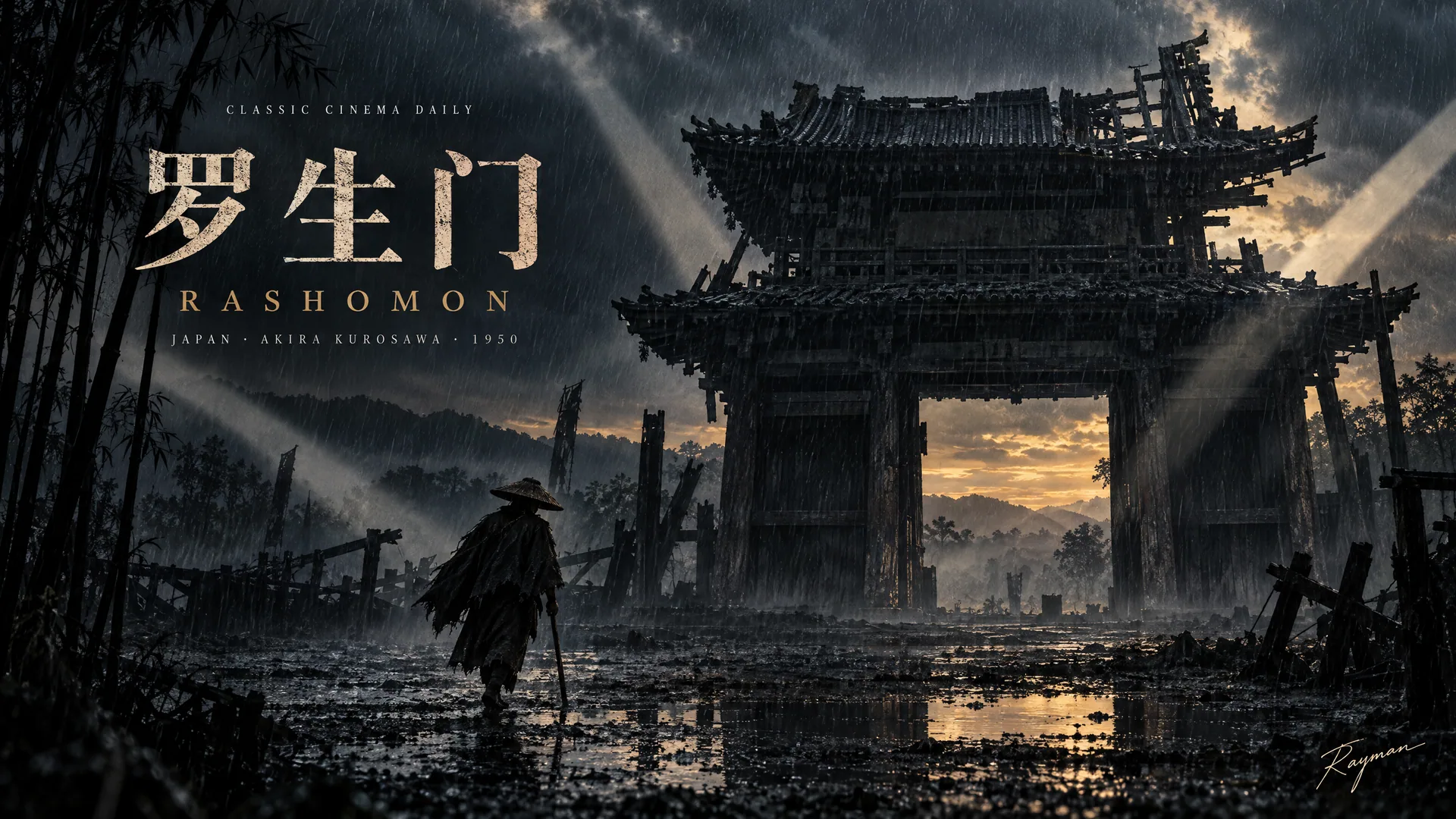
Rashomon
罗生门
1950
Akira Kurosawa
Japan · Jidaigeki / Psychological thriller / Mystery · 88 min
A samurai is found dead in a bamboo grove, and a bandit, a wife, the dead man's spirit and a woodcutter each tell the story differently. The Golden Lion winner at Venice in 1951, and the first of Kurosawa and Mifune's sixteen films together.
01Why this film today
No authoritative film-history anniversary anchors today's date, so here is a structural one instead.
Rashomon (1950) and The 400 Blows (1959) are nine years apart, East and West — and two halves of the same revolution: both put the act of storytelling itself on screen. Rashomon gives one crime four contradictory testimonies; The 400 Blows lets a Paris boy see the world through his own eyes — and it is semi-autobiographical too.
Each also opened a long partnership: Kurosawa and Toshiro Mifune went on to make 16 films together; Truffaut and Jean-Pierre Léaud made five under the name Antoine Doinel. And while shooting The 400 Blows, Truffaut took Léaud every night to watch rushes of Godard's Breathless — a film that entered this archive on 29 September.
Kurosawa, after watching The 400 Blows, called it one of the most beautiful films he had ever seen. Today's pair annotate each other.
02Film details
- Chinese title
- 罗生门
- English title
- Rashomon
- Director
- Akira Kurosawa / 黑泽明
- Year
- 1950
- Country
- Japan / 日本
- Language
- Japanese
- Genre
- Jidaigeki / Psychological thriller / Mystery / 时代剧 / 心理惊悚 / 悬疑
- Runtime
- 88 min
03About the film
京都,雨。竹林里发现一具尸体。
一个樵夫报案,一个盗贼被擒,一个女人失踪,一个武士死了。案子不大,却要审上法庭——因为每个活着的人都说了自己那一版,而四个版本没有一处完全重合。
谁在说谎?谁又在说自己的真相?
(这里不再往下说。)
04Why it is a classic
One crime, four testimonies, zero truths
Rashomon premiered at Tokyo's Imperial Theatre on 25 August 1950. 88 minutes, Japanese, produced and distributed by Daiei. Directed by Akira Kurosawa, co-written with Shinobu Hashimoto; cinematography by Kazuo Miyagawa, score by Fumio Hayasaka, editing by Shigeo Nishida.
The screenplay borrows from two Ryūnosuke Akutagawa stories: plot and characters from "In a Bamboo Grove" (1922), the title and frame from "Rashōmon" (1915) — a destitute man sheltering from the rain under a ruined gate, listening to ghost stories.
Four versions
The bandit Tajōmaru (Toshirō Mifune), the samurai's wife (Machiko Kyō), the samurai himself (Masayuki Mori, appearing as a spirit), and the woodcutter (Takashi Shimura) each tell their version of what happened in the grove. Every version is internally consistent; together they demolish one another. The film refuses to judge: it puts the very concept of "truth" on the witness stand.
Technique: the forbidden move
- Shooting directly into the sun — forbidden by Daiei's own cinematography manuals; Kurosawa did it anyway, using Miyagawa's eight-sided mirror rig to bounce natural light into the grove;
- the dappled light in the trees was made by hanging baseball netting in the branches;
- Fuji film stock's contrast pushed to the extreme, lenses from 32 to 75mm, a Mitchell NC camera;
- rain mixed with black ink — plain water is invisible on film.
From unloved to the Golden Lion
Daiei considered the film unrepresentative of Japan and preferred Yasujirō Ozu for Venice. Giuliana Stramigioli of Italifilm championed it after seeing rushes, and it went to the 1951 Venice Film Festival (the 12th edition), winning the Golden Lion and the Italian Film Critics' Award — the first time a Japanese film topped one of the world's three major festivals. At the 24th Academy Awards in 1952 it received an Honorary Award for foreign-language film (then non-competitive); it was later nominated for Best Art Direction (Sō Matsuyama), BAFTA Best Film, and won the Blue Ribbon for best screenplay. RKO released it in the United States on 26 December 1951; overseas earnings were roughly US$800,000.
Reception and legacy
Rotten Tomatoes: 63 reviews, 98%, average 9.2. Metacritic: 98/100 from 18 critics. Roger Ebert gave four stars and admitted it to Great Movies. Sight & Sound 2022: critics' poll 43rd, directors' poll 21st. Kinema Junpo 2009: 7th-greatest Japanese film. BBC 2018: 4th-greatest foreign-language film. Restored in 2008 by the Academy Film Archive, Japan's National Film Center and Kadokawa.
Reception in Japan was divided, and the score courted trouble: Boléro was accused of plagiarizing Ravel, French publishers protested after the release there, and the film was pulled from the 4th Cannes competition in late 1950.
Its deepest legacy is a phrase: the "Rashomon effect" — one event told as different versions by differently placed witnesses. Pulp Fiction, The Usual Suspects and Hero all descend from it.
05What to notice
三船敏郎的第一部黑泽明。 影片开启了黑泽明与三船敏郎长达 16 部的合作,直到 1965 年的《红胡子》。多襄丸让三船从「危险的性感符号」变成国际明星——他 1961 年与 1965 年两度获得威尼斯影帝,1977 年《影子武士》一片的成就也根植于此。
一个借来的标题。 芥川龙之介的《竹林中》只提供人物与情节;片名来自他 1915 年的另一篇短篇《罗生门》——穷人守在倒闭的城门下避雨听鬼故事。黑泽明把这个框架搬到了影片开场的雨夜,让「听故事的人」也有了位置。
棒球网造出斑驳的光。 竹林里筛下来的光斑不是自然形成的——工作人员把棒球网挂上树梢,让阳光穿过网眼。这个布景上的小花招,后来成了无数电影模仿的「罗生门式光影」。
雨里掺了黑墨水。 暴雨戏的水掺了黑墨水,因为普通清水在富士胶片的高反差曝光下几乎透明。全片 7 月 7 日至 8 月 17 日在京都拍摄,只搭了三座布景,后期仅用一周——一部 88 分钟的影片,几乎没有一寸废地。
它差点代表不了日本。 大映原本属意小津安二郎出战威尼斯,是 Italifilm 的 Giuliana Stramigioli 看到样片后坚持推荐《罗生门》。金狮奖揭晓后,日本电影在世界影坛的位置被改写——好莱坞第一次认真注视东京。
06Before you watch
它是什么。 1950 年日本出品,88 分钟,日语,时代剧 / 心理悬疑。导演黑泽明,摄影宫川一夫,配乐早坂文雄。
🔴 不要找「正确答案」。 这部片子最大的陷阱是观众想做裁判。四个证词互相矛盾,但影片的论点恰恰是:没有中立的观察者。你每看一遍相信谁,取决于你带着什么立场进去。
声音。 配乐里最有名的是 Boléro——一段几乎压过画面的鼓点。它曾被指抄袭拉威尔,法国出版商在影片赴法发行后提出抗议。知道这段来路,再听会不一样。
时长友好。 88 分钟,黑白,没有长段落的心理交代。结尾在罗生门下的雨戏里,人物关系被重新排列——注意樵夫做了什么,那才是影片真正的落点。
内容提示。 有暴力与死亡的呈现,以暗示为主;核心是证词里的性别与阶级视角。
一句话建议。 如果只听过「罗生门效应」这个词条而没看过原片,今天就是补上的日子。
07In one line
One crime, four testimonies — and every witness is telling the truth, which is why no single version holds all of it. In a rainy Kyoto night in 1950, film history put storytelling itself on the witness stand for the first time.