7 min
Seven Samurai
七武士
1954
Akira Kurosawa
Japan · Jidaigeki / Action / Adventure / Drama · 207 min
In 1954 Kurosawa took a premise as plain as a fable — seven masterless samurai hired by farmers to fight bandits — and made the longest and most expensive Japanese film to that date. What it actually invented was not fight choreography but a narrative grammar of recruitment, defence and last stand, borrowed ever since.
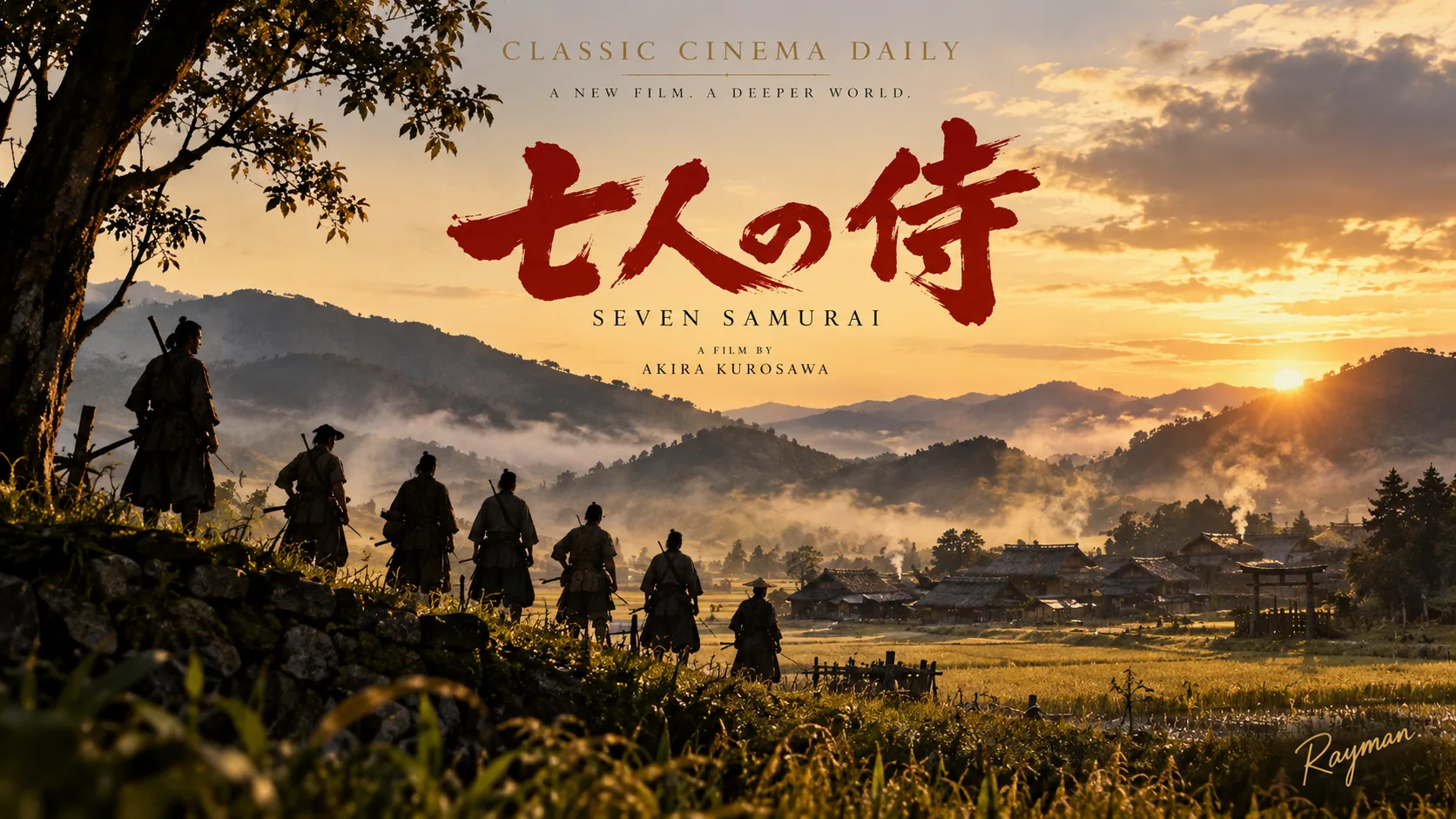
01Why this film today
Because most of the films you saw this year about a group of people assembling to do one job are, knowingly or not, repeating this structure: recruit at length, assign everyone a role, settle it in one war of attrition. Seven Samurai is where that grammar comes from. Watching the original shows you what the imitations leave out — most keep the fun of the recruitment and drop the honesty about the cost.
02Film details
- Chinese title
- 七武士
- English title
- Seven Samurai
- Director
- Akira Kurosawa / 黑泽明
- Year
- 1954
- Country
- Japan / 日本
- Language
- Japanese
- Genre
- Jidaigeki / Action / Adventure / Drama / 时代剧 / 动作 / 冒险 / 剧情
- Runtime
- 207 min
03About the film
故事发生在 1586 年。一个山中的农民村落得到消息:等秋收之后,盘踞在山里的强盗会回来,把粮食和能带走的一切都抢走。
村里的农民既没有武器,也没有战斗经验。他们能拿出来交换的,只有一日三餐。于是村长派人进城,去寻找愿意为饭食卖命的武士。
影片前半段讲的是这件事有多难:真正有本事的武士看不上这点报酬,愿意来的各有各的落魄理由。后半段讲的是他们回到村子之后做了什么——勘察地形、修栅栏、分派岗哨、教农民用竹枪。
《七武士》的力量不在于打斗本身,而在于它把「准备」拍得比「开战」更紧张。它真正的问题是:一群被雇来的人,和一群雇人的农民之间,究竟谁欠谁什么。
04Why it is a classic
Director and screenplay
Kurosawa found the premise in Edo-period sources: samurai hired to protect farmers from bandits. He brought in Shinobu Hashimoto and Hideo Oguni, and the three wrote the shooting script in a little over six weeks in an Atami inn. Kurosawa said Hashimoto and he supplied the technique while Oguni was the film's soul. Preparation was obsessive — he wrote detailed character notes for each of the seven samurai, down to how they spoke and tied their sandals, and compiled a family tree for the villagers.
Cinematography
Shot by Asakazu Nakai, the film leans heavily on long lenses, compressing figures into layered planes of depth so that who stands in front of whom carries meaning. Weather is a compositional instrument: mud, wind and rain are physical forces driving the plot, not backdrop.
Editing and rhythm
Edited by Koichi Iwashita, the action works on rhythm rather than speed — long stillness, one very short burst, stillness again. Kurosawa's signature horizontal wipe compresses parallel events into a single breath. Later action cinema borrowed the rhythm; few matched the restraint.
Performance
Takashi Shimura's Kambei is a man who has fought real wars and no longer expects to win; his authority travels through silence. Toshiro Mifune's Kikuchiyo is the opposite — crude, comic, of uncertain origin, and the only one with peasant blood. The two performances are the film's true counterpoint.
Structure and film language
The recruitment sequence is the key text. Each samurai is introduced through an action, with almost no expository dialogue. That efficiency became the template for every ensemble film since — and the hardest part for them to reach.
Historical impact
In September 1954 the film won Kurosawa the Silver Lion at the 15th Venice International Film Festival, and Japanese cinema began to be taken seriously in the West. It received two Academy Award nominations (Best Art Direction and Best Costume Design, both black-and-white). In Sight & Sound's decennial polls it placed 3rd in 1982, 9th in 1992 and 20th in 2022; in 2018 the BBC's poll of 209 critics named it the greatest foreign-language film. Hollywood remade it as The Magnificent Seven in 1960, and the borrowings have not stopped since.
05What to notice
剧本只花了六个星期:桥本忍先写出了约五百页的素材,随后三人在热海闭门六周完成定稿。黑泽明后来提到,如果时间更宽裕,片子会更好——但这部被公认为影史杰作的电影,确实是在六个多星期里写出来的。
菊千代是后来加进去的:最初的设定只有六名武士。黑泽明担心七个角色全都严肃沉重,观众会看不下去,于是加进了菊千代这个冒牌武士。结果这个为了「好看」而加的角色,成了全片道德重心所在——他是农民的儿子,也是唯一有资格质问武士的人。
那场雨戏是故意放到最后拍的:黑泽明判断,如果先拍决战,制片厂看到进度落后就会强行停机。所以村庄决战的段落被安排在最后,时值严冬,前后拍了约两个月,剧组在人工降雨和低温中工作。三船敏郎拍完之后需要住院恢复。
结尾不是胜利:影片最后,幸存者站在山坡上的坟冢前,勘兵卫说的话大意是——输的又是我们,赢的是农民。武士打赢了每一场仗,却什么也没有得到。这句话是全片真正的主题,也是它比后来所有模仿者更冷的地方。
它是当时日本最贵的剧情片:东宝最初的预算约十五万到二十万美元,中途资金耗尽,1953 年 9 月一度停机,黑泽明趁停机去钓鱼,笃定公司会继续投钱。最终总成本约 2.1 亿日元。影片是当年日本票房最高的电影,但因为成本太高,利润并不丰厚。
06Before you watch
先确认你看的是哪个版本。原始完整版长 207 分钟(含中场休息),当年在日本广泛发行的是 160 分钟版,1956 年美国首映时是 155 分钟、后来又剪到约 141 分钟。市面流通的很多版本是删减版。建议看完整版,并留出一整个晚上的时间。
不要分段看。影片前一个多小时的招募与准备,是为最后四十分钟的决战积累筹码。分成两晚看,会损失全部结构感。
它不会给你现代动作片的爽感。战斗的核心是地形、阵型和消耗,不是招式。如果你期待的是《十三刺客》式的对决场面,前两个小时会觉得慢——那不是缺点,是它的方法。
前后两段节奏差异很大,这是刻意的。招募段落带喜剧节奏,人物一个接一个登场;回到村子之后,节奏转向纯粹的战术推演。这个落差是设计的一部分。
建议找修复版。这是一部黑白片,画质直接影响你对摄影的判断。目前有 4K 修复版流通,比老版 DVD 好得多。
不建议先读剧透或结局解析。谁活下来、谁没有,是这部片子与观众之间的契约。
07In one line
What Seven Samurai actually invented is not the fight scene but the assembly: why a group comes together, what each person carries, and who ends up with anything at all. It became a narrative grammar that everyone borrowed and almost no one inherited whole.