12 min
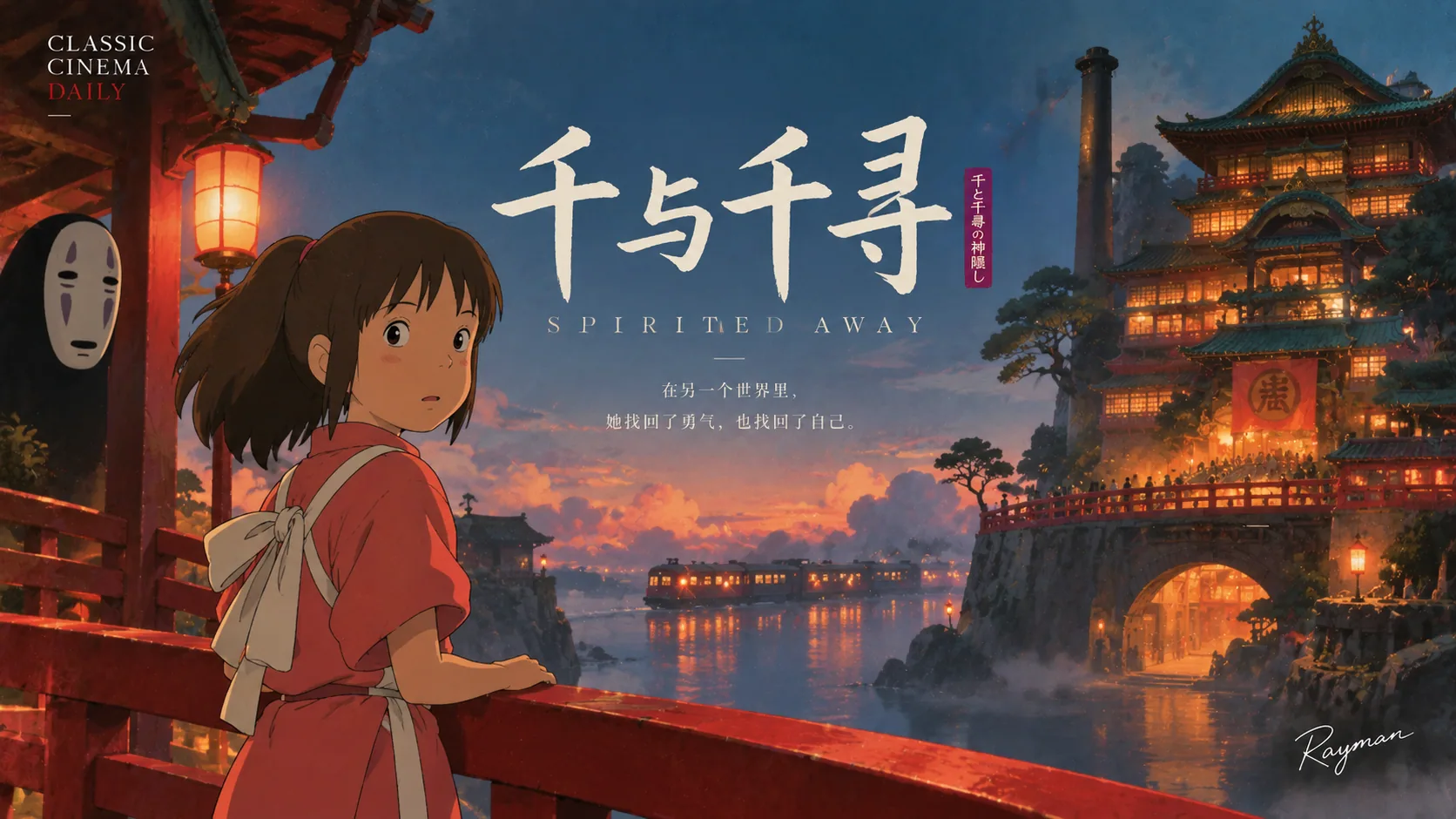
Spirited Away
千与千寻
2001
Hayao Miyazaki
Japan · Animation / Fantasy / Coming-of-age · 124 min
Ten-year-old Chihiro is moving house when her family wanders into an abandoned theme park. Her parents eat food that is not theirs and turn into pigs, and she is left to work in a bathhouse that serves the gods. Yubaba takes her name and leaves her only one character of it — "Sen". She has to work to survive, and she has to remember who she is to get them all back.
01Why this film today
Today's pair is held together by one specific thread.
Yesterday's film was Modern Times: a man swallowed by an assembly line. The first of today's two films is the other side of that same thing — a child whose name is taken away by her employer. Yubaba files "Chihiro Ogino" away in a contract and hands the girl back a single character of it: "Sen". Lose the name and you become the job.
Today's second film, Black Girl, is the same motif in live action: in Paris, Diouana is called "the maid"; she cannot read or write, and even her letters home are written for her by her employers. Somebody else authors her life.
So today's pair is not an arbitrary grab. One film turns "your name is taken from you" into a fairy tale; the other films it in black and white in 65 minutes. Thirty-five years apart, one in Tokyo and one in Dakar.
The second reason is structural, and it has been overdue for a while. The archive now holds fourteen films, from Metropolis (1927) to Parasite (2019), spanning nine decades and a dozen countries or territories — and yet it contains no animated feature at all, and nothing from sub-Saharan Africa. Those are the two most conspicuous holes left, and today closes both.
A third reason concerns the year 2001. Around then, mainstream animation worldwide was converting wholesale to 3D. That year Miyazaki delivered a 124-minute feature drawn mainly by hand, borrowing digital tools only for isolated shots — and it went on to take the Golden Bear at Berlin and to become the first non-English animated film ever to win the Academy Award for Best Animated Feature. Nothing of comparable scale has happened in that category since.
02Film details
- Chinese title
- 千与千寻
- English title
- Spirited Away
- Director
- Hayao Miyazaki / 宫崎骏
- Year
- 2001
- Country
- Japan / 日本
- Language
- Japanese
- Genre
- Animation / Fantasy / Coming-of-age / 动画 / 奇幻 / 成长
- Runtime
- 124 min
03About the film
千寻十岁。父母在搬家路上开错了路,把车停在一座看起来废弃的主题公园门口。父亲说这是泡沫经济时代留下的烂尾游乐园。
往里走,是一条空无一人的商业街,摊子上摆着刚做好的食物,摊主不在。父母坐下来吃。千寻不吃,她往街的深处走。
等她回来,父母已经变成了猪。
天开始黑。街灯亮起来,河涨上来,一艘船靠岸,船上下来的是日本神道里的各种神灵——他们是来洗澡的。这个地方是一座澡堂,属于一个叫汤婆婆的女巫。
一个少年把她藏起来,告诉她这里的规矩:没有工作的人会被变成动物。她去要工作,汤婆婆把她的名字收走,只留下一个字。从这一刻起,她叫「千」。
接下来是她在澡堂里的日子:锅炉房、大浴池、被分配给她的小玲、来洗澡的客人——包括一个被所有人当成「腐烂神」的、臭得让人无法靠近的客人;还有一个不说话的、戴着面具的影子,一直站在雨里。
她必须在这里活下来,也必须记住自己原来叫什么。
(这里不再往下说。)
04Why it is a classic
A film made for one ten-year-old girl
Miyazaki was born in Tokyo in 1941. Before Spirited Away he had made films for very young children (My Neighbor Totoro, 1988) and for teenagers (Kiki's Delivery Service, 1989) — but never one for a ten-year-old girl.
That gap had a specific origin. A friend of his, Seiji Okuda, who was an associate producer on the film, had a ten-year-old daughter who came to Miyazaki's mountain house each summer. He decided to make a film for that age. Looking for material he read girls' manga magazines — Nakayoshi, Ribon — and concluded they contained nothing but crushes and romance. That was not what he wanted. He wanted a heroine girls could look up to, not a pretty girl. He initially found Chihiro a plain character, and only later came to think she "would grow into a fascinating woman".
Hand-drawn, with digital tools only where they were needed
Production began in February 2000. By Miyazaki's original script the film would have run over three hours; compressing the running time was the hardest problem of the production.
As on Princess Mononoke, Ghibli used computer animation (Softimage 3D and similar), but sparingly — the technology was there to support the story rather than to perform. Every character remained primarily hand-drawn. In 2001 that was a decision taken against the direction of the whole industry, and the result is a 124-minute feature that carries almost no sense of compromise.
The name is the engine of the film
The Japanese title is Sen to Chihiro no Kamikakushi. Kamikakushi literally means "hidden by the gods" — in Japanese folklore not a disappearance but a form of social death; to come back from it is a social resurrection.
The entire mechanism of the film therefore rests on names. Yubaba files Chihiro's name away in a contract and leaves her one character of it, "Sen". Haku has forgotten his own name entirely, because the Kohaku River was filled in and built over with apartments. The climax is not a fight but an act of recollection — the real action of this film is remembering. That is why it is a coming-of-age film rather than an adventure.
The bathhouse, Shinto, and a widely repeated mistake about the setting
The bathhouse is where the gods come to bathe. Miyazaki cited summer solstice rituals in which villagers summon the local deities and invite them to bathe. He said that in his grandparents' generation people believed gods were everywhere — in trees, rivers, insects, wells, in anything at all; his own generation did not, but he liked the idea that we should treat everything with care, because a god might be there.
Confirmed visual references include the Edo-Tokyo Open Air Architectural Museum in Koganei, the Notoya Ryokan in Yamagata, and Dōgo Onsen.
One correction is worth making here: it is often claimed that the bathhouse was modelled on Jiufen in Taiwan. Miyazaki explicitly denied it. Producer Toshio Suzuki, for his part, pointed to European influences including The Snow Queen and The Shepherdess and the Chimney Sweep.
The river god, Haku, and an environmentalism that is simply drawn
The guest everyone takes for a "stink spirit" turns out to be a river god. Chihiro pulls a bicycle, tyres and heaps of rubbish out of it before it comes clean. Haku has lost his name because the Kohaku River was filled in and apartments built on it.
None of this is an interpretation imposed by critics; it is on the screen. Miyazaki never turns it into a slogan — he turns it into a concrete action: a small girl grabs a rope and pulls.
"Becoming a pig" has a source
Why do the parents turn into pigs for eating? Miyazaki's explanation is blunt: during Japan's bubble economy of the 1980s, some people "became pigs" — and those people are still saying "we're in a recession, we can't eat enough."
Yubaba wears Western dress and lives among European furnishings; the bathhouse sits inside an abandoned theme park. These are not incidental design choices. They point at the influence of Western capitalism on Japan from the Meiji period onward.
Hisaishi, and a song that existed before the film
The score is by Miyazaki's long-time collaborator Joe Hisaishi, who also conducted it, performed by the New Japan Philharmonic. The cue "One Summer's Day" was later given lyrics by Hisaishi as "Inochi no Namae" (The Name of Life), sung by Ayaka Hirahara.
The ending song, "Itsumo Nando Demo", was written and sung by the Osaka composer and harpist Youmi Kimura, with lyrics by her friend Wakako Kaku. It had originally been written for an unproduced Miyazaki project, Rin the Chimney Painter. On the Japanese DVD extras Miyazaki said the song was in fact what set Spirited Away going — a film started by a song written for a different film.
Where it stood, and the award he did not collect
It opened in Japan on 20 July 2001. It took ¥31.68 billion at the Japanese box office, spent eleven consecutive weeks at number one, drew more admissions than Titanic, and held the all-time Japanese record for nineteen years, until Demon Slayer: Mugen Train passed it in 2020. Its Japanese television premiere on 24 January 2003 drew a 46.9% rating, the highest film broadcast in that network's history.
At the 52nd Berlin International Film Festival in 2002 it won the Golden Bear, shared with Bloody Sunday. At the 75th Academy Awards in 2003 it won Best Animated Feature — a category created only in 2002, whose first winner was Shrek. Spirited Away was the first non-English animated film to win it, and the first hand-drawn film to win it.
Miyazaki did not attend. In 2009, at San Diego Comic-Con, he explained why: "The reason I wasn't here for the Academy Award was because I didn't want to visit a country that was bombing Iraq." His producer had not allowed him to say so at the time. In Tokyo he issued a handwritten statement saying that because of what was happening in the world he could not rejoice over the prize from the heart. He collected an Academy Honorary Award in person in 2014.
Its standing
BBC's 2016 poll of critics, "The 21st Century's 100 Greatest Films", placed it 4th — the highest-ranked animation on that list. Sight & Sound's 2022 Greatest Films of All Time poll placed it 75th, one of only two animated films on the list (the other being Miyazaki's own My Neighbor Totoro). The New York Times ranked it 2nd in its 2017 list of the best films of the 21st century. Rotten Tomatoes records 96% from 221 reviews; Metacritic 96. Roger Ebert gave it four stars and called it one of the best films of its year.
What came after
A stage adaptation written and directed by John Caird opened in Tokyo on 28 February 2022, produced by Toho with Ghibli's support, with Kanna Hashimoto and Mone Kamishiraishi sharing the role of Chihiro. It transferred to the London Coliseum from April 2024. In 2024 Billie Eilish released a song, "Chihiro", inspired by the film.
05What to notice
名字是被收走的。汤婆婆把千寻的名字收进合同,只还给她一个「千」字;白龙连自己的名字都忘了,因为琥珀川被填平、盖上了公寓。片名里的 kamikakushi(神隠し)意为「被神藏起来」,在日本民俗里是一种社会性死亡,从神隐中回来等于社会性的复活——所以这部电影真正的动作是「想不想得起来」。
一个流传很广的取景地说法是错的。长期有人说澡堂的原型是台湾九份,宫崎骏本人明确否认过。可以确认的参考是东京小金井的江户东京建筑园(明治时期仿西式建筑)、山形县的能登谷旅馆、以及道后温泉。
河神那一段。被所有人当成「腐烂神」的客人其实是河神,千寻从它身上拉出一辆自行车、轮胎和成堆的垃圾,它才干净下来。环保解读不是评论家加上去的,是画在画面上的。
「变成猪」是有出处的。宫崎骏解释父母变成猪的设定时说:1980 年代泡沫经济时期,有些人「变成了猪」,而这些人今天还在说「经济不景气,吃不饱」。
主题歌原本属于另一部电影。片尾曲《いつも何度でも》由木村弓作曲演唱、觉和歌子作词,原本是为宫崎骏一个未拍成的企划《烟囱画家小玲》写的。宫崎骏在日版 DVD 花絮里说,其实是这首歌先让他动了拍《千与千寻》的念头。
他没去领那个奥斯卡。2003 年第 75 届奥斯卡,宫崎骏缺席。2009 年他在圣迭戈漫展上解释:「我不想去一个正在轰炸伊拉克的国家。」当时的制片人没让他公开这么说。2014 年他才亲自去领了奥斯卡荣誉奖。
06Before you watch
它是什么。124 分钟,彩色,2001 年日本出品,日语。日文片名「千と千尋の神隠し」,直译近于「千与千寻的神隐」。吉卜力工作室制作,东宝发行,宫崎骏编剧并执导,铃木敏夫制片,久石让配乐。
不要期待的东西。它不是靠打斗推进的故事。真正的高潮是一场「记不记得住」的考验,中段在澡堂里的日常节奏偏慢——那是设计,不是拖。如果你带着「奇幻冒险大片」的预期进来,前四十分钟会觉得它一直在原地。
版本。优先日文原声加字幕。迪士尼 2002 年的英文配音版质量不差——由 Kirk Wise(《美女与野兽》联合导演)执导,John Lasseter 担任执行制片,Daveigh Chase 配千寻、Jason Marsden 配白龙、Suzanne Pleshette 一人配汤婆婆与钱婆(这是她 2008 年去世前最后一个电影角色)——但日语原声里千寻的呼吸和喘气本身就是表演的一部分。
人名。千寻(荻野千寻),被改名后叫「千」;白龙(Haku),本名是琥珀川;汤婆婆(Yubaba)和她的双胞胎姐姐钱婆(Zeniba);锅炉爷爷(Kamaji);分派给千寻的同事小玲(Lin);无脸男(Kaonashi / No-Face);汤婆婆的巨婴坊(Boh)。
强度。没有血腥画面。有两处会让小朋友紧张:父母变成猪,以及无脸男吞噬东西。整体适合八岁以上,学龄前儿童会怕。
一句话建议。如果你只看一部宫崎骏,很多人会选《My Neighbor Totoro》;但要看他把一整套世界观压进一部电影的能力,选这一部。
07In one line
Yubaba took the girl's name; she could not take her memory of who she was.