11 min
Picnic at Hanging Rock
悬崖上的野餐
1975
Peter Weir
Australia · Mystery / Drama · 115 min
Valentine's Day, 1900, Victoria, Australia. A girls' school picnic at Hanging Rock ends with three students and a teacher walking into the rock and never coming back. Peter Weir turned an unsolved disappearance into the most celebrated film in Australian cinema.
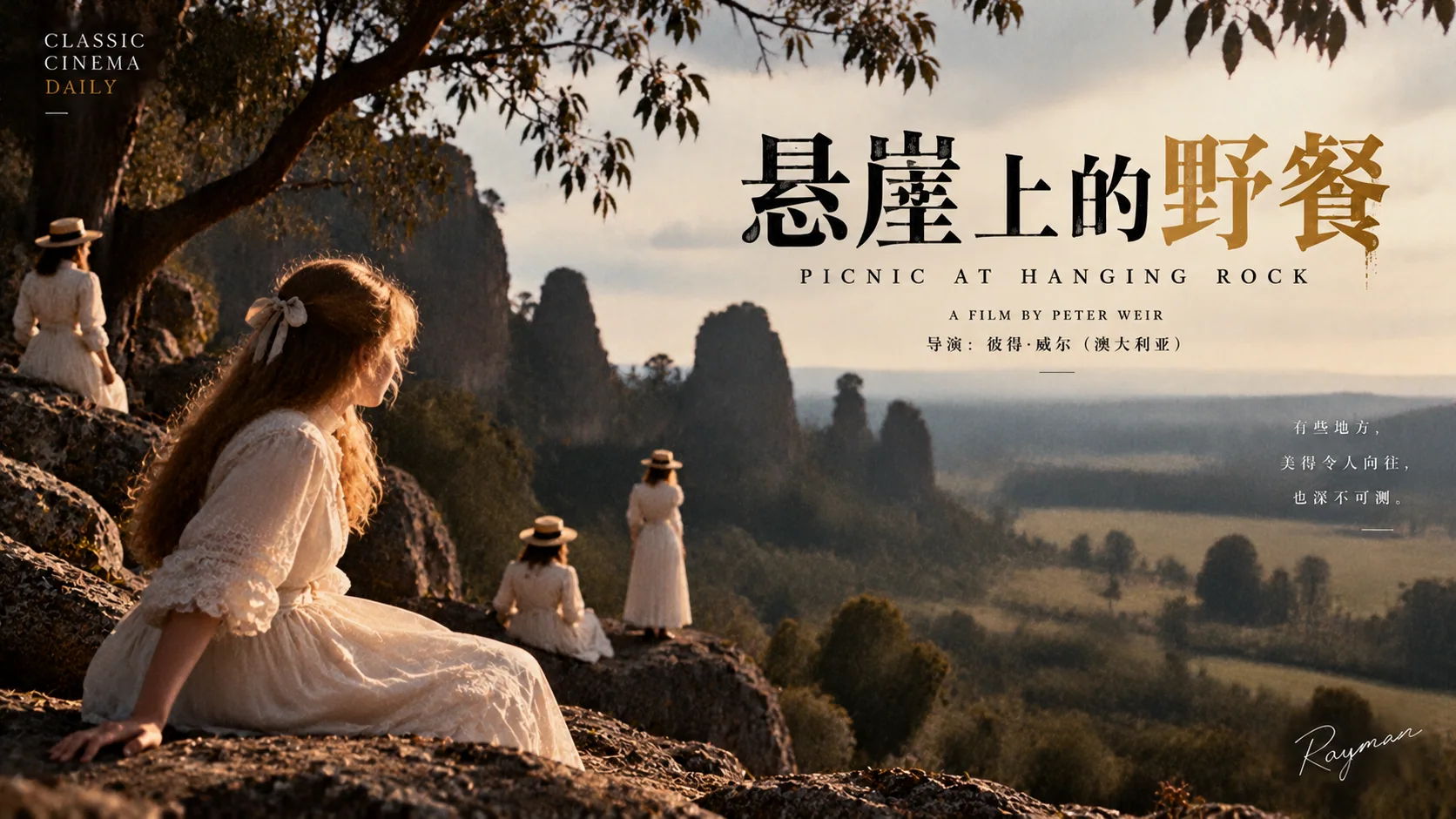
01Why this film today
Today, 8 October, is Cold Dew (寒露).
In 2026 Cold Dew falls on 8 October at 14:29 Beijing time: the seventeenth solar term, the fifth of autumn, and the first to carry the character 寒 — cold. The dew is on the point of freezing. Summer ends on this day.
Both films recommended today are about a summer that is already over. This one is set on 14 February 1900 — high summer in the southern hemisphere, Valentine's Day. At noon two schoolgirls' watches stop at twelve, and then they walk into the rock and never come back.
Why recommend it today?
First, the archive previously held not a single film from Oceania. Australian cinema went through a revival in the 1970s, and this 1975 film is its most celebrated product: in a 1996 poll run by the Victorian Centenary of Cinema Committee and the National Film and Sound Archive, it was voted the greatest Australian film ever made.
Second, it is a mystery film that refuses to answer its own question. At its American premiere in 1975 a distributor threw his coffee cup at the screen because he had been given "a mystery without a goddamn solution". Half a century on, that refusal is exactly what makes it feel modern: it hands the explanation back to the audience.
Third, the site offers joints. The Spirit of the Beehive (1973) also puts a child at the threshold of an adult world she cannot interpret; The Passion of Joan of Arc (1928) likewise refuses to explain itself and carries everything on a single face; In the Mood for Love (2000) is also about a time that is over and can only be looked back on.
Fourth, it forms a line with the other film running today: both are films in which a national cinema was born — the Australian revival of 1975, the Taiwan New Cinema of 1991. Both use a young person's disappearance or death to write the story of a vanishing world: on one side a colonial order failing in front of a rock, on the other every form of authority in 1960s Taipei collapsing at once.
02Film details
- Chinese title
- 悬崖上的野餐
- English title
- Picnic at Hanging Rock
- Director
- Peter Weir / 彼得·威尔
- Year
- 1975
- Country
- Australia / 澳大利亚
- Language
- English
- Genre
- Mystery / Drama / 悬疑 / 剧情
- Runtime
- 115 min
03About the film
1900 年 2 月 14 日,情人节。澳大利亚维多利亚州,一所名叫 Appleyard College 的女子学校。
一辆马车把一群穿白裙的女学生和两位教师送到悬崖岩(Hanging Rock)脚下。她们在岩石的阴影里铺开桌布,弹琴,切蛋糕。天气很热,阳光很亮。
下午,四名学生向岩石深处走去。其中一位教师随后也跟了上去。
到了傍晚,只有一个人跑了回来。
(这里不再往下说。)
04Why it is a classic
A film that refuses to give you the answer
Picnic at Hanging Rock premiered at the Hindley Cinema Complex in Adelaide, Australia, on 8 August 1975. It runs 115 minutes, in colour, in English. Directed by Peter Weir, written by Cliff Green from Joan Lindsay's 1967 novel. Cinematography by Russell Boyd, editing by Max Lemon, music by Bruce Smeaton, with the pan flute played by Gheorghe Zamfir.
The novel is itself an elaborate hoax: Lindsay framed it as a true story in her introduction, but it is historical fiction. In a 1974 interview she said: "Well, it was written as a mystery and it remains a mystery."
The manuscript contained a chapter explaining the girls' fates, cut before publication and only published separately in 1987 as The Secret of Hanging Rock. The film was adapted from the version without an answer — not an oversight, but its central decision.
The birth of a national cinema
Australia's film revival of the 1970s is known as the Australian New Wave. This was the first Australian film of the period to win both critical acclaim and a large international theatrical release, and it was Weir's breakthrough at home and abroad.
It was financed in part by the South Australian Film Corporation on a budget of roughly A$440,000, and took about A$5.12 million at the Australian box office — over three million of it by 1978. In 1996, in a poll run by the Victorian Centenary of Cinema Committee and the National Film and Sound Archive, it was voted the greatest Australian film ever made.
Weir went on to make Witness (1985), Dead Poets Society (1989), The Truman Show (1998) and Master and Commander (2003). He received three Academy Award nominations for Best Director, an Academy Honorary Award in 2022, and a lifetime-achievement Golden Lion at Venice in 2024.
How the light was made
Weir and the cinematographer Russell Boyd took their cue from the British photographer and director David Hamilton: they stretched veils of different thicknesses across the lens — Boyd used bridal veil fabric — producing a soft-focus, dreamlike, almost over-exposed image.
There was also a painterly source: the Australian impressionists of the Heidelberg School, and above all Frederick McCubbin's painting Lost (1886). Here is a genuine coincidence: as a young woman Joan Lindsay studied at the National Gallery of Victoria Art School, and one of her teachers was McCubbin. The light a novelist learned to look at while training as a painter was put on screen fifty years later.
Shooting began in February 1975 and the main photography took six weeks, at the real Hanging Rock, at Martindale Hall near Mintaro in South Australia (standing in for Appleyard Hall), and at studios in Adelaide. Weir later recalled the atmosphere on location: "There is just something about the area that is oppressive and depressing… everyone was nervous while we were there, and we were all glad to get away at last."
The sound
The main theme comes from the Romanian pan-flute pieces "Doina: Sus Pe Culmea Dealului", with Gheorghe Zamfir on pan flute and Marcel Cellier on organ. The score also uses Bach's Prelude in C from the Well-Tempered Clavier, the Romance from Mozart's Eine kleine Nachtmusik, the Andante cantabile from Tchaikovsky's String Quartet No. 1, the slow movement of Beethoven's Fifth Piano Concerto, and "God Save the Queen" and "Men of Harlech". A film about a British colony with a European playlist — and the one sound not on that playlist is the pan flute.
CBS released a vinyl LP, A Theme from Picnic at Hanging Rock, in 1976; a 7-inch by the Nolan-Buddle Quartet reached No. 15 on the Australian singles chart the same year. There is still no official commercial soundtrack release.
Reception
92% on Rotten Tomatoes across 48 reviews, average 8.5/10; 81/100 on Metacritic. It won the BAFTA for Best Cinematography (Russell Boyd) and a Saturn Award for Best Cinematography, and took five AACTA nominations including Best Film, Direction, Actress, Supporting Actor and Screenplay.
Vincent Canby in The New York Times (1979): horror "need not always be a long-fanged gentleman in evening clothes… It may be a warm sunny day, the innocence of girlhood and hints of unexplored sexuality that combine to produce a euphoria so intense it becomes transporting." Roger Ebert called it "a film of haunting mystery and buried sexual hysteria" and noted that it uses two hallmarks of modern Australian cinema: beautiful cinematography, and stories about the chasm between settlers from Europe and the mysteries of their ancient new home.
Weir recalled the American premiere: one distributor threw his coffee cup at the screen, furious at having "wasted two hours of his life — a mystery without a goddamn solution!" Joan Lindsay was calmer about it: "I wrote that book as a sort of atmosphere of a place, and it was like dropping a stone into the water. I felt that the thing that happened on St. Valentine's Day went on spreading, out and out and out, in circles."
05What to notice
两个停在正午的手表。 女孩们走向岩石之前,两个手表同时停在十二点。影片没有解释这件事——它只是把它放在那里。整部影片的运作方式都是这样:给一个细节,不给一个理由。
镜头前的新娘头纱。 柔焦、过曝、几乎发光的画面,是摄影指导 Russell Boyd 用不同厚度的新娘头纱盖在镜头前做出来的,灵感来自英国摄影师 David Hamilton。它让 1900 年的澳大利亚看起来像一张正在褪色的照片——你看到的不是那个年代,而是那个年代留下的影像。
小说家曾是画家,而电影用了她老师的画。 影片的视觉参考之一是澳大利亚印象派(Heidelberg School),尤其是 Frederick McCubbin 1886 年的《Lost》。而原著作者 Joan Lindsay 年轻时在维多利亚国立美术馆美术学校学画,老师之一正是 McCubbin。写小说的人学过的那套光,被导演用来拍这部小说。
被删掉的那一章。 小说草稿里有一章解释女孩们的结局,出版前被删除,1987 年才以《The Secret of Hanging Rock》为名单独出版。电影改编用的是没有答案的版本。 换句话说:这个谜不是导演制造的,是导演选择不去解开的。
情人节。 故事发生在 2 月 14 日——而这正是 Joan Lindsay 与丈夫、画家 Daryl Lindsay 的结婚纪念日(两人 1922 年 2 月 14 日在伦敦 Marylebone 结婚)。她把自己婚礼的那一天,给了故事里那群女孩消失的那一天。
06Before you watch
它是什么。115 分钟(1998 年导演剪辑版 107 分钟),彩色,1975 年澳大利亚出品。导演 Peter Weir,编剧 Cliff Green,原著 Joan Lindsay(1967),摄影 Russell Boyd,剪辑 Max Lemon,配乐 Bruce Smeaton,排箫 Gheorghe Zamfir。
🔴 它不会给你答案。 这是一部悬疑片,但不是推理片:它不解释失踪的原因,也不指认任何凶手。1975 年美国首映时,有发行商因为这一点把咖啡杯扔向银幕。进片前请接受「没有答案」是设计,不是缺陷——把它当推理片看会失望,把它当一首关于一个时代结束的诗看,它几乎无可替代。
版本。 1975 年原版 115 分钟;1998 年 Weir 为院线重映剪掉 7 分钟,成为 107 分钟的导演剪辑版。2025 年影片做了 4K 修复并在 50 周年时重映,修复由 Weir 监督,使用 NFSA 保存的原始 35mm 底片。任何版本都能看懂,但原版的 115 分钟更完整。
强度。 全片几乎没有血腥场面。真正的压迫感来自光、音乐,和一群维多利亚时代成年人面对一件无法解释的事时的反应。有一名学生的死亡被呈现,但没有画面。
时代背景。 1900 年的澳大利亚是英国殖民地,女子学校教的是英式礼仪与钢琴,片中的人物弹贝多芬、莫扎特、柴可夫斯基,唱「God Save the Queen」。这部电影真正的主题之一,是欧洲人带来的那一整套秩序,在一座比他们古老得多的岩石面前失效。
人名。 Anne-Louise Lambert(Miranda)、Rachel Roberts(Mrs Appleyard)、Helen Morse(Mlle de Poitiers)、Dominic Guard(Michael Fitzhubert)、Margaret Nelson(Sara Waybourne)、John Jarratt(Albert Crundall)、Karen Robson(Irma Leopold)、Jane Vallis(Marion Quade)、Christine Schuler(Edith Horton)、Vivean Gray(Miss McCraw)。
一句话建议。 如果你想看一部用光、音乐和沉默而不是用解释来讲故事的悬疑片,这是最好的入口之一。
07In one line
Two watches stop at noon; three girls walk into the rock and never come back. Peter Weir made a film that refuses to answer its own question — and it became the greatest Australian film ever made.