7 min
Yol
道路
1982
Yılmaz Güney & Şerif Gören
Turkey / Switzerland / France · Ensemble drama / Road movie / Social realism · 124 min
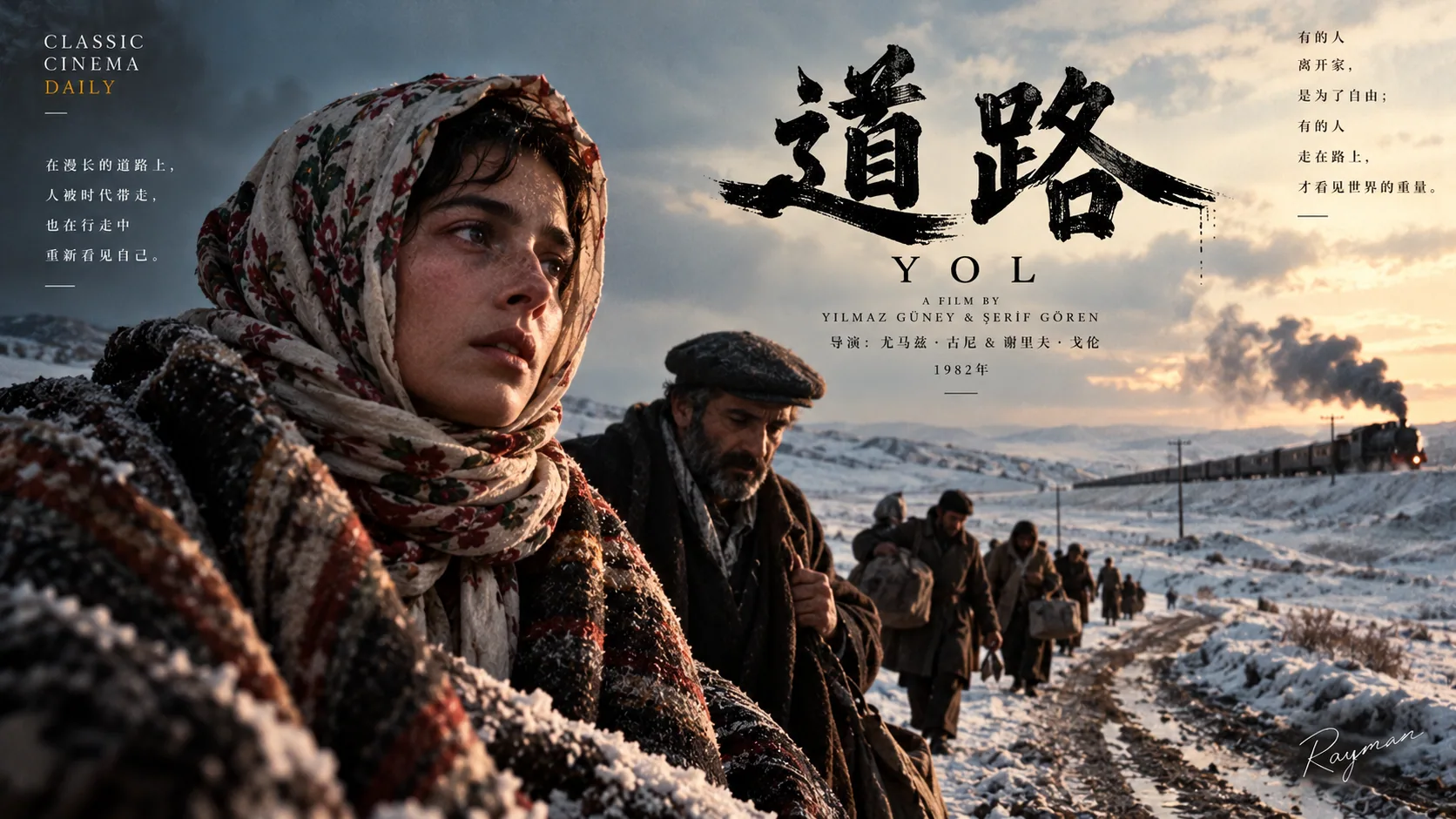
After Turkey's 1980 military coup, five prisoners are granted a week's home leave. The screenplay was written from inside prison by Yılmaz Güney, who never reached the set. It won the Palme d'Or at Cannes in 1982 — and was banned in Turkey until 1999.
01Why this film today
It shared a Cannes programme with today's other film.
The 35th Cannes Film Festival ran from 14 to 26 May 1982. It opened with the 1916 American silent Intolerance, and its Palme d'Or was awarded jointly to Costa-Gavras's Missing and to this film, Yol. The jury was chaired by the Italian opera and theatre director Giorgio Strehler, with Gabriel García Márquez, Geraldine Chaplin, Sidney Lumet and Mrinal Sen among its members.
A 1916 silent and a 1982 Turkish film, 66 years apart, in the same programme.
They are two versions of the same idea.
Intolerance cuts together four storylines roughly 2,500 years apart; Yol sets five prisoners' one-week leave side by side. Neither film will tell only one story, and in neither is the protagonist a person — it is the structure of several things happening at once.
The difference is scale: Griffith took 2,500 years, Güney took one week. And Yol had the harder job — Griffith had three thousand extras on a Hollywood lot; Güney had a pen in a prison cell.
One more thing links them. Both were cut or banned: a major segment of Intolerance's French story, involving the attempted assassination of Admiral Coligny, was removed before release, while Yol was banned in Turkey and only released there on 12 February 1999 — seventeen years after it took the Palme d'Or.
Watch this one to see the plainest and hardest version of what multi-strand storytelling costs.
02Film details
- Chinese title
- 道路
- English title
- Yol
- Director
- Yılmaz Güney & Şerif Gören / 尤马兹·古尼 & 谢里夫·戈伦
- Year
- 1982
- Country
- Turkey / Switzerland / France / 土耳其 / 瑞士 / 法国
- Language
- Turkish / Kurdish
- Genre
- Ensemble drama / Road movie / Social realism / 群像剧 / 公路片 / 社会写实
- Runtime
- 124 min
03About the film
土耳其,一所监狱放出一批获准离监的囚犯,每人一周。
有人要回家,去看一个已经不属于他的房间。有人要去找一个不愿意认他的人。有人想去边境。有人只是想知道,妻子还在不在。
他们各自上路,互不相识,也不知道对方的存在。
这一周结束时,没有人回到出发时的位置。
(这里不再往下说。)
04Why it is a classic
A screenplay posted out of a prison cell
Yol premiered at Cannes in May 1982. 124 minutes, a Turkish, Swiss and French co-production, mostly in Turkish, shot on location. It is credited to two directors: Yılmaz Güney and Şerif Gören.
That credit needs explaining. Güney wrote the screenplay in prison — not just dialogue but detailed blocking and camera angles, a shooting script someone else could execute. The person who actually took the crew on location was his assistant, Gören. Güney later escaped from İmralı prison, carried the negatives to Switzerland and completed the edit in Paris. The editing credit is his too.
The production is more like a film than the film
Güney's first choice as a stand-in director was not Gören but Erden Kıral. Displeased with Kıral's footage, he had it destroyed and fired him. That episode became the basis of Kıral's own later film, Yolda.
It is said that Güney and other prisoners watched much of Gören's footage projected on a prison wall.
The score is by Zülfü Livaneli, credited under the pseudonym "Sebastian Argol" — in the judicial climate of post-coup Turkey he did not want trouble over the film.
The cinematographer was Erdoğan Engin.
Five lines that never meet
The film is a portrait of Turkey after the 1980 military coup, threaded through five prisoners granted a week's leave: a man returning to his village, a man who must face his in-laws, a man heading for the border. Their roads never intersect and never explain each other. The structure makes the film read less like a story than like five parallel pieces of anthropology.
Banned for seventeen years
Turkey banned the film for its negative portrayal of the country under military rule. It was not released there until 12 February 1999.
It shared the Palme d'Or at Cannes in 1982 with Costa-Gavras's Missing, and was submitted by Switzerland that year for the Academy Award for Best Foreign Language Film — it was not accepted as a nominee.
Reception: from "masterpiece" to "ponderous panorama"
The split is sharp.
Werner Herzog said in 1982 that it was "one of the films that has touched me so deeply — like barely anything else in the last ten years. It's just a masterpiece." Richard Corliss of Time called Güney "a world-class moviemaker". Leonard Maltin gave it three stars and the word "Incisive". And Alejandro González Iñárritu has said that seeing this film as a young man was the reason he turned to cinema — in 2016 it was one of fifteen films he exhibited in Milan.
The dissent is just as strong. Vincent Canby of The New York Times held that addressing important issues is not the same as great art, calling it "a large, decent, ponderous panorama". In 2016 The Hollywood Reporter, ranking the Palme d'Or winners, placed it 65th and said flatly that the production was a better story than what is on screen. On Rotten Tomatoes, 77% of 13 reviews are positive, averaging 7.3/10 — low for this archive, but this is a divisive film rather than a mediocre one.
05What to notice
剧本是一份「导演说明书」。 居内伊在狱中写下的不只是对白,还有具体的分镜与机位指示——一份别人可以照着执行的文件。真正到外景地执行的是他的助手 Şerif Gören。所以这部影片的导演署名是两个人,而写下它的人从没到过片场。
被销毁的第一版。 居内伊最初找的替手是 Erden Kıral。他看了 Kıral 拍回的样片后不满意,把已拍素材销毁并解雇了他,之后才改用 Gören。Kıral 后来把这段经历拍成了自己的电影《Yolda》——两部电影互为彼此的注脚。
监狱墙上的放映。 有传闻说,居内伊和其他囚犯曾把 Gören 从外景地拍回的素材投在监狱的墙上观看。如果属实,这意味着这部电影的第一个「观众席」在监狱里,而写它的人是从墙上的画面判断它是否成立的。
一个化名。 配乐由 Zülfü Livaneli 写成,署名却是「Sebastian Argol」——1980 年政变后的土耳其司法环境让他不敢用真名。一段音乐为了能出现在电影里,先把自己藏了起来。
三个数字。 它在戛纳拿下金棕榈(与《Missing》并列);被瑞士选送第 55 届奥斯卡最佳外语片,未获提名;在土耳其被禁,直到 1999 年 2 月 12 日才正式公映——从得奖到回家,隔了十七年。
06Before you watch
它是什么。 1982 年土耳其/瑞士/法国合拍,124 分钟,土耳其语为主,实景拍摄。导演 Yılmaz Güney 与 Şerif Gören,摄影 Erdoğan Engin,配乐 Zülfü Livaneli。
🔴 五条线不会合流。 不要等它们交汇——它们不会。人物一多容易脸盲,建议按「谁回了哪里、要找谁」来记,比记名字有效。
背景。 影片写于 1980 年土耳其军事政变之后,而创作者本人当时在监狱里。知道这两件事,片中的沉默与规矩会更容易读。
声音。 配乐很克制,没有铺满全片的煽情段落,大量时间是实景环境声。
内容提示。 涉及家庭暴力、荣誉处决、边境枪击。呈现方式是写实的、不美化的,但没有刻意的血腥特写。
一句话建议。 把它当成五段并行的人类学记录,而不是一部政治论文——它的力量来自结构,不来自结论。
07In one line
Five prisoners, one week's leave, five roads that never meet. The screenplay was written by a man in prison who specified every camera angle and never once stood behind the camera. The Palme d'Or went to it; its own country banned it for seventeen years.