6 min
The 400 Blows
四百击
1959
François Truffaut
France · Coming-of-age / Drama / French New Wave · 99 min
A Paris boy, punished for a lie, escapes a reform school and runs toward the sea. The film that opened the French New Wave: Truffaut's feature debut, semi-autobiographical, and Cannes Best Director in 1959.
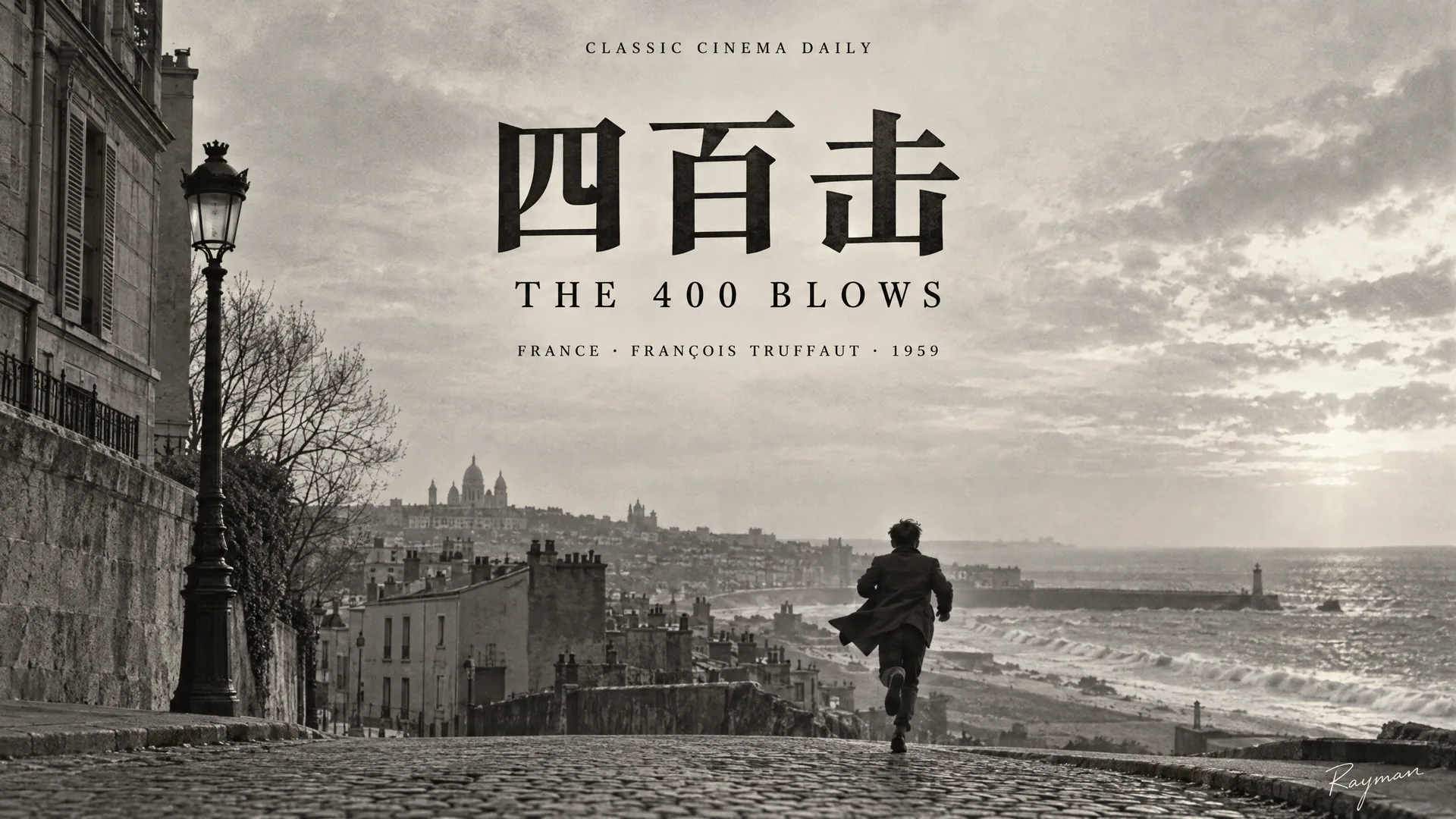
01Why this film today
No authoritative film-history anniversary anchors today, so a structural reason instead.
The 400 Blows (1959) and Rashomon (1950) are nine years apart, West and East — two halves of the same revolution. Rashomon asks how truth is told; The 400 Blows asks how childhood is seen — and it is semi-autobiographical too: Truffaut put his own upbringing inside Antoine Doinel's body.
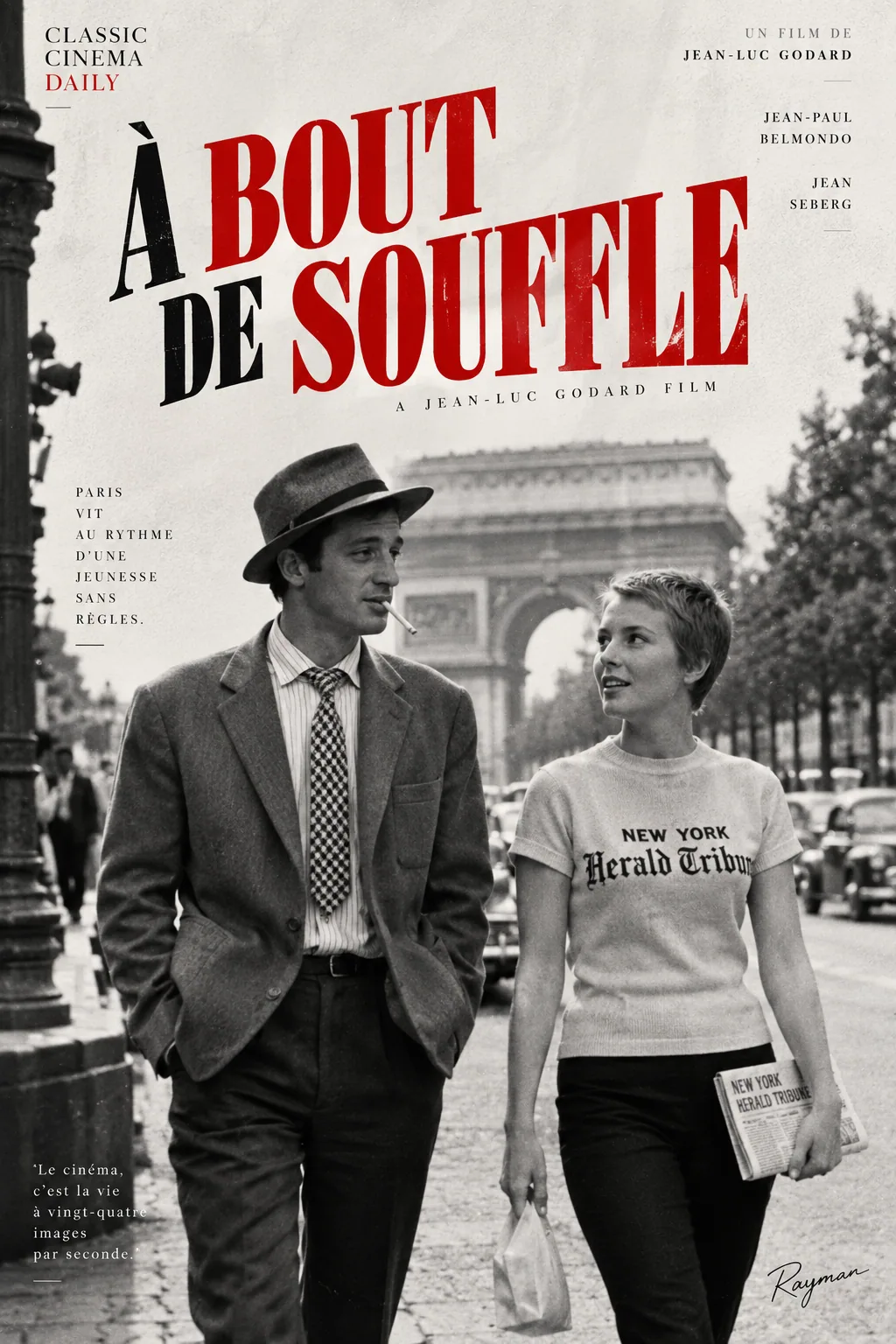
Each opened a long partnership: Truffaut and Jean-Pierre Léaud made five films as Doinel; Kurosawa and Mifune made sixteen. While shooting, Truffaut took Léaud every night to watch rushes of Godard's Breathless — a film that entered this archive on 29 September.
And there is one endorsement from Kurosawa himself: after watching The 400 Blows, he called it one of the most beautiful films he had ever seen. Today, start with Rashomon — then come to this one.
02Film details
- Chinese title
- 四百击
- English title
- The 400 Blows
- Director
- François Truffaut / 弗朗索瓦·特吕弗
- Year
- 1959
- Country
- France / 法国
- Language
- French
- Genre
- Coming-of-age / Drama / French New Wave / 成长 / 剧情 / 法国新浪潮
- Runtime
- 99 min
03About the film
巴黎,一个单亲家庭长大的男孩,成绩不好,一篇作文就闯了祸。
一句谎话、一次离家、一间管教所。海边有一扇门,门后面是浪。
他跑过整座巴黎,最后只剩下一个镜头。
(这里不再往下说。)
04Why it is a classic
The film that opened the French New Wave
The 400 Blows opened in France on 4 May 1959. 99 minutes, French, DyaliScope anamorphic. Directed by François Truffaut — his feature debut — co-written with Marcel Moussy; cinematography by Henri Decaë, music by Jean Constantin; produced by Les Films du Carrosse, distributed by Cocinor.
The title comes from the French idiom «faire les quatre cents coups» — "to raise hell". The first American translation mistranslated it as Wild Oats before distributor Zenith restored the name.
A 14-year-old semi-autobiographical hero
Antoine Doinel is played by Jean-Pierre Léaud, aged 14 at his audition. The resemblance between Truffaut and Doinel is no accident: both were only children of loveless marriages. The rest of the Doinel cycle — a 1962 short and Stolen Kisses, Bed & Board and Love on the Run — kept the character alive for twenty years.
The film borrows scenes from Jean Vigo's Zero for Conduct and is dedicated to André Bazin, Truffaut's spiritual father, who died on 11 November 1958, aged 40, just before filming began. It is also a document: an exposure of how France then treated juvenile offenders.
One boy chosen from hundreds
Truffaut placed an ad in France-Soir and auditioned hundreds of children in September–October 1958; Cahiers critic Jean Domarchi recommended Léaud. Truffaut said the two shared "a certain pain about family". During the shoot he took Léaud every night to watch rushes of Godard's Breathless (as Jay Carr recorded).
Honours
It opened the 1959 Cannes Film Festival; Truffaut won Best Director and the OCIC Award, and it was nominated for the Palme d'Or. At the 32nd Academy Awards it was nominated for Best Original Screenplay; the New York Film Critics Circle named it best foreign-language film in 1959 and the Bodil gave it Best European Film in 1960. Admissions in France: 4.1 million — Truffaut's biggest home hit.
Rotten Tomatoes: 71 reviews, 99%, average 9.4. Sight & Sound 2022: critics' poll 50th, directors' poll 33rd. BBC 2018: 8th-greatest foreign-language film. Scorsese lists it among the 39 essential foreign films for young filmmakers.
And Kurosawa — the director of today's other film — called it one of the most beautiful films he had ever seen.
05What to notice
片名是一句法语成语。 «faire les quatre cents coups» 意为「胡闹、闯祸」(to raise hell)。美国首版误译成 Wild Oats,被发行商 Zenith 改回来——一个关于「闯祸」的片名,差点在美国闯了祸。
莱奥的选角过程。 特吕弗在 France-Soir 登公告,1958 年 9–10 月试镜数百名儿童,最终由 Cahiers 评论家 Jean Domarchi 推荐的 14 岁 Jean-Pierre Léaud 胜出。特吕弗认为两人共有「关于家庭的某种痛苦」——这几乎是一部自传。
献给巴赞。 影片献给 André Bazin:法国电影资料馆的精神支柱、特吕弗的导师,1958 年 11 月 11 日去世,年仅 40 岁——就在开拍前不久。《四百击》是一封写给「看电影这件事」的悼词。
实景巴黎。 影片在巴黎多地实景拍摄——弗罗肖大道、埃菲尔铁塔、蒙马特、夏乐宫;管教所的场景在 Honfleur 拍,终场海滩在 Villers-sur-Mer。法国影评人说,这是第一次有人把巴黎拍成一个孩子的逃跑路线。
一个定格的结尾。 影片最后一个镜头定格在 Antoine 奔向大海的背影——freeze frame 在 1959 年还是新鲜手法,它让「未完」本身成了结局。Doinel 在之后四部特吕弗作品里继续活着。片中的客串也全明星:特吕弗与 Philippe De Broca 在游乐场、Jacques Demy 演一名警察,Godard 与 Belmondo 出现在画外音里。
06Before you watch
它是什么。 1959 年法国出品,99 分钟,法语,DyaliScope 变形宽银幕。导演特吕弗(处女作),摄影 Henri Decaë,主演 Jean-Pierre Léaud(14 岁)。
🔴 它不是「问题少年」片。 片名里的「四百击」容易让人以为这是管教题材的故事片。它的核心是一个孩子在无爱的家里、在学校里、在体制里被一层层推开的过程——节奏很慢,残酷是冷的那一种。
看结尾的方式。 最后一个镜头是定格。不要快进,也不要急着解读——它故意把「未完」留给观众。Doinel 这个角色后来又活了四部特吕弗电影。
彩蛋。 片中有特吕弗本人与 Philippe De Broca 在游乐场的客串、Jacques Demy 演一名警察,Godard 与 Belmondo 出现在画外音里——新浪潮的一家人几乎都在场。
一句话建议。 如果想看法国新浪潮从哪里出发,从这一部开始——它拍的是一个孩子,但它的镜头语言改变了之后五十年的电影。
07In one line
A boy runs across Paris toward the sea, and the frame freezes before the waves — in 1959, cinema ended on an unfinished sentence for the first time. Dedicated to André Bazin, who died at forty, and to every child raised in a loveless home.