9 min
In the Mood for Love
花样年华
2000
Wong Kar-wai
Hong Kong / France · Romance / Drama · 98 min
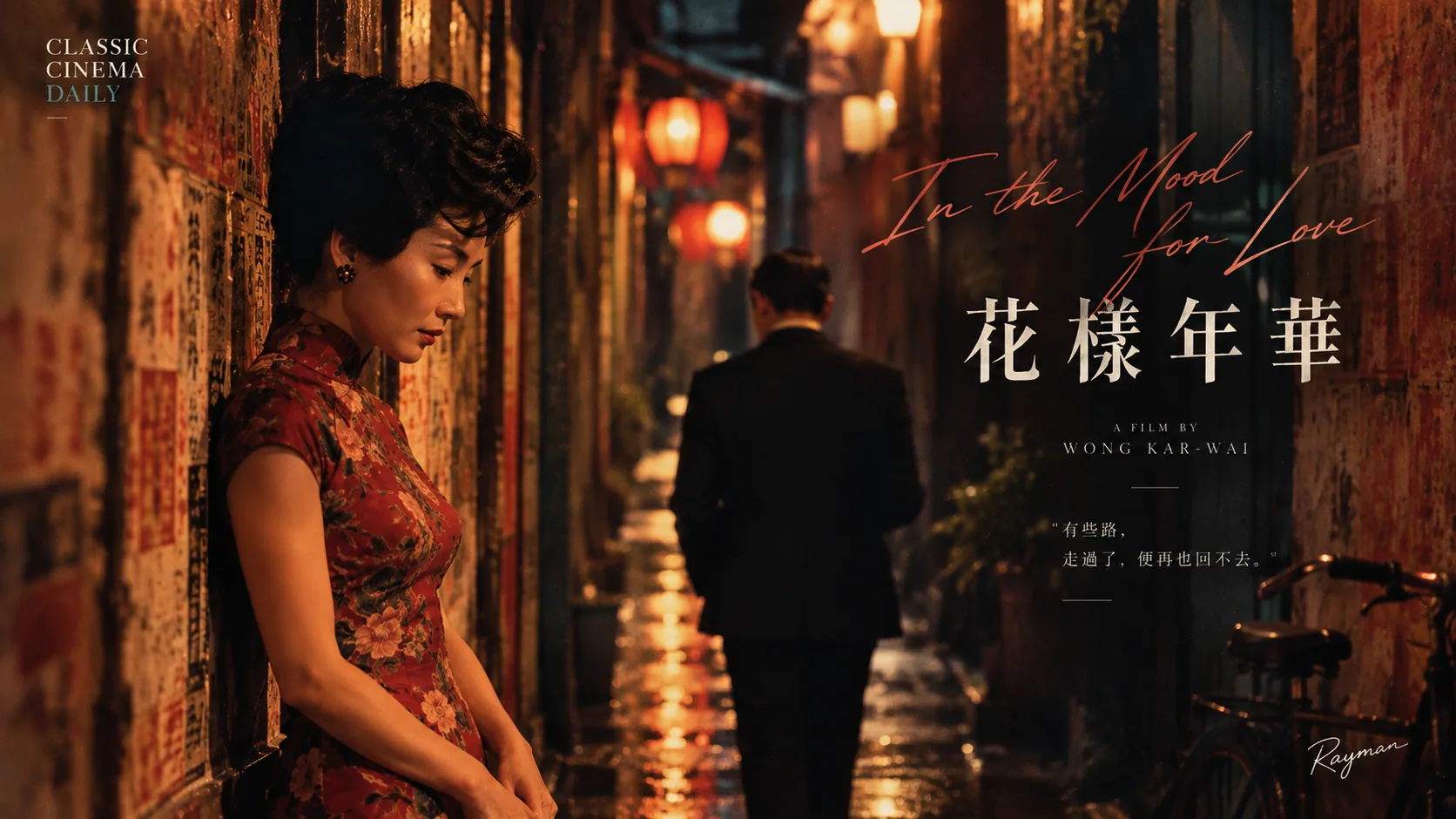
Hong Kong, 1962. Two couples move into the same apartment building, and a man and a woman discover that their spouses are having an affair. They never cross the line, and what they leave behind stays in corridors, stairwells and rainy street corners. With cheongsams, a repeated theme and frames within frames, Wong Kar-wai turned almost nothing happening into one of the most moving love stories of the past quarter century.
01Why this film today
If today's lead film is a cold, cosmic-scale picture, this is its exact opposite: interiors, warm colours, extreme proximity. Hong Kong, 1962, two people talking in a corridor with the camera less than a metre away. Nothing else in the archive makes distance this concrete.
The timing is right too. Wong Kar-wai won Best Actor and the Technical Grand Prize at Cannes in 2000 for this film, and more than two decades on its position on best-of-century lists has only risen: it placed fifth in the 2022 Sight & Sound critics' poll, the highest-ranked film of the 2000s.
There is also a practical reason. At 98 minutes it is a film you can watch in one evening and then keep thinking about for days. There is very little plot; almost all the information sits in repeated shots, one recurring piece of music and the changing cheongsams. It sets up a neat pair with 2001 — one film explains nothing, the other says almost nothing outright.
02Film details
- Chinese title
- 花样年华
- English title
- In the Mood for Love
- Director
- Wong Kar-wai / 王家卫
- Year
- 2000
- Country
- Hong Kong / France / 香港 / 法国
- Language
- Cantonese, Shanghainese
- Genre
- Romance / Drama / 爱情 / 剧情
- Runtime
- 98 min
03About the film
1962 年,香港。苏丽珍与周慕云在同一天搬进相邻的两间房:她随丈夫租住孙太太家的一间,他与妻子租住顾先生家的隔壁。公寓里人多、走廊窄、房东爱打麻将,两个人的生活一开始只是偶尔擦身。
后来他们发现,各自的配偶与对方的配偶有了关系。这件事影片从头到尾都没有正面拍过:那两个人只以背影、声音和画外的方式存在。留下来面对这件事的,是两个被留在原地的人。
他们开始见面——起初是为了弄清楚事情是怎么发生的,后来只是为了一起吃一碗面、走一段路、合写一段武侠小说。影片讲的就是这段关系如何在没有人越界的情况下,变成两个人一生中最重的东西。
故事后来离开香港,结束在新加坡与柬埔寨。为什么是那里,看完才知道。
04Why it is a classic
Director and method
Wong Kar-wai began developing the film after Days of Being Wild (1990). Its first incarnation was Summer in Beijing, which he abandoned; he also considered a three-part structure similar to the original plan for Chungking Express, before keeping only one story, provisionally titled A Story of Food — about a man and a woman sharing noodles and secrets. The setting finally moved from mainland China to 1960s Hong Kong. A short story by the Hong Kong writer Liu Yichang, Intersection, was among his early inspirations. The Chinese title comes from a song by Zhou Xuan, and the English title from Bryan Ferry's I'm in the Mood for Love; the film was once provisionally called Secrets.
Shooting lasted 15 months with no finished script: plot, structure and even some characters were decided as filming went on. Although the story is set in Hong Kong, some exterior and hotel scenes were shot in the less modernised districts of Bangkok, part of the ending in Singapore, and the final passage uses footage of Angkor Wat in Cambodia. Christopher Doyle left when the production overran and was replaced by Mark Lee Ping-bing; both share the credit on the finished film.
Performance
Maggie Cheung plays Su Li-zhen and Tony Leung Chiu-wai plays Chow Mo-wan. At Cannes in 2000 Leung won Best Actor, the first Hong Kong actor to do so. Both performances are extraordinarily restrained: much of the work happens in glances, gestures and pauses, and the dialogue rarely states a feeling outright. Cheung wears more than twenty cheongsams over the course of the film, and the changes of costume carry much of the sense of time passing; the styling is by William Chang.
Cinematography, design and editing
The cinematographers are Christopher Doyle and Mark Lee Ping-bing; the editors are William Chang and Kwong Chi-Leung; art direction and styling are also led by Chang. The film constantly uses door frames, window grilles, mirrors and foreground obstruction: the audience is very often watching the characters through a doorway, a window or a pane of glass, with the line of sight repeatedly interrupted. The compositions favour symmetry and frames within frames inside a narrow image, the space is always crowded, and the physical distance between the two characters is held with great precision. Rain, staircases, corridors, noodle stalls and the back seat of a taxi form a recurring system of locations — the same places, the same actions, only the time has moved.
Cannes' Technical Grand Prize went to Doyle, Lee and Chang.
Music
The score is by Michael Galasso, but the melody the film is remembered for is Shigeru Umebayashi's Yumeji's Theme, originally written for Seijun Suzuki's film Yumeji. Wong reuses the same theme throughout, making it the characters' main outlet for feeling; the technique of repeating one piece of music was widely imitated afterwards. The soundtrack also includes Nat King Cole singing Quizás, Quizás, Quizás and other Spanish-language songs, Rebecca Pan's Bengawan Solo, and a large body of historical recordings of pingtan, Cantonese opera, Peking opera and Yue opera — together they form the aural environment of 1960s Hong Kong.
Film language
The most unconventional thing about the film is that it is built entirely on what does not happen. It never films the affair itself, only the two people left behind; it never films an outcome, only the process and the aftertaste. Wong works by ellipsis: key scenes are simply skipped, and what the audience sees is preparation and aftermath. Feeling is not delivered through dialogue but through repetition — the same music, the same corridor, the same rainy night, each time slightly different.
That makes the film two things at once: extremely specific (period, costume, language and streets are all exact) and extremely abstract (almost every plot event occurs off screen). It is what separates it from an ordinary love story, and what makes it worth returning to.
Historical impact
The film premiered at Cannes on 20 May 2000 in competition, with Wong nominated for the Palme d'Or; Leung won Best Actor and Doyle, Lee and Chang took the Technical Grand Prize. It cost about $3 million and grossed around $17 million worldwide.
Its standing on lists has risen steadily: second in the BBC's 2016 poll of the greatest films of the 21st century; ninth in the BBC's 2018 list of the greatest foreign-language films; eighth in Time Out's 2021 list of the 100 best films of all time; and fifth in the 2022 Sight & Sound critics' poll, the highest-ranked film of the 2000s and the best placing by a director of Chinese descent on that poll. Rotten Tomatoes records 92% from 191 reviews, with a Metacritic score of 87.
The Criterion Collection completed a 4K restoration in 2020 with L'Immagine Ritrovata, supervised by Wong Kar-wai. That restoration proved controversial: the new version changed the aspect ratio, the colour grading and some of the voiceover. Wong's response was: "I invite the audience to start over with me, because these are no longer the same films, and we are no longer the same audience."
05What to notice
它原本是另一个项目:最初的构想叫《北京之夏》(Summer in Beijing),王家卫和杜可风曾在北京做过少量未获许可的拍摄。他也一度打算拍成三段式故事,最后只保留一段,暂名《A Story of Food》——关于一对男女分享面条和秘密。背景最终从中国大陆移到 1960 年代的香港。
片名来自两首歌:中文片名出自周璇的歌《花样的年华》;英文片名出自 Bryan Ferry 的《I'm in the Mood for Love》,而那首歌本身并不出现在电影里(只收在法语版原声双 CD 中)。影片原名一度叫《Secrets》,是在戛纳电影节总监的建议下改掉的。
旗袍不是服装设计,是时间轴:张曼玉在片中换了二十多套旗袍。因为影片几乎不用字幕交代时间跳跃,服装的更替实际上承担了「过了多久」的信息——观众是靠旗袍的图案与颜色判断故事推进的。
那栋公寓是真的,但取景不止在香港:影片设定在 1960 年代的香港,部分户外与酒店场景却在曼谷较不现代化的街区拍摄,片尾部分在新加坡,最后还用了柬埔寨吴哥窟的影像。拍摄时香港本地的老街区正在快速消失。
它是一部非正式三部曲的中间一部:前作是《阿飞正传》(1990),后作是《2046》(2004)。《花样年华》与《2046》的写作几乎同时开始,王家卫在拍这部片时已经在构思《2046》的内容,最后丢掉大部分素材,留下的成为《花样年华》,其余重新拍摄成了《2046》。
06Before you watch
版本:片长 98 分钟,彩色,粤语与上海话。2020 年 Criterion 与 L'Immagine Ritrovata 完成的 4K 修复版调整了画幅比与调色,评价不一。如果有条件,可以对比着看旧版与修复版——这是一个关于「修复是否等于改片」的具体案例。
不要找情节。它的情节线极细,甚至关键事件都发生在画外。第一次看时如果一直在等「什么时候发生」,会错过它真正在做的部分。
注意重复。同一段主题曲、同一条楼梯、同一个面摊、同一个雨夜会反复出现,每一次都略有不同。影片的时间感就建立在这些差异上,第二遍看会比第一遍多出很多东西。
留意画框。门、窗、镜子、栏杆在片中反复挡住画面的一部分,观众常常是「隔着什么」在看人物。这不是构图习惯,而是这部片子表达距离的方式。
语言是分层的。主要对白是粤语,房东与上海移民之间讲上海话。这种分层对应着 1960 年代香港的移民社会结构,配音版会丢掉这层信息。
旗袍值得单独看一遍。二十多套旗袍的颜色与图案随情绪变化,它是影片最容易被忽略、也最耐看的一层。
07In one line
Almost nothing happens: no crossing of the line, no confession, no resolution. And it has become one of the most rewatched love stories of the past quarter century.