12 min
The Spirit of the Beehive
蜂巢幽灵
1973
Víctor Erice
Spain · Drama / Fantasy / Coming-of-age · 99 min
In 1940, with the Spanish Civil War just over, a mobile cinema brings the 1931 Frankenstein to an isolated village on the Castilian plateau. Six-year-old Ana comes to believe the monster really lives nearby and sets out to find him. Víctor Erice's feature debut: honey-coloured light, hexagonal windows, and a mystery that is never explained.
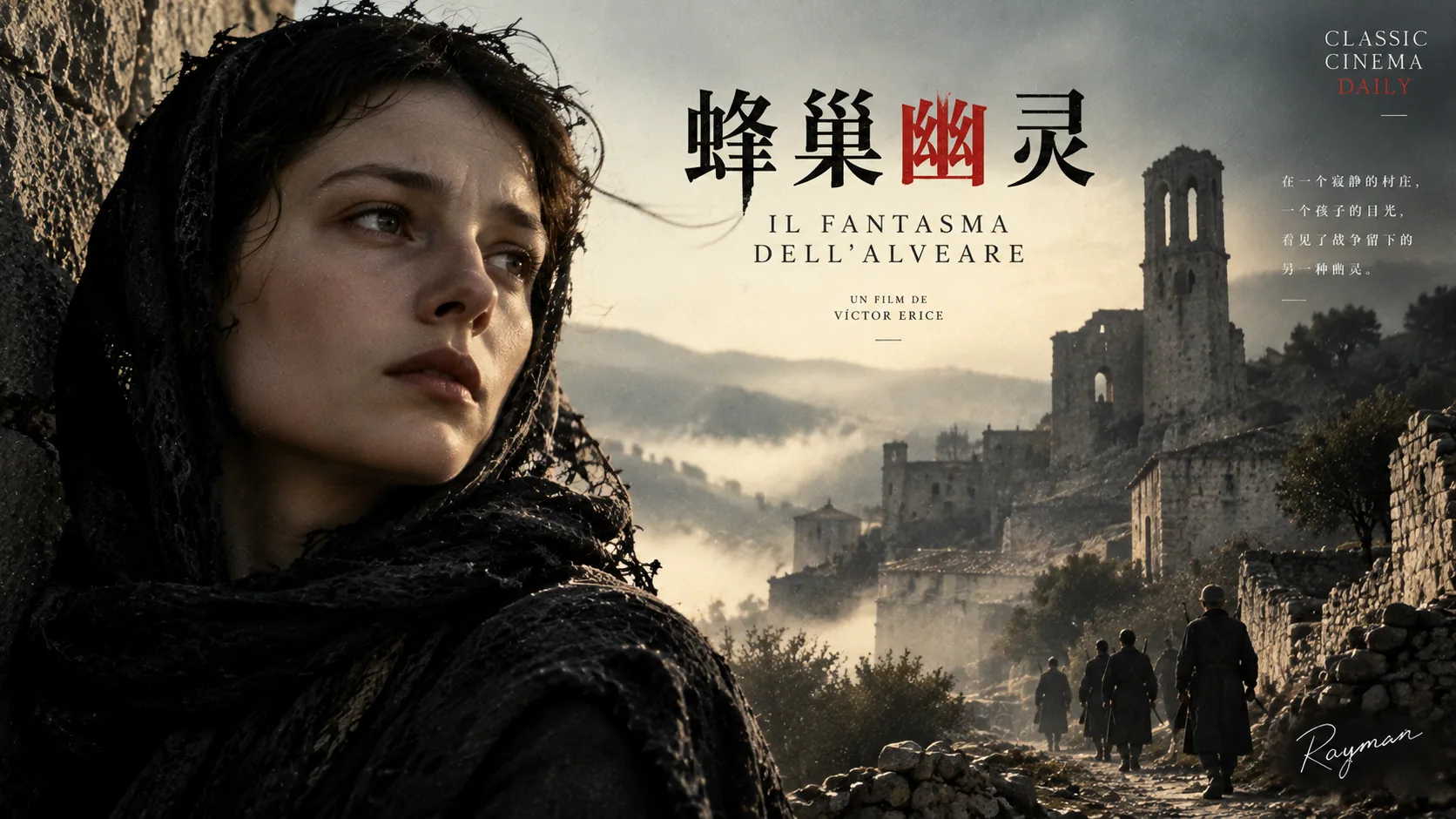
01Why this film today
The invisible thing in The Spirit of the Beehive is a monster made out of a lie.
Her sister Isabel means no harm. She simply tells Ana, offhand, that everything in a film is fake, that the monster did not die, that he is like a spirit, and that if she closes her eyes and calls him she can talk to him. She also takes Ana to a derelict sheepfold outside the village and tells her it is where the monster lives.
Ana believes her. She starts going there alone.
And what Erice does is hand the whole thing back to the audience: no flashback, no narration, no second point of view, no signal as to whether the creature ever appeared. Every place where the film could explain itself has been left empty. The critic Tony Rayns described it as "a haunting mood piece that dispenses with plot and works its spells through intricate patterns of sound and image."
But there is a more concrete and more startling reason to recommend it today.
The film's cinematographer was going blind while it was being shot.
Luis Cuadrado (1934–1980) was one of the most important Spanish cinematographers of his generation, winning the Cinema Writers Circle award for best cinematography almost every year. During The Spirit of the Beehive he began losing his vision to an inoperable brain tumour and had to rely on his assistants to describe the image. By the time he shot Emilia, parada y fonda in 1976 he was completely blind. He died in Madrid in 1980, aged 45.
A film about a child learning how to see was photographed by a man who was losing his sight. That is not a metaphor; it is a production fact, and it is where the film's honey-coloured light — as if seen through amber — actually comes from. Many critics have attributed the film's success to his "essential contribution."
The second reason is the archive.
It now holds 20 films across 18 countries or territories. But Spain is at zero. And The Spirit of the Beehive is, as of 2022, the only film by a Spanish or Latin American director on Sight & Sound's list of the 100 greatest films of all time. Today Spain goes from 0 to 1.
The third reason is internal to the archive.
It connects to Come and See (1985). The archive already holds one film that puts a child into the empty ground left by war — that one is the battlefield in Belarus, with the war shown head-on. This one is Spain five years after: the war never appears at all, only the silence it left inside a house.
It also pairs with Spring in a Small Town (1948): a half-ruined courtyard in a small Jiangnan town, and a manor house steeped in honey-coloured light on the Castilian plateau. Neither film shows the war. Both show only the people left in a house with nothing to say.
One last reason is a date: in two days, on 8 October, the film marks 53 years since its Spanish release.
02Film details
- Chinese title
- 蜂巢幽灵
- English title
- The Spirit of the Beehive
- Director
- Víctor Erice / 维克多·艾里斯
- Year
- 1973
- Country
- Spain / 西班牙
- Language
- Spanish
- Genre
- Drama / Fantasy / Coming-of-age / 剧情 / 奇幻 / 成长
- Runtime
- 99 min
03About the film
1940 年,西班牙内战刚刚结束。
故事发生在卡斯蒂利亚高原上一座与世隔绝的村庄里,一座大宅子中住着四口人。父亲年纪大了,大部分时间在照料蜂巢、在本子上写下他对蜜蜂的观察;母亲比父亲年轻得多,整天想着一个不在场的远方情人,并给他写信。姐姐 Isabel 是家里唯一和 Ana 说话的人——她爱妹妹,但也忍不住利用妹妹的轻信。
然后,一辆流动放映车开进了村子。它带来的是 1931 年的美国恐怖片《Frankenstein》。
散场之后,Ana 问姐姐一个问题:他为什么杀死那个女孩?为什么之后他们又杀死了他?
Isabel 给了她一个答案。那个答案让 Ana 从此开始一个人寻找。
(这里不再往下说。)
04Why it is a classic
A film about seeing
The Spirit of the Beehive (Spanish title El espíritu de la colmena) is a Spanish film of 1973, running 99 minutes — the feature debut of Víctor Erice. He wrote it with Ángel Fernández-Santos; the producer was Elías Querejeta, the cinematographer Luis Cuadrado, the composer Luis de Pablo, the editor Pablo G. del Amo.
Camera: a man losing his sight
This is the most easily missed and most startling thing about the film.
During the shoot, Luis Cuadrado (1934–1980) began losing his vision to an inoperable brain tumour and had to rely on his assistants to describe the image. Many critics have attributed the film's success to his "essential contribution."
The light became the thing the film is remembered for: honey-coloured, late-afternoon yellow, as if seen through a layer of amber. The windows of the house are hexagonal, matching the structure of a honeycomb; the whole building sits in that light, and indoors the characters look almost sealed inside amber.
Performance: a child who did not think she was acting
Ana is played by Ana Torrent (born 12 July 1966 in Madrid), six or seven years old at the time. Erice visited many schools, photographing girls during recess, to cast the part.
She later recalled:
"It wasn't a difficult process because it wasn't acting. I never considered myself an actress. I was just playing myself, a child, and they gave me instructions. I remember my character in the film was even supposed to have a different name, but at that age, I didn't understand why they weren't calling me my name, so Victor changed it to Anna. I wasn't conscious of acting at all, and I didn't understand what I was doing. It was just like a big mysterious game."
That detail decisively changes how the film reads: the four main characters — Fernando, Teresa, Ana, Isabel — carry the names of the actors playing them. This is not a stylistic choice. It is because a six-year-old gets confused when she is called something else on set. Erice changed the script, not the child.
Script: a film that does not explain itself
The screenplay was rewritten from the ground up. Erice's earliest version was set in the 1970s and told of an aged father dying while Ana returns to the village to see him; he thought it would "tidy the story up into a soap opera," scrapped it, and moved everything back to 1940 and into a child's point of view.
The result is a film that barely advances through plot at all. That is its core method: it does not explain. The objects that recur — the father's notebook on his bees, the mother's letters to a distant lover, the hexagonal windows, the hive on the wall — are never glossed. They are simply placed, and the audience is left to draw the lines.
Context: filming 1940 in 1973
The film was shot in 1973 — which means Francisco Franco was still alive and in power (1892–1975). The story is set in 1940, the year the Civil War ended and the Francoist state was being built.
That made direct statement impossible, so the film works entirely through symbol: an isolated village, a family whose emotional life is coming apart, a father who hands everything over to order and repetition. The beehive is the most direct of these symbols — orderly, organised, and entirely without imagination. Working through symbol to evade censorship was the shared condition of Spanish cinema at the time; Erice belongs on that line alongside Luis Buñuel.
Reception and influence
- 2022: the only film by a Spanish or Latin American director on Sight & Sound's list of the 100 greatest films of all time.
- 2010: named No. 25 best arthouse film of all time by The Guardian.
- 20 November 2012: entered Roger Ebert's "Great Movies" selection.
- 1973: won the Golden Shell at the San Sebastián International Film Festival.
- Rotten Tomatoes: 96% from 26 reviews, average 9.00/10; Metacritic 87/100.
- Guillermo del Toro has repeatedly cited the film as an influence on The Devil's Backbone and Pan's Labyrinth.
- Ana Torrent went on to star in Carlos Saura's Cría cuervos (1976) and Alejandro Amenábar's Tesis (1996, Goya nomination for Best Actress); in 2023 she worked with Erice again on Close Your Eyes — his fourth feature in fifty years.
05What to notice
摄影师在拍摄期间正在失明。摄影指导 Luis Cuadrado 因无法手术的脑肿瘤开始失去视力,只能靠助手描述画面来完成工作。到 1976 年拍摄《Emilia, parada y fonda》时他已完全失明,1980 年在马德里去世,45 岁。一部关于孩子学习「看」的电影,是由一个正在失去视力的人拍下的。
四个角色的名字就是演员本人的名字。Fernando、Teresa、Ana、Isabel 分别对应 Fernando Fernán Gómez、Teresa Gimpera、Ana Torrent、Isabel Tellería。原因不是风格,而是六七岁的 Ana Torrent 会因为在片场被叫另一个名字而困惑——Erice 因此改了剧本,让角色沿用演员本名。
影片里放映的是 1931 年的《Frankenstein》。流动放映队带来的这部美国恐怖片由 James Whale 导演,是整部电影的引信。片中出现的那个「怪物」由 José Villasante 扮演,造型参照的是 1931 年的经典设计。
姐姐的谎言有三层。Isabel 告诉 Ana:怪物没有杀死那个女孩、他并没有真的死去;电影里的一切都是假的;他像一个幽灵,只要闭上眼睛呼唤他,就能和他说话。她还把村外一处荒废的羊圈指为「怪物的家」——而 Ana 在那里真正遇到的,是另一件东西。
六边形的窗与蜂蜜色的光。大宅的窗框是六边形,与蜂巢的构造一致;整座宅子浸在偏黄的光里。这组视觉母题与父亲的养蜂笔记、墙上的蜂巢共同构成影片的核心象征:有序、有条理,却毫无想象力——这是评论者普遍读出的、对佛朗哥时代西班牙的隐喻。
结尾是一句「我是 Ana」。影片最后,Ana 没有回到家人中间,而是独自站在窗边,像姐姐教她的那样默默呼唤那个幽灵。片末那句 "Yo soy Ana"(我是 Ana)被许多评论者视为全片最重的一句台词。
片名来自一本关于蜜蜂的书。Erice 说片名取自莫里斯·梅特林克(Maurice Maeterlinck)写蜜蜂的著作,用「蜂巢的幽灵」指代蜜蜂所服从的那种强大、神秘而悖论性的力量。
1973 年拍 1940 年。影片拍摄时佛朗哥仍在世并掌权,而故事设定在内战刚结束的 1940 年。这决定了它不可能直说,只能用象征。影片于 1973 年 10 月 8 日在西班牙公映,同年获圣塞巴斯蒂安电影节金贝壳奖。
06Before you watch
它是什么。99 分钟,彩色,西班牙语,1973 年西班牙出品。导演 Víctor Erice,制片 Elías Querejeta,摄影 Luis Cuadrado,配乐 Luis de Pablo。
节奏:它不是情节电影。它几乎没有「事件」——推进它的是重复的画面与声音:一座宅子、一片高原、一扇六边形的窗、一段反复出现的音乐。如果你在等一个解释,你会等不到;如果你接受它的语法,99 分钟会过得比预期快。
🔴 关键提醒:不要试图解开那个谜。影片不打算告诉你那个「怪物」是否真的出现过。Erice 刻意不给任何标记来区分现实与想象——没有闪回、没有旁白、没有第二个视角。把它当成一道需要解开的题,会毁掉这部影片;把它当成一个孩子所看到的世界,它才成立。
强度:有暴力,但极其克制。片中有一名受伤的人被枪杀的情节,也有一个孩子直面死亡的场面;但枪击几乎全部发生在画外,画面里没有血腥。除此之外,这是一部非常安静的电影。
版本。无重大版本争议,修复版流通良好。画质对这部影片尤其重要——它的光就是它的语言。
人名。Fernando Fernán Gómez(父亲 Fernando)、Teresa Gimpera(母亲 Teresa)、Ana Torrent(Ana)、Isabel Tellería(Isabel)、José Villasante(怪物)。
一句话建议。如果你想看一部关于「一个孩子如何第一次意识到世界并不安全」的电影,这是最精确的一部;如果你只记得一件事,请记得它是由一个正在失明的人拍下的。
07In one line
A film about a child learning how to see, photographed by a man losing his sight — it hands you a mystery and then refuses to solve it.