9 min
Intolerance
党同伐异
1916
D. W. Griffith
United States · Epic / Silent film / Anthology film / Historical drama · 197 min
D. W. Griffith intercuts four stories separated by 2,500 years — the fall of Babylon, the Crucifixion, the St. Bartholomew's Day Massacre and a modern American labour strike — to argue that intolerance never goes out of date. The costliest gamble of the silent era, and the first true epic of film editing.
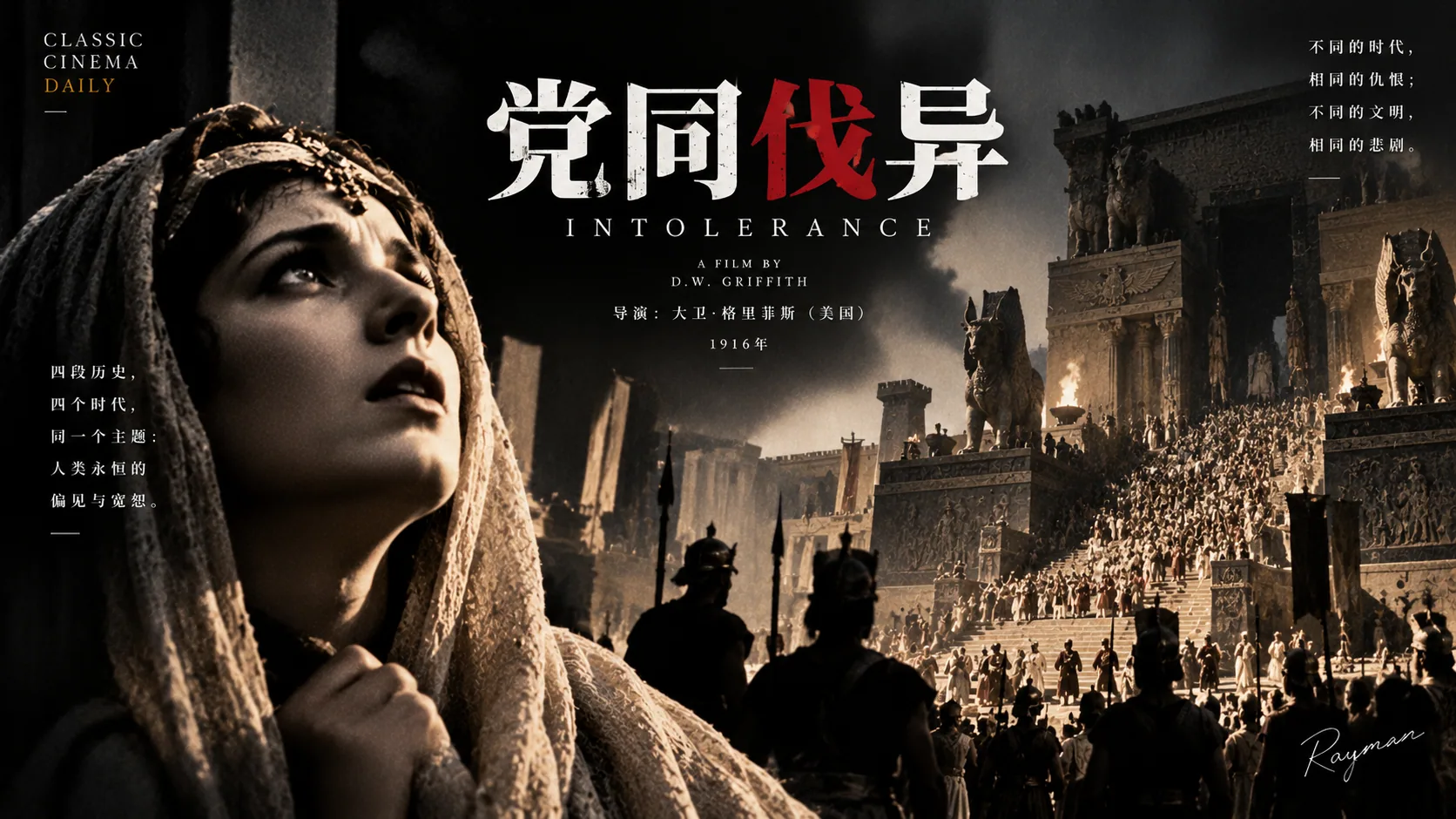
01Why this film today
A real coincidence sits between today's two films.
The 35th Cannes Film Festival ran from 14 to 26 May 1982. Its opening film was this 1916 American silent, Intolerance. It closed with Spielberg's E.T. the Extra-Terrestrial. And its Palme d'Or went jointly to Missing and to the Turkish film Yol. The jury was chaired by the Italian opera and theatre director Giorgio Strehler, with Gabriel García Márquez, Geraldine Chaplin, Sidney Lumet and Mrinal Sen among its members.
So a 1916 silent and a 1982 Turkish film ended up in the same programme — 66 years, two languages and two continents apart.
They are genuinely a pair.
First, neither film will tell only one story. Intolerance cuts together four storylines roughly 2,500 years apart; Yol sets five prisoners' one-week leave side by side. In both, the protagonist is not a person but the structure itself — several things happening at once.
Second, both were cut or banned. A major segment of Intolerance's French story, involving the attempted assassination of Admiral Coligny, was removed before release; Yol was banned in Turkey and only released there on 12 February 1999.
Third, both were misread on release and canonised decades later. Intolerance has long been written off as a box-office disaster, though the film's own accounts show it recouped; Yol won the Palme d'Or and was banned at home for seventeen years.
Start with this one — it is the earliest and most expensive attempt at the structure.
02Film details
- Chinese title
- 党同伐异
- English title
- Intolerance
- Director
- D. W. Griffith / 大卫·格里菲斯
- Year
- 1916
- Country
- United States / 美国
- Language
- Silent film (English intertitles)
- Genre
- Epic / Silent film / Anthology film / Historical drama / 史诗 / 默片 / 多线叙事 / 历史剧
- Runtime
- 197 min
03About the film
四条故事线同时开始。
公元前 539 年的巴比伦,城墙有 300 英尺高,城里正在准备一场盛宴,而波斯的军队已经在城外。公元 27 年的犹地亚,一场婚礼刚刚结束,一个年轻人走进人群,开始讲话。1572 年的巴黎,王室正在筹备一场联姻,街上的人却在磨刀。二十世纪初的美国,一家工厂的老板宣布:所有工人的工资下调 10%。
四段故事里的人互不相识,隔着两千五百年,也永远不会相遇。它们在同一卷胶片上,同时走向各自的结局。
(这里不再往下说。)
04Why it is a classic
One film, four eras, roughly 2,500 years
Intolerance opened in the United States on 5 September 1916. Silent, with English intertitles. Directed by D. W. Griffith; cinematography by G. W. Bitzer; editing by Griffith, James Smith and Rose Smith; distributed by the Triangle Distributing Corporation. It carries two subtitles: Love's Struggle Throughout the Ages and A Sun-Play of the Ages.
Four storylines:
- Babylon (539 BC) — Prince Belshazzar against Cyrus the Great of Persia. The city falls because of intolerance between the devotees of two Babylonian gods.
- Judea (c. AD 27) — from the Wedding at Cana to the Crucifixion. The shortest of the four.
- France (1572) — the St. Bartholomew's Day Massacre of the Huguenots, fomented by the Catholic House of Valois.
- The modern story (c. 1914) — a strike, moral uplift societies and the collision of capital and labour, ruining the lives of people at the margins.
Why it was made
This has to be said plainly. Griffith's previous film, The Birth of a Nation (1915), was fiercely attacked by the NAACP and others for perpetuating racial stereotypes and glorifying the Ku Klux Klan. Intolerance was partly a response to that criticism — but not an apology. In numerous interviews Griffith made clear he felt he had nothing to apologise for: the film was a rebuttal to his critics, whom he considered intolerant themselves.
So the film occupies an awkward position: it answers a criticism of its own maker's work with a film about intolerance. That situation is more complicated than any of its four stories.
The cradle: the single shot that stitches four eras together
Between the stories the film keeps returning to one image: a woman representing Eternal Motherhood, rocking a cradle, played by Lillian Gish. It marks not a date but the passing of generations.
The film contains more than 50 transitions between its segments. As it builds to the climax the cutting accelerates, and the four lines alternate faster and faster — the earliest large-scale experiment in accelerating montage in cinema.
In the original print each storyline carried its own colour tint, distinguishing the eras by hue.
Sets, cost and a genuine gamble
The sets stood on the lot on Sunset Boulevard: the Babylon walls rose 300 feet (91 m), alongside streets of Judea and medieval France. The production used more than 3,000 extras, with the extras' payroll reported to reach $12,000 a day; 300,000 feet of film were shot.
The film's own accounts give the exact cost as $385,907 (a widely repeated figure of "close to $2 million" includes a reported $250,000 for the Belshazzar feast scene alone). A third of the budget went into the Babylonian segments. The sets were demolished two years after they were built.
Why the characters mostly have no names
The heroine of the modern story is "The Dear One", the hero "The Boy", the gang leader "The Musketeer of the Slums". Griffith wanted them to be emblematic of human types rather than individuals. Critics and theorists read the naming as a symptom of his sentimentality.
From "box-office disaster" to "the greatest film ever made"
Contemporary critics received it enthusiastically. It has long been reported as a box-office bomb, but according to the film's own accounts that reputation comes from a misreported budget: it returned roughly $1.75 million in theatrical rental to its backers, enough to recoup.
Its standing has only grown:
- seventh in the 1958 Brussels World's Fair film poll;
- among the first films selected for the United States National Film Registry in 1989 — the first year of voting — for being "culturally, historically, or aesthetically significant";
- 49th in AFI's 100 Years...100 Movies (10th Anniversary Edition), 2007;
- 98% on Rotten Tomatoes across 42 reviews, average 8.30/10; 99/100 on Metacritic from 15 critics;
- Pauline Kael called it "one of the two or three most influential movies ever made, and I think it is also the greatest";
- included by the Vatican in its 1995 list of important films, under the category "Values".
The dissent
Not everyone accepts it. David Thomson argues the film is weakened by its own "self-destructive frenzy": "The cross-cutting, self-interrupting format is wearisome... The sheer pretension is a roadblock, and one longs for the 'Modern Story' to hold the screen." That objection still stands — it is a real face of this film.
05What to notice
摇篮,和一个刚过完 22 岁生日的演员。 缝合四段故事的那个「永恒的母亲」由 Lillian Gish 饰演。她生于 1893 年 10 月 14 日——也就是说,今天距离她的生日还有五天。她活到 99 岁,从 1912 年一直演到 1987 年,演艺生涯横跨 75 年;1927 年《Vanity Fair》称她为「银幕第一夫人」,1999 年 AFI 把她列为经典好莱坞第 17 位最伟大的女星。
布景的规模。 巴比伦的城墙高 300 英尺(约 91 米),片场同时搭起了犹地亚与中世纪法国的街道。全片用了 3,000 名以上临时演员,临时演员的日薪总额据报道达到 12,000 美元,共拍摄 30 万英尺胶片。这批布景在建成两年后就被拆掉,土地改作他用。
颜色是叙事的一部分。 在原版拷贝里,四条故事线各有自己的色调(tint)——观众不用看字幕卡就知道自己现在在哪一个时代。这个做法在有声片时代基本消失了,直到几十年后才以别的形式回到电影里。
剪辑在加速。 全片有 50 次以上的段落切换,而且越到后面切得越快:四条线交替的频率持续上升,最后汇成一段节奏极紧的平行高潮。这不是「多线叙事」的雏形,而是它第一次被当成节奏工具使用。
「票房惨败」是一则误传。 影片长期被写成让格里菲斯破产的灾难,但它的账目显示实际成本为 385,907 美元,为投资人带回约 175 万美元的影院租金收入——足以回本。「惨败」的说法来自当年被夸大的预算数字(流传版本是「接近 200 万美元」)。一部被误传了一百多年的亏损,比真实的账本更有名。
06Before you watch
它是什么。 1916 年美国出品,默片,英文间幕。导演 D. W. Griffith,摄影 G. W. Bitzer,剪辑 Griffith、James Smith、Rose Smith。四段故事,约 2,500 年跨度。
🔴 时长先确认。 原始版本 210 分钟,现存多数版本 197 分钟;市面上流通的影碟版从 163 到 197 分钟不等。版本差异不小,看之前先确认手上是哪一个。
默片怎么看。 没有对白,只有英文间幕。四段故事来回跳,前半小时需要一点耐心去认人。一个实用的看法是:不要试图记住情节,去注意剪辑的节奏——什么时候切、切得越来越快。这部电影真正的主角,是「切换」这个动作本身。
版本选择。 推荐 Kevin Brownlow 与 David Gill 1989 年的 Thames Silents 修复版(约 177 分钟,Carl Davis 配乐);Kino 2002 年版(197 分钟)也可看,但完整性不如前者。影片已进入公有领域,网上能搜到大量画质很差的版本,注意避开。
内容提示。 有战争场面、人群暴力与钉十字架的段落。呈现方式属于默片时代的舞台化表演,冲击力来自规模而非血腥。
一句话建议。 如果你想找一部电影来理解「剪辑可以自己当主角」,就从这一部开始。
07In one line
Four stories, 2,500 years, more than fifty transitions: Griffith spent the silent era's largest fortune to prove that intolerance belongs to no single age. The real starting point of film editing is here.