11 min
A Brighter Summer Day
牯岭街少年杀人事件
1991
Edward Yang
Taiwan, China · Drama / Crime · 237 min
Taipei, 1960. Hsiao Si'r, the son of a civil servant, grows up between night school, street gangs and his father's silences. In 237 minutes and over a hundred speaking parts, Edward Yang turns a real juvenile murder into the portrait of a whole generation.
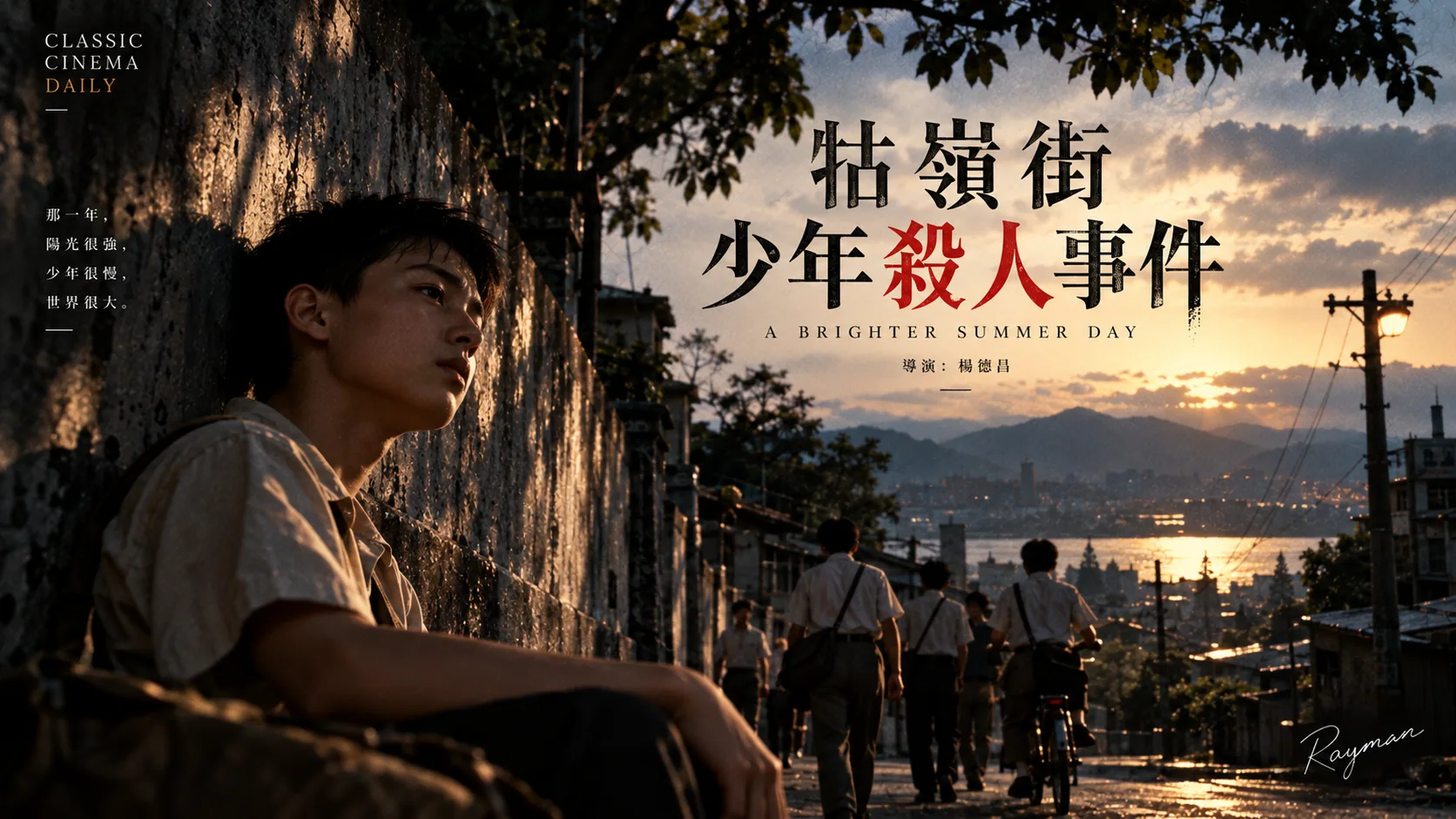
01Why this film today
Today, 8 October, is Cold Dew (寒露).
In 2026 Cold Dew falls on 8 October at 14:29 Beijing time. It is the seventeenth of the twenty-four solar terms, the fifth of autumn, and the first to carry the character 寒 — cold. The classical almanac puts it plainly: the dew is no longer merely cool, it is cold enough to be on the point of freezing.
Summer ends on this day.
So both films recommended today are about a summer that is already over.
This one is literally titled A Brighter Summer Day. The title is paraphrased from a lyric in Elvis Presley's 1960 recording of Are You Lonesome Tonight? — recorded in Nashville on 4 April 1960, released on 1 November 1960, and a No. 1 on both the Billboard Hot 100 and the UK singles chart. It is exactly the Western world that Taipei teenagers of the early 1960s were hearing on the radio.
Why recommend it today?
First, it fills the largest remaining blank in the archive: Taiwan, China. Of the previous 24 entries the only Chinese-language films were In the Mood for Love and Spring in a Small Town; none came from Taiwan. The 1990s had a single slot (Close-Up, 1990); today it gets a second.
Second, it is Edward Yang's masterpiece and one of the very few Chinese-language films that critics and fellow filmmakers keep calling one of the greatest ever made: No. 78 in the 2022 Sight & Sound critics' poll of the greatest films of all time, 100% on Rotten Tomatoes across 26 reviews, 91 on Metacritic.
Third, the site already offers joints. The Spirit of the Beehive (1973) and Pather Panchali (1955) are both about a child seeing the cruelty of the adult world for the first time; Come and See (1985) is a boy swallowed by war. This is a boy swallowed by a decade with no war in it — no artillery, only night-school report cards, a father demoted, one typhoon, and a Japanese sword taken from another family's attic.
Fourth, it forms a line with the other film running today: both are films in which a national cinema was born — the Australian revival of 1975, the Taiwan New Cinema of 1991. Both use a young person's disappearance or death to write the story of a world that is vanishing.
02Film details
- Chinese title
- 牯岭街少年杀人事件
- English title
- A Brighter Summer Day
- Director
- Edward Yang / 杨德昌
- Year
- 1991
- Country
- Taiwan, China / 中国台湾
- Language
- Mandarin / Shanghainese / Taiwanese
- Genre
- Drama / Crime / 剧情 / 犯罪
- Runtime
- 237 min
03About the film
1960 年的台北。夜里,一个穿制服的中学生拿着手电筒,在黑暗的片场里照来照去——他刚刚在隔壁偷看了一场不属于他的电影。
他叫小四,家里五个孩子里的第四个。父亲是公务员,母亲在小学代课,一家人从大陆搬来,住在一间日式宿舍里。
他考砸了,被分到夜间部。他的朋友里有几个属于「小公园帮」,街对面的眷村孩子属于「217」。他本人不是帮派的人。
然后他遇见了一个女孩,叫小明。
(这里不再往下说。)
04Why it is a classic
A 237-minute film with more than a hundred speaking parts
A Brighter Summer Day opened in Taiwan on 27 July 1991. It runs 237 minutes, in colour, mixing Mandarin, Shanghainese and Taiwanese. Directed by Edward Yang, written by Hung Hung, Lai Ming-tang, Edward Yang and Alex Yang. Cinematography by Chang Hui-kung, editing by Chen Bo-wen, music by Zhang Hongda. Distributed by Cine Qua Non Films.
The film has more than 100 speaking parts. Its 1991 release was a version just over three hours; the full cut of over four hours came later. Yang said his model for the gangster material was Martin Scorsese's Goodfellas.
The title: half a real case, half a song
The Chinese title names the case outright: in 1961 a teenage boy in Taipei stabbed his girlfriend to death. Yang was thirteen when it happened, near the school he attended. He acknowledged the film as his memory rather than his story — he had to bridge the silence between two generations.
The English title is paraphrased from Elvis Presley's 1960 recording of Are You Lonesome Tonight?. The song was written by Roy Turk and Lou Handman in 1926; Presley recorded it at RCA Studio B in Nashville on 4 April 1960, released it on 1 November 1960, and it topped both the Billboard Hot 100 and the UK singles chart — his fifteenth No. 1. Yang on the period: tired of propaganda songs, the kids kept the radio on the rock 'n' roll stations; "We'd see Elvis movies and think, that's cool, that's the sort of thing we don't speak to our parents about."
So the film has two faces. The Chinese title points at a society in which, as the critic Godfrey Cheshire put it, all proper authority — a very Confucian concern — has been eroded or undermined, and a boy is pulled into violence. The English title points at adolescence itself — loneliness, melancholy and longing, unbound by time or place.
A director who trained as an engineer
Edward Yang was born in Shanghai on 6 November 1947 and died of complications from colon cancer at his home in Beverly Hills, California, on 29 June 2007, aged 59.
He studied electrical engineering: a BSEE from National Chiao Tung University, a master's from the University of Florida in 1974, then seven years in Seattle working on microcomputers and defence software. He briefly attended USC film school, found it "too commercial and mainstream oriented", and concluded cinema was not for him. What brought him back was seeing Werner Herzog's Aguirre, the Wrath of God (1972) in Seattle — a film he later named as his single favourite.
He was one of the pioneers of the Taiwan New Cinema of the 1980s, alongside Hou Hsiao-hsien; he contributed one segment to the 1982 portmanteau In Our Time. Against Hou's rural bent, Yang was called a poet of the city. He completed only eight features, the last being Yi Yi (2000), which won him Best Director at Cannes.
Form: locked-off cameras, long takes, no close-ups
Yang's style is deliberate pacing, long takes, fixed camera positions, very few close-ups, and a great deal of empty space and cityscape. He hands the camera to the room rather than to the emotion.
Most of this film happens at night: night-school classrooms, pool halls, Japanese-era dormitories, a recording studio, the streets during a typhoon. The "brighter" in the title has almost nothing to do with the light on screen — the film's most precise irony.
Reception
100% on Rotten Tomatoes across 26 reviews, average 9.4/10; 91/100 on Metacritic. In the 2022 Sight & Sound critics' poll of the greatest films of all time it placed 78th, one of four Chinese-language films on the list and higher than Yang's own Yi Yi.
A.O. Scott, The New York Times (2011): "In every aspect of technique — from the smoky colors and the bustling, off-center compositions to the architecture of the story and the emotional precision of the performances — this film is a work of absolute mastery."
David Bordwell placed it among the ten best films of the 1990s; Jonathan Rosenbaum put it in his personal top 100 in 2004 and called it "arguably the greatest Taiwanese film ever". The director Ari Aster: "It's like The Godfather in that way" — you cannot watch it without believing it is the greatest film ever made.
Awards: Golden Horse Awards for Best Film and Best Original Screenplay (plus ten further nominations, including Best Leading Actor for Chang Chen); the FIPRESCI Prize and Special Jury Prize at the Tokyo International Film Festival; Best Film at the 1991 Asia-Pacific Film Festival; the 1993 Kinema Junpo Best Foreign Language Film Director Award; Best Director at the Nantes Three Continents Festival. It was Taiwan's submission for Best Foreign Language Film at the 64th Academy Awards and was not nominated.
Restoration
In 2009 the World Cinema Foundation restored the film from the original 35mm camera and sound negatives supplied by the Edward Yang estate. In March 2016 the Criterion Collection released it on Blu-ray and DVD with a new 4K restoration, a commentary by Tony Rayns, a new interview with Chang Chen, and Our Time, Our Story (2002), a documentary on the Taiwan New Cinema.
05What to notice
手电筒。 影片的第一个场景:小四和 Cat 在片场偷看剧组拍戏,逃出来时用偷来的手电筒乱照,照到一对看不清脸的恋人。这支手电筒是全片的第一个隐喻——一个孩子试图用光去弄清一件他还看不懂的事。整部影片都在做这件事,而他到最后也没能看清。
片名的两半。 中文片名指向 1961 年台北一桩真实的少年杀女友案(杨德昌当时 13 岁,事发地点在他学校附近);英文片名取自 Elvis Presley 1960 年《Are You Lonesome Tonight?》里的一句歌词。两个名字,一部电影的两张脸:一张是社会,一张是青春期。
张震的处女作。 演小四的张震此前没有演过电影,凭这个角色获金马奖最佳男主角提名;后来他成了《Happy Together》(1997)、《Crouching Tiger, Hidden Dragon》(2000)、John Woo《Red Cliff》(2008) 的主演。片中演他父亲的是张震现实中的父亲张国柱——父子在银幕上演父子。
美国流行文化的两重身份。 片中的人物听摇滚、看 Elvis 电影,把美国流行乐当作逃离宣传歌曲的出口;同时好莱坞电影(《Citizen Kane》《Rebel Without a Cause》《Rio Lobo》等)不断出现在他们的对话和想象里。他们用别人的故事来解释自己的生活,而杨德昌把这件事本身也拍进了电影。
它有三个版本。 1991 年首映的版本是三小时多一点,后来发行过 237 分钟的完整版,另有一个 127 分钟的短版。三个版本的长度差异不是技术问题:看完整版是唯一能理解它为什么需要这么长的方式——它靠的是累积,不是单场戏。
06Before you watch
它是什么。237 分钟,彩色,1991 年中国台湾出品。国语/上海话/台语混用。导演 Edward Yang(杨德昌),编剧 Hung Hung、Lai Ming-tang、Edward Yang、Alex Yang,摄影 Chang Hui-kung,剪辑 Chen Bo-wen,配乐 Zhang Hongda。
🔴 时长是真的。 237 分钟,接近四小时。它靠累积起作用,不是靠单场戏——建议一次看完,不要分成三次。
需要一点历史背景。 故事发生在 1960 年代初的台北。1949 年后,大批大陆家庭随国民党当局迁往台湾,他们的孩子在一个对未来没有把握的氛围里长大——影片用一段字幕直接说明了这件事。小四一家就是这样一户人家:父亲是公务员,说上海话;母亲在小学代课;家里五个孩子。片中还有一条线:小四的父亲因为过去在大陆时期的人际关系被带走问话,获释后被降职。不了解这层背景,影片里那些沉默和「为什么父亲会突然变小」的时刻会失去一半重量。
语言。 全片混用国语、上海话与台语,不同群体说不同的话。字幕版本的标注差异会直接影响你听到的东西,尽量选有完整语言标注的版本。
强度。 有帮派斗殴、刀伤与一次明确的杀人。暴力的呈现是突然的、不美化的,但血腥程度克制,多数冲击来自之前那几分钟的安静。
版本。 尽量看 237 分钟完整版(Criterion 2016 年蓝光为 4K 修复)。三小时版与 127 分钟版都做过删减。
人名。 Chang Chen 张震(小四 Hsiao Si'r)、Chang Kuo-chu 张国柱(父亲)、Elaine Jin 金燕玲(母亲)、Lisa Yang(小明 Ming)、Wong Chi-zan(小猫王 Cat)、Lawrence Ko(飞机 Airplane)、Tan Chih-kang(小马 Ma)、Lin Hong-ming(Honey)。
一句话建议。 如果你想看一部把「一个人的青春期」和「一个时代的失败」放进同一个镜头的电影,这是最完整的一部。
07In one line
The title comes from an Elvis lyric about a brighter summer day; the screen is almost entirely night. In 237 minutes Edward Yang turns a real juvenile murder into the adolescence of a whole generation.