10 min
City of God
上帝之城
2002
Fernando Meirelles & Kátia Lund
Brazil · Crime / Drama / Epic · 130 min
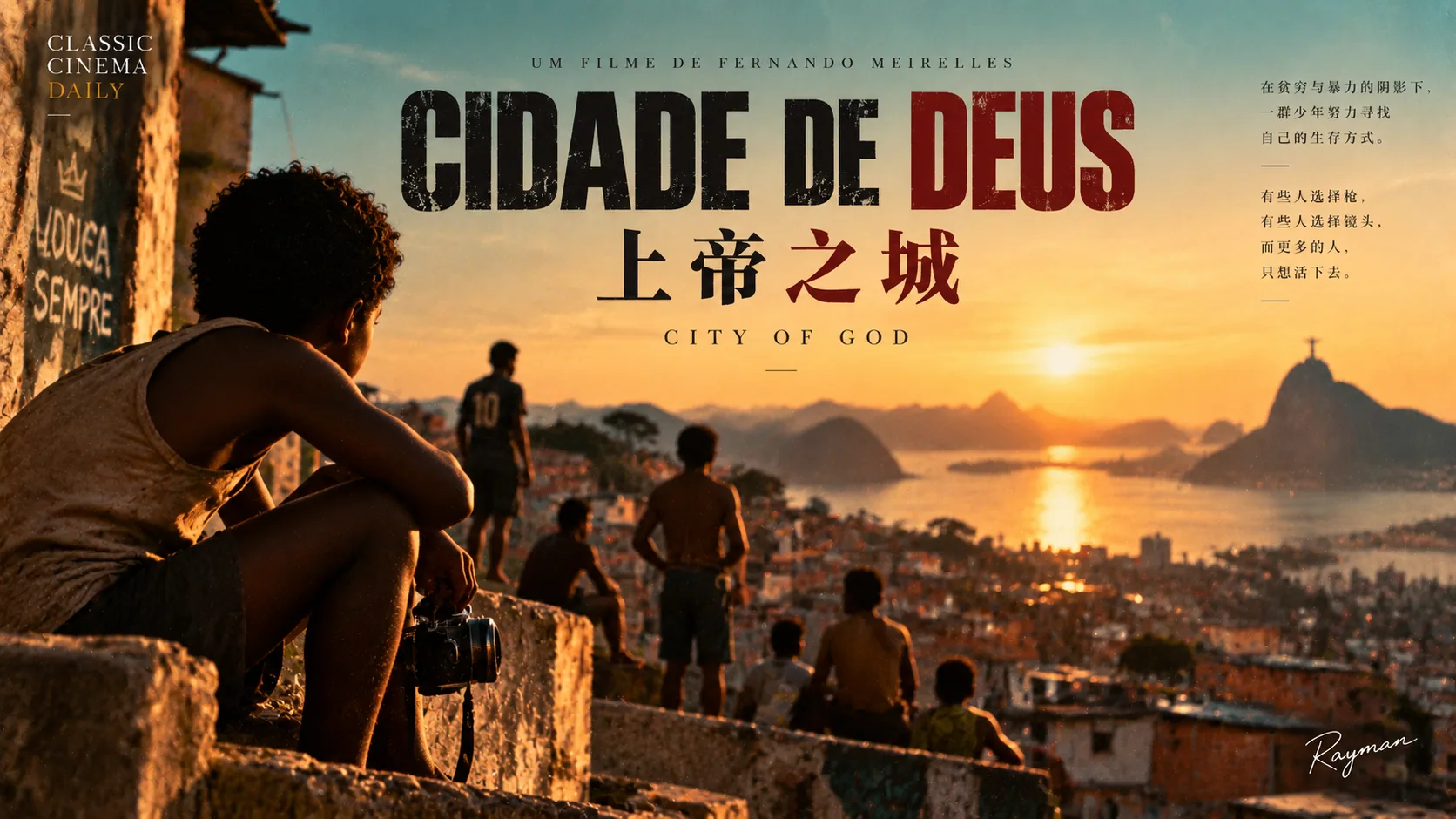
On the western edge of Rio de Janeiro, a relocation housing estate called Cidade de Deus grows over twenty years into a city ruled by armed teenagers. One boy who wants to be a photographer survives — because he learned to watch it all from behind a viewfinder.
01Why this film today
The second reason is the mirror image of the first.
The archive holds twelve films, from 1927 to 2019, covering the United States, Japan, Italy, Sweden, France, Britain, Germany, the Soviet Union, India, Iran, South Korea and Hong Kong — and nothing at all from Latin America. Not one film from the whole of South or Central America. City of God is the least arguable candidate for that gap.
It forms a deliberate counterweight to today's other selection, Modern Times: 1936 against 2002, sixty-six years apart; one built on studio sets in Hollywood, one shot handheld on 16mm in real Rio favelas; one with almost no dialogue, one carried from beginning to end by narration and music; one a comedy, one a crime film.
But they are about the same thing: an ordinary person ground down by a machine he cannot influence. In Modern Times the machine is the assembly line, technology that counts only profit. In City of God the machine is the logic a neighbourhood ran on for twenty years — whoever picks up a gun first survives — and that logic is not decided by any single character.
Both are also films about the poor, by opposite methods. Chaplin grew up in the slums of Victorian London, became a millionaire, and filmed the poor with studio sets and choreography timed to the frame. Meirelles and Lund spent two years casting in Rio's favelas, and in the end almost every lead was someone who lived there, many of them acting for the first time.
The last reason is plainer: the 2000s currently hold a single film in the archive, In the Mood for Love, and it is Asian. With this one added, both ends of that decade are covered.
02Film details
- Chinese title
- 上帝之城
- English title
- City of God
- Director
- Fernando Meirelles & Kátia Lund / 费尔南多·梅里尔斯 & 卡提亚·伦德
- Year
- 2002
- Country
- Brazil / 巴西
- Language
- Portuguese
- Genre
- Crime / Drama / Epic / 犯罪 / 剧情 / 史诗
- Runtime
- 130 min
03About the film
里约热内卢的西郊,有一个叫 Cidade de Deus 的地方——「上帝之城」。它不是自然长出来的:1960 年代,政府为了把市中心的棚户区迁走,在这里建起一片一模一样的安置住宅,四周什么都没有。
故事从 1960 年代末开始。三个少年在街上抢劫,只拿钱和煤气罐,还给自己立了规矩;一个叫 Buscapé(火箭)的男孩在旁边看着。他胆子小,怕事,想当摄影师。
十年后,同一片空地上出现了一批更小的孩子。他们比上一批更快、更狠、更不讲规矩。
影片用二十年时间,把这块地方怎么一步步变成一座由持枪少年统治的城,讲了一遍。旁白从头到尾都是 Buscapé——那个没拿枪、只拿着相机的人。
(这里不再往下说。这个故事的一半力量来自不知道谁会活到最后。)
04Why it is a classic
How a documentary turned into a film
The starting point was not the novel but a documentary. In 1996 Kátia Lund handled production in Rio for Spike Lee's music video for Michael Jackson's "They Don't Care About Us", shot inside a favela. Until then she knew almost nothing about them.
In 1999 she co-directed, with João Moreira Salles, the documentary Notícias de uma Guerra Particular (News from a Personal War, 57 minutes): no narration, just police, dealers and residents speaking to camera. One of the interviewees was Paulo Lins — the man who later wrote the novel.
In 2001 Fernando Meirelles asked Lund to co-direct the short Golden Gate (Palace II), about two small boys in a favela. The two then made City of God together. The documentary was later included on the City of God DVD — it is the film's real first draft.
Casting: one professional actor in the entire film
The film adapts Paulo Lins's 1997 novel of the same name, scripted by Bráulio Mantovani. Lins grew up in Cidade de Deus; the novel is semi-autobiographical and its characters loosely correspond to real people and events.
Meirelles decided against stars. His reason was blunt: at the time Brazil had only three or four young Black professional actors, and middle-class actors could not produce what the film needed. He wanted authenticity.
So from around 2000 the production ran an actors' workshop, selecting roughly a hundred children and young people from the favelas and training them for months. The method was not acting class but the simulation of real street conflict — robberies, brawls, shootings — relying heavily on improvisation. Most leads had never acted, and came from real communities including Vidigal and Cidade de Deus itself. The only professional actor in the film is Matheus Nachtergaele, playing the supporting role of Carrot.
There was an aftermath: Lund and the production set up Nós do Cinema ("We of Cinema"), which began with the young cast of this film and offers film courses and work to children from the favelas. The production also set up a support team to help the actors build lives after the shoot.
Camera and editing: the film's real signature
César Charlone shot it on 16mm. Because the real Cidade de Deus was in the middle of armed conflict, most of the film was shot in Cidade Alta, another Rio favela; the location would not allow the production to bring its own security, so local guards were hired.
Daniel Rezende edited. His cutting is the film's most recognisable feature: the timeline is shattered, the same event re-enters from different years, the image is driven forward by a flood of short takes and jump cuts, and the narration and music almost never stop. The style was imitated for years, and Rezende won a BAFTA for it.
Four Oscar nominations, and an argument
The film premiered at Cannes on 18 May 2002, but out of competition — because executive producer Walter Salles was on that year's jury, which barred it from the official selection. It opened in Brazil on 30 August 2002 and in the United States on 17 January 2003.
At the 76th Academy Awards in 2004 it received four nominations: Best Director (Fernando Meirelles), Best Adapted Screenplay (Bráulio Mantovani), Best Cinematography (César Charlone) and Best Film Editing (Daniel Rezende). It won none. The argument concerns the directing nomination: co-director Kátia Lund was not nominated, though the casting, the on-location work and the understanding of the community's internal relationships were largely hers. The point has been debated in Brazil ever since.
Brazil submitted it for Best Foreign Language Film at the 75th Academy Awards; it was not selected as a finalist.
Reception, and a hard criticism
The budget was about $3.3 million and the worldwide gross about $30.6 million; it was the most-watched Brazilian film of 2002. Roger Ebert gave it four stars; Robert Altman called it the best picture he had ever seen. Rotten Tomatoes records 91% and Metacritic 79.
It is not uncontested. The Brazilian critic Ivana Bentes argued that the film domesticated Brazil's most radical subject matter into an export product, and said it "promotes tourism in hell" — that it turns favela violence into spectacle for outside consumption. That criticism is worth carrying in: watch how the film pursues authenticity through non-professional actors, and ask at the same time who it is showing these people's lives to.
On lists: Paste ranked it first among the 50 best films of the 2000s; the BBC's 100 Greatest Films of the 21st Century placed it 38th; the New York Times' "100 Best Movies of the 21st Century" (June 2025) placed it 15th; Abraccine's 2015 poll of the 100 greatest Brazilian films placed it 8th.
05What to notice
全片只有一个专业演员。其余主要演员都是从 Vidigal、Cidade de Deus 等真实社区里挑出来的,许多人此前没有演过戏。唯一的职业演员是 Matheus Nachtergaele,演配角 Carrot。
训练方法是模拟枪战,不是表演课。剧组从 2000 年前后办起演员工作坊,选出约一百名儿童和青年训练数月,方法是反复模拟街头抢劫、扭打和交火,大量依赖即兴。
真实的 Cidade de Deus 当时在打仗。因为那片区域正处在武装冲突中,大部分戏改在里约另一个贫民窟 Cidade Alta 拍摄。当地不允许制片公司自带安保,剧组只能雇用本地保安。
剪辑是这部电影最容易被认出来的签名。时间线被打碎,同一件事从不同年份切进来,短镜头和跳切把画面一直推着走,旁白和音乐几乎不停。Daniel Rezende 凭它拿下 BAFTA 最佳剪辑。
四项奥斯卡提名,没有一项属于联合导演。2004 年第 76 届奥斯卡,影片拿到最佳导演、改编剧本、摄影、剪辑四项提名,全部落空;而联合导演 Kátia Lund 未获导演提名——选角和实地协调主要由她完成,这一点在巴西国内长期有争议。
片子拍完之后,人还在。剧组建立了援助小组帮助这批年轻演员安排后续生活;Lund 则建立了「Nós do Cinema」,以这批演员为起点,给贫民窟的孩子提供电影课程和工作机会。
06Before you watch
先说最重要的:强度。这是本次推荐里需要提前打招呼的一部。片中有大量枪击、处决式的暴力和儿童持枪的画面,处理方式是直接、密集、不带缓冲的,还有一场涉及很年幼孩子的暴力场景。它不是恐怖片,但它比大多数恐怖片更让人难受,因为这些事情对应的是真实发生过的事。请按这个前提决定要不要看、什么时候看。
它是什么。130 分钟,葡萄牙语,彩色,2002 年巴西出品,Fernando Meirelles 与 Kátia Lund 联合执导,改编自 Paulo Lins 1997 年的小说。
叙事方式需要一点耐心。时间线是非线性的,旁白由 Buscapé 讲述,影片在不同年份之间来回跳,有时同一个场景会从另一个角度重来一遍。开头二十分钟人物出现得很快,名字也密——不必强行记住每个人,跟着 Buscapé 的视角走就行,他在片中也是一个「旁观者」而不是参与者,这一点是理解全片的关键。
人名。Buscapé(火箭,旁白者,想当摄影师)、Zé Pequeno(小个子,成年后由 Leandro Firmino 扮演,童年叫 Dadinho)、Benny(Zé 最好的朋友)、Carrot(Carrot 是片中的另一派)、Knockout Ned(原名 Mané Galinha)、Angélica(Buscapé 喜欢的女孩,这是 Alice Braga 的银幕处女作)。
版本与字幕。找带完整中文字幕的版本。片中大量对话是贫民窟的俚语和快速语速,字幕质量直接影响理解,尤其是几处关键的时间提示——影片靠字幕标注年份来锚定时间线,别跳过。
带一个问题看。看完之后值得想一下巴西影评人 Ivana Bentes 的那个批评:这部电影把贫民窟的暴力拍得极具观赏性,那么它到底是替这些人说话,还是把他们的处境变成了别人的娱乐?两种答案都有道理,但带着这个问题看,收获会比只看故事多一层。
07In one line
It compresses twenty years into two hours, and the boy at its centre gets exactly one thing right: he never takes the gun.