10 min
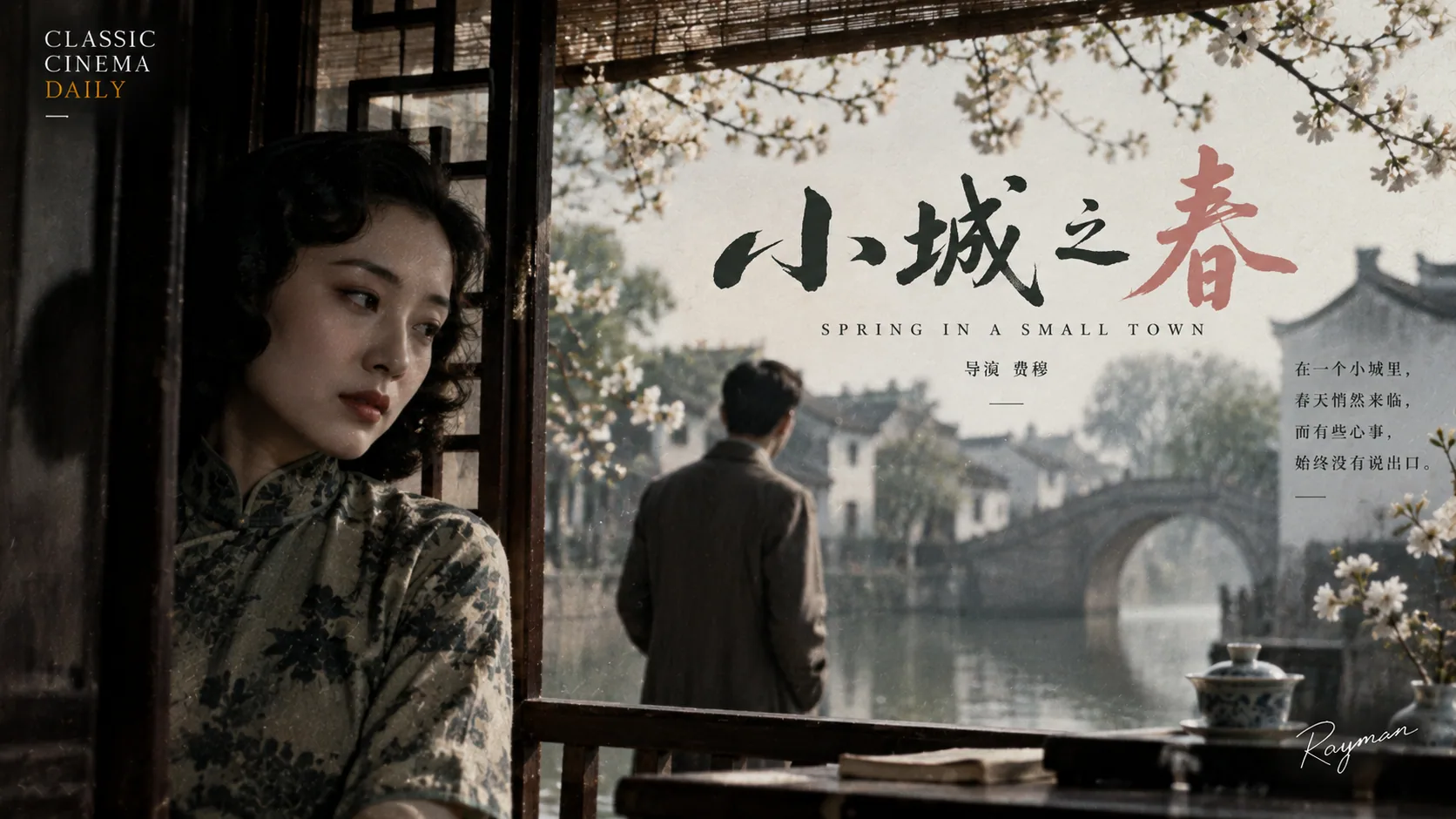
Spring in a Small Town
小城之春
1948
Fei Mu
China · Drama / Romance · 93 min
In a half-ruined family compound in a small Jiangnan town just after the war with Japan, five people live out one spring. Zhou Yuwen's marriage to her ailing husband Dai Liyan has gone silent — until his old friend Zhang Zhichen, who was Yuwen's lover before the war, arrives from Shanghai. Fei Mu's 1948 black-and-white masterpiece: five people, one crumbling courtyard, and a love that never crosses the line.
01Why this film today
Today is the 162nd anniversary of the birth of Louis Lumière (born 5 October 1864 in Besançon). With his brother Auguste he built the Cinématographe and, on 28 December 1895 in Paris, held the first public paying film screening in history. Their earliest films were Workers Leaving the Lumière Factory and Arrival of a Train at La Ciotat — capturing what could be seen was cinema's first and entire ambition.
Today's two films go in the opposite direction: their power comes from what is never shown.
Spring in a Small Town has the word "spring" in its title, and not one scene in it crosses a line. Zhou Yuwen's narration says a great deal — about the city wall she walks every day, about why she is still in this courtyard — but the camera never moves past the line between feeling and propriety. This 1948 Chinese film turns restraint itself into a cinematic language.
Alien has the monster in its title, and yet the film almost never gives it a complete, clear, steady frontal shot. It spends most of its time in shadow, in the gaps between cuts, in the audience's own imagination. Ridley Scott sold the script to studios as "Jaws in space" — and the thing that made Jaws frightening was precisely that Spielberg kept the shark out of the water.
The second reason is more concrete: these are the last two axes on the list that are entirely empty.
The archive holds eighteen films across eighteen countries or territories and ten decades. But there are two things it does not hold a single example of: mainland China, and horror. One is a hole on the regional axis, one on the genre axis. Today closes both.
The third reason is internal to the archive, and it happens to be neat.
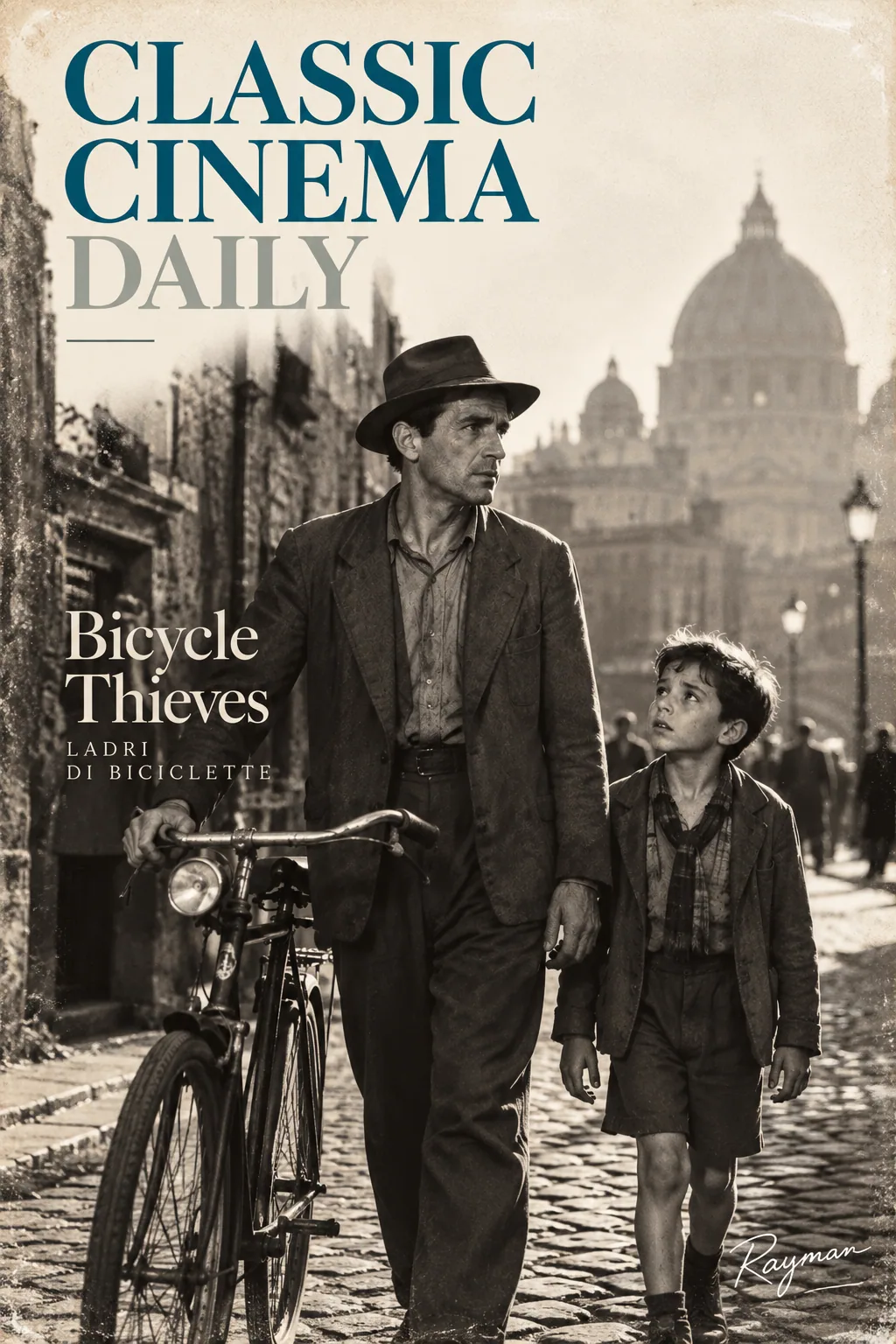
The 1948 slot already holds Bicycle Thieves. The same year, the same postwar world: in one film a man runs across Rome after a stolen bicycle; in the other a woman keeps to a half-ruined courtyard in a small town on the Yangtze delta and goes nowhere. Both films point their cameras at ruins — one in the street, one behind a wall.
And Alien connects to 2001: A Space Odyssey, in the 1968 slot. The two films share one very specific device: a crew member who is not human, whose true orders rank above the lives of the entire crew. In 2001, HAL 9000 must kill everyone to protect the mission; in Alien, the science officer Ash has orders to bring the organism back to Earth, and the crew's survival is not part of the instruction. Eleven years apart, the most human-looking thing on board is never human.
02Film details
- Chinese title
- 小城之春
- English title
- Spring in a Small Town
- Director
- Fei Mu / 费穆
- Year
- 1948
- Country
- China / 中国
- Language
- Mandarin
- Genre
- Drama / Romance / 剧情 / 爱情
- Runtime
- 93 min
03About the film
故事发生在中国江南的一座小城里,时间在抗日战争结束之后。
戴家曾经是这城里的殷实人家,如今只剩一座塌了一半的老宅、一个忠心的老仆老黄,和兄妹两个人。哥哥戴礼言久病,整天坐在院子里,对着祖上留下的废墟叹气;妻子周玉纹每天做的事,是提着菜篮走过城墙、走过田埂,买药,回家,然后再走一遍。妹妹戴秀十六岁,是这院子里唯一还活着的一股生气。
玉纹和礼言的婚姻早已无话可说,但两个人仍然各尽本分。日子就这样一天一天地过。
然后,礼言的一位童年好友从上海来了。他叫章志忱,是一位医生——他同时也是玉纹战前的恋人。
(这里不再往下说。)
04Why it is a classic
A film with five people in it
Spring in a Small Town is a black-and-white film produced by the Wenhua Film Company in 1948, running 93 minutes. It has exactly five named characters: Zhou Yuwen (Wei Wei), Dai Liyan (Shi Yu), Zhang Zhichen (Li Wei), the old servant Lao Huang (Cui Chaoming) and Dai Xiu (Zhang Hongmei).
The screenplay Li Tianji delivered was far longer. Fei Mu cut roughly two thirds of it and shot without a complete shooting script, finishing the film in three months. That explains why the film feels so empty: it is not a reduced plot but a deliberate selection of only what could be allowed to remain.
Sound: the most underrated element
In 1948 Chinese production sound was still optical, single-channel, with dialogue, music and effects mixed onto one track. That meant every sung performance had to be recorded in one pass on set — so Fei Mu had his actors sing live, rather than pre-recording and lip-syncing.
Two songs appear in the film: "In That Faraway Place" (sung by Zhang Hongmei and Shi Yu) and "A Lovely Rose" (Zhang Hongmei in the first half, Li Wei in the second). They are not score; they are things the characters do — the only action permitted to two people in a situation that cannot be spoken aloud.
The narration: a form almost unheard of in Chinese cinema
The film opens on Zhou Yuwen's first-person narration. She walks along the ruined city wall and says she takes the same route every day — buys medicine, comes home, and the days repeat as if they had not happened. That narration runs for nearly eighteen minutes, until she and Zhichen actually meet on screen.
In the history of Chinese cinema, sustaining a film on a first-person female narration was highly unusual. The critic Leung Ping-kwan read it not as a narrative device but as a "lyrical film form" whose characteristics belong to modern literature rather than to traditional storytelling; the narration cares not with what happened but with what happened inside her. Other critics have read the film directly as a feminist one — because her narration discusses her marriage "without guilt", and that absence of guilt was itself a departure from the norms of every other film of its moment.
How a courtyard becomes the shape of a mind
Fei Mu's framing follows a recurring logic: people are placed behind door frames, window frames and broken walls. What the viewer sees is a person inside an opening, not simply a person. The paths in the compound, the gaps in the city wall, the corridors between rooms form the film's real dramatic space — relationships advance not through dialogue but through who stands on which side, who enters, who stops.
This is why it looked strange in 1948 and looks modern now: it contains almost no "events", only changes of position.
Neglected, then rediscovered
The film opened in 1948 and was then long overlooked. One reason was that it appeared to have no politics: unlike the left-wing films of the 1930s it dealt only in private feeling, and it has no clear villain — unless time and circumstance count. That absence was criticised at the time as a retreat from reality. Fei Mu died in 1951.
The original print was later held by the China Film Archive. In the early 1980s the Archive struck a new print, and the film returned to audiences, gradually becoming recognised as one of the masterworks of Chinese cinema:
- In 2005, for the centenary of Chinese cinema, the Hong Kong Film Awards Association polled critics for its "100 Best Chinese Motion Pictures". Spring in a Small Town ranked first
- In 2011 the Taipei Golden Horse Film Festival Executive Committee included it among the 100 Greatest Chinese-language Films
- Rotten Tomatoes: 100% from 16 reviews, average 9.7/10
Its descendants
In 2002 Tian Zhuangzhuang remade it as Springtime in a Small Town, well received at Venice but criticised for removing Yuwen's narration — cutting the narration means cutting the film's point of view, which is itself a measure of how much that narration was doing. In 2015 the director Li Liuyi staged it as a play with the Beijing People's Art Theatre.
05What to notice
旁白持续将近 18 分钟。影片以周玉纹的第一人称旁白开场,这段独白一直延续到她与志忱在银幕上真正见面为止——也就是说,观众是先「听」了十几分钟她的内心,才第一次看到她与旧恋人同处一个空间。在中国电影史上,这样的第一人称女性旁白极为罕见。
全片只有五个角色。93 分钟,一座塌了一半的院子,五个有名有姓的人(周玉纹、戴礼言、章志忱、老黄、戴秀)。因为文华影业公司当时资金紧张,影片以很小的预算完成,极简因此不是风格选择,也是条件的结果。
两首歌是现场唱的。1948 年中国电影的同期录音仍是光学单声道,对白、音乐、音效混在一条音轨上,无法先录后对。费穆让演员现场演唱《在那遥远的地方》与《可爱的一朵玫瑰花》。在今天看来这是「真实感」,在当时这是技术限制下唯一可行的做法。
「发乎情,止乎礼」。这句话出自《毛诗序》,也是本片最常被引用的一句概括:感情可以发生,但不能越过礼的边界。全片没有一场越界的戏——它的全部张力都建立在「没有发生」之上。
构图:人总是被框住。费穆反复把人物放在门框、窗框、残墙的开口里,让「墙」成为画面中的第二个角色。院子、城墙缺口与走廊承担了本片大部分的叙事功能——关系的推进靠位置的移动,不靠台词。
结尾曾经有另一个版本。费穆与编剧李天济讨论过让志忱与玉纹一同投身革命、以当时左翼影片常见的方式收尾,最终没有采用。今天看到的结尾,是两个人各自回到原来的位置上。
它曾经「不正确」。影片上映后长期被忽视,原因之一是它只写私密情感、不写时代政治,在当时被批评为脱离现实。费穆 1951 年去世;直到 1980 年代初中国电影资料馆制作新拷贝,这部电影才重新被看见。
06Before you watch
它是什么。93 分钟,黑白,单声道,1948 年中国出品,普通话。文华影业公司制作,费穆导演,李天济编剧,李生伟摄影,黄贻钧音乐,韦纯葆与徐明剪辑。
版本。原始拷贝存于中国电影资料馆;1980 年代初由资料馆制作了新拷贝,此后有数字修复版流通。请优先选择修复版。
节奏:它很慢,而慢是有意的。这部影片几乎没有「事件」——没有追逐、没有冲突升级、没有反转。它推进的方式是位置的变化:谁走进院子,谁停在门口,谁在城墙上站得更远一点。如果你在等一个戏剧性的爆发,你会等不到;如果你接受它的语法,93 分钟会过得比你预期的快。
旁白是钥匙,不是装饰。全片的视点属于周玉纹。她的旁白不是解释剧情,而是给出一个只有她自己知道的版本。2002 年的翻拍版删掉了旁白,也因此丢掉了这部电影的立足点——看原版时请留意这一点。
人名。周玉纹(韦伟)、戴礼言(石羽)、章志忱(李纬)、老黄(崔超明)、戴秀(张鸿眉)。
强度。无暴力,无裸露。片中有一场自杀未遂的戏,处理得相当克制,但如果你对此类内容敏感,可以提前知道。除此之外这是一部非常安静的电影,适合在任何状态下观看。
一句话建议。如果你想理解「中国电影在 1948 年就能做到什么」,就是这一部;如果你只想看一部关于「什么都没发生」的电影,也是这一部。
07In one line
A film in which nothing happening is the entire drama — five people, a half-ruined courtyard, and a spring that never crosses the line.