12 min
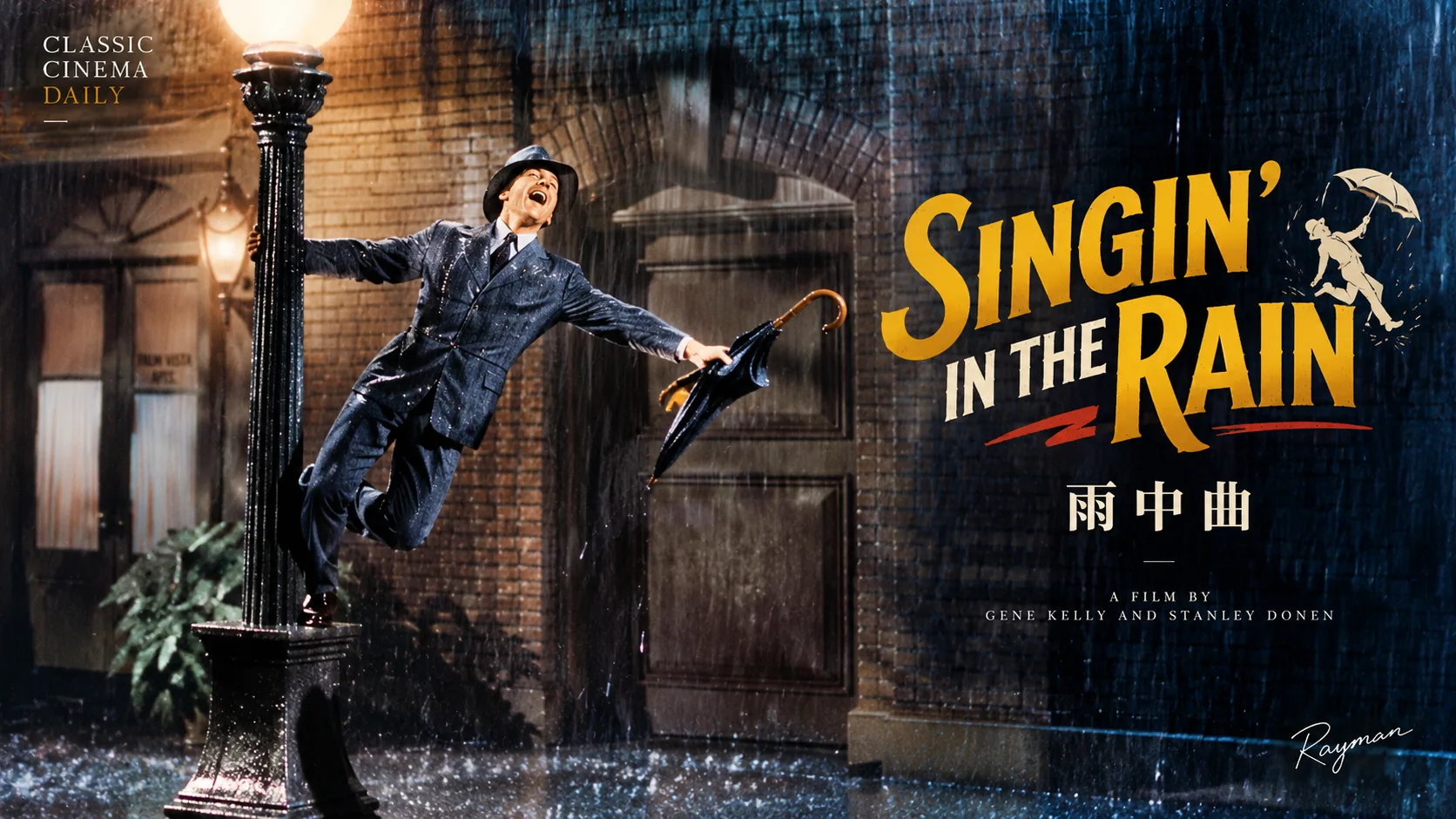
Singin' in the Rain
雨中曲
1952
Gene Kelly & Stanley Donen
United States · Musical / Comedy / Romance · 103 min
Hollywood, 1927. Don Lockwood and Lina Lamont are the studio's most bankable screen couple — on screen. Then sound arrives, and Lina's voice cannot survive it, so Kathy, out of the chorus, is pushed behind the curtain to speak for her. A musical comedy about how the movies learned to talk.
01Why this film today
Today's pair is held together not by plot but by time.
Singin' in the Rain is set in 1927 — the year silent cinema was dying and sound was being born. On 6 October 1927, two days from now, Warner Bros. premiered The Jazz Singer in New York, the film that effectively ended the silent era. Today's first film is what Hollywood, a quarter of a century later, had to say about that afternoon: a musical comedy that explains how an art form can become obsolete inside a single season.
Once Upon a Time in the West is about the same thing with the word "sound" replaced by "railroad". The West did not end in a gunfight; it ended when the railroad arrived, the land acquired a price, and somebody was willing to pay for a patch of dirt with water on it. And by 1968, when Leone made it, the Western itself had run its course — so the film is both a Western and an elegy for the Western, a film that buries its own genre.
So the two are not an arbitrary grab. Both are about a world being dismantled by a new technology: one with laughter, one with silence; one in 103 minutes, one in 165.
The second reason is more concrete. The archive holds sixteen films across sixteen countries or territories and nine decades — and it contains no musical and no Western at all. Those are the two largest genre holes on the list, and today closes both. To be clear, today's choice is genre-driven, not region-driven: both films are rooted in the United States (Once Upon a Time in the West is an Italian-American co-production), and regional coverage does not change today. I am not going to dress that up as something else.
The third reason is internal to the archive. The 1927 slot already holds Metropolis — German silent cinema at the technical and aesthetic limit of what it could do. Singin' in the Rain is about the year that world was switched off. The 1968 slot holds 2001: A Space Odyssey — also 1968, also a film whose entire scale is established by an opening passage with almost no dialogue. The ten-minute wait that opens Once Upon a Time in the West and the Dawn of Man sequence are the same grammar.
02Film details
- Chinese title
- 雨中曲
- English title
- Singin' in the Rain
- Director
- Gene Kelly & Stanley Donen / 吉恩·凯利 / 斯坦利·多南
- Year
- 1952
- Country
- United States / 美国
- Language
- English
- Genre
- Musical / Comedy / Romance / 歌舞 / 喜剧 / 爱情
- Runtime
- 103 min
03About the film
1927 年,好莱坞。Don Lockwood 和 Lina Lamont 是 Monumental Pictures 最卖座的一对银幕情侣——在银幕上。私下里,Don 受不了她。
Don 的底子是杂耍和歌舞,Cosmo Brown 是他从少年时代就在一起的搭档,现在给他写曲子、救场、出主意。一场首映礼之后,Don 被一个姑娘当众指出「你们那套表演早就过时了」——那是合唱队出身的 Kathy Selden。
然后,有声片来了。
片厂老板 R. F. Simpson 宣布:下一部要拍有声片。问题立刻变成了一个人的问题——Lina 的声音不能听。
于是有了一个办法:让 Kathy 站在幕后,替 Lina 说话。
(这里不再往下说。)
04Why it is a classic
A film set in motion by a song written in 1929
Arthur Freed was one of MGM's most powerful musical producers, and a lyricist himself. He and the composer Nacio Herb Brown had written a large catalogue of songs from the late 1920s onward, including "Singin' in the Rain", written in 1929 for The Hollywood Revue of 1929.
Freed's idea was to build a film around that catalogue. And because most of those songs were written during the silent-to-sound transition, the story was set back in that period. The songs came first; a period was then found for them. The only wholly new song in the film is "Moses Supposes", with lyrics by Betty Comden and Adolph Green and music by the musical director Roger Edens.
That origin defines what the film is: not an original screenplay about Hollywood, but Hollywood looking back at its own songbook — and the object of that backward glance happens to be the year sound arrived.
Two directors, two kinds of body
Both the direction and the choreography are credited to Gene Kelly and Stanley Donen. Kelly was a dancer, and his passages are athletic and weighted (the "Broadway Melody" ballet); Donen was younger, a choreographer who had moved to the director's chair, with an instinct closer to that of a comedy director.
The division shows most clearly in "Make 'Em Laugh": a solo number for Donald O'Connor with no leading lady, no romance — just a body fighting gravity, a wall and a floor.
Two corrections about the rain
The title number is one of the most mythologised passages in cinema.
First, there was no milk in the water. The story is widespread and it is false: the raindrops were made visible by backlighting, which was simply very difficult to shoot.
Second, it is not one take. The equally widespread claim that Kelly performed the whole number in a single unbroken shot is also a myth — the sequence took two to three days to film.
What is true: Kelly was running a fever of 103°F (39°C) while shooting it, and the water shrank his woollen suit during the take.
Three performances holding up one film
Donald O'Connor was smoking four packs a day. After one of the film's most demanding dance numbers he was bedridden in hospital for several days.
Debbie Reynolds was not a dancer but a gymnast when she played Kathy. Kelly humiliated her over her lack of dance training, and she was miserable about it — until Fred Astaire found her crying under a piano on the set, learned why, and showed her one of his own rehearsals to demonstrate that even professional dancers go through the same grind. The "Good Morning" number was shot from eight in the morning until eleven at night, and her feet were bleeding when it wrapped. Years later she said: "Singin' in the Rain and childbirth were the two hardest things I've ever had to do."
Jean Hagen's Lina Lamont is modelled on Judy Holliday's Billie Dawn in Born Yesterday — a voice both stupid and shrill.
A film about who speaks for whom
It looks like a romantic comedy. Underneath it is a film about the ownership of a voice.
Kathy speaks for Lina; Lina then swallows Kathy's work, her voice and eventually her person, and converts them into her own asset. The studio organises the trade; the audience is complicit in it.
And there is a third layer inside the production itself: Kathy's own singing is dubbed by Betty Noyes — Debbie Reynolds' vocals were recorded by someone else. Better still, in the scene where Kathy dubs Lina, the voice used is Jean Hagen's own speaking voice, not Reynolds': Donen felt Reynolds' Midwestern accent did not suit the scene.
A film about dubbing, with three layers of dubbing inside it.
"Make 'Em Laugh" and Cole Porter
The newly written "Make 'Em Laugh" is strikingly similar to Cole Porter's "Be a Clown" (from The Pirate, 1948 — also produced by Freed). Donen's own verdict was "100% plagiarism". Porter never sued.
A classic nobody expected
The film premiered at Radio City Music Hall on 27 March 1952 and went into general release on 11 April. MGM treated it as a routine musical project and it was only a moderate success; nobody expected it to become anything.
What canonised it came later. Comden and Green recalled meeting François Truffaut in Paris, who told them he had seen the film so many times that he knew it frame by frame; he and Alain Resnais would return to a small Paris cinema to watch it repeatedly, sometimes for months on end.
Where it stands now
- In 1989 it was one of the first 25 films selected for the Library of Congress National Film Registry
- American Film Institute: No. 10 on the 1998 "100 Years...100 Movies"; No. 5 on the 2007 tenth-anniversary edition; No. 1 on "Greatest Movie Musicals" (2006); the title song No. 3 on "100 Years...100 Songs" (2004)
- Sight & Sound critics' polls: No. 3 in 1982, No. 10 in 2002, No. 10 in 2022
- Rotten Tomatoes: 100% from 64 reviews, average 9.3/10. Metacritic: 99/100 from 17 critics
Two Oscar nominations, neither won
At the 25th Academy Awards (1953) the film received two nominations — Jean Hagen for Best Supporting Actress and Lennie Hayton for Best Scoring of a Musical Picture. Neither won.
The awards came elsewhere: Donald O'Connor won the Golden Globe for Best Actor in a Musical or Comedy, and Comden and Green won the Writers Guild of America award for Best Written American Musical.
05What to notice
雨水里没有牛奶,也不是一镜到底。这是电影史上被误传最多的段落之一。雨滴在画面上显形靠的是逆光,不是往水里掺牛奶;「Kelly 用一个长镜头一气呵成」同样是流言,实际拍了两到三天。真实的部分是:他当时发着 39°C 的高烧,淋水让他的羊毛西装在拍摄中缩了水。
主题歌不是为本片写的。主题曲写于 1929 年,原为《The Hollywood Revue of 1929》所作。整部电影是围绕 Arthur Freed 与 Nacio Herb Brown 的旧歌库搭起来的——因为这些歌大多写于默片转向有声片的年代,故事才被放回那个时代。全片唯一一首全新创作的歌是《Moses Supposes》(Comden 与 Green 作词、Roger Edens 作曲)。
《Make 'Em Laugh》与 Cole Porter 的《Be a Clown》高度相似。后者出自 1948 年的《The Pirate》,同为 Freed 制作的米高梅音乐片。Donen 称这是「100% 抄袭」,但 Porter 从未提起诉讼。
Debbie Reynolds 不是舞者,是体操运动员。Fred Astaire 在片场发现她躲在一架钢琴下面哭,问清缘由后把自己的一次排练给她看,用来说明专业舞者也要经历同样的苦练。《Good Morning》从早上八点拍到晚上十一点,收工时她的脚在流血。她后来的一句话是:「《Singin' in the Rain》和生孩子,是我一生中最难做的两件事。」
Donald O'Connor 的身体代价。他当时每天抽四包烟;片中一段极高强度的舞蹈拍完之后,他不得不住院卧床数日。
配音有三层。Kathy 替 Lina 说话;而 Kathy 自己的歌由 Betty Noyes 配唱(Reynolds 的演唱由别人代唱)。最妙的是 Kathy 替 Lina 配音的那场戏——用的其实是 Jean Hagen 本人的正常嗓音,不是 Reynolds 的:Donen 认为 Reynolds 的中西部口音不适合那个场景。一部关于代唱的电影,配音链条本身就有三层。
Lina 的说话方式有原型。Jean Hagen 演 Lina Lamont,是在模仿 Judy Holliday 在《Born Yesterday》里的 Billie Dawn——一个又蠢又亮、声音刺耳的嗓音。她因此拿到奥斯卡最佳女配角提名。
06Before you watch
它是什么。103 分钟,Technicolor 彩色,1952 年美国出品,英语。米高梅制作,Arthur Freed 制片,Gene Kelly 与 Stanley Donen 执导并编舞,Betty Comden 与 Adolph Green 编剧,Harold Rosson 摄影,Adrienne Fazan 剪辑,Lennie Hayton 音乐指导。片中歌曲除《Moses Supposes》外,均为 Arthur Freed 作词、Nacio Herb Brown 作曲。
版本。原始底片毁于火灾,现在流通的版本来自数字修复;2012 年出过 4K 修复的蓝光,2022 年出过 UHD 蓝光。优先选修复版。
不要期待的东西。它不是一部剧情复杂的电影,也不需要是。中段有一整段独立的《Broadway Melody》芭蕾(Cyd Charisse 出场),和主线几乎无关——那是当年米高梅音乐片的惯例:在大制作里插一段与情节无关的歌舞奇观。别把它当结构缺陷。
人名。Don Lockwood(Gene Kelly)、Cosmo Brown(Donald O'Connor)、Kathy Selden(Debbie Reynolds)、Lina Lamont(Jean Hagen)、片厂老板 R. F. Simpson(Millard Mitchell)、导演 Roscoe Dexter(Douglas Fowley)、Lina 的朋友 Zelda Zanders(Rita Moreno)。
强度。完全没有暴力与性内容,也没有任何需要提前说明的段落。适合全家一起看,是这份片单里少数几部可以给小孩看而不需要任何前置解释的电影。
一句话建议。如果你这辈子只看一部好莱坞歌舞片,就是这一部;如果你想理解「电影是如何学会说话、以及在这个过程中谁被牺牲掉了」,也是这一部。
07In one line
How a medium learned to speak — and how many people had to stand behind the curtain for it to happen.