9 min
Modern Times
摩登时代
1936
Charlie Chaplin
United States · Comedy / Social satire / Drama · 87 min
America, deep in the Depression. A factory worker is pushed to a breakdown by the assembly line, and afterwards meets a young woman who survives by stealing bananas on the waterfront. It is Chaplin's last film as the Tramp — and the first in which the character speaks, in a language nobody understands.
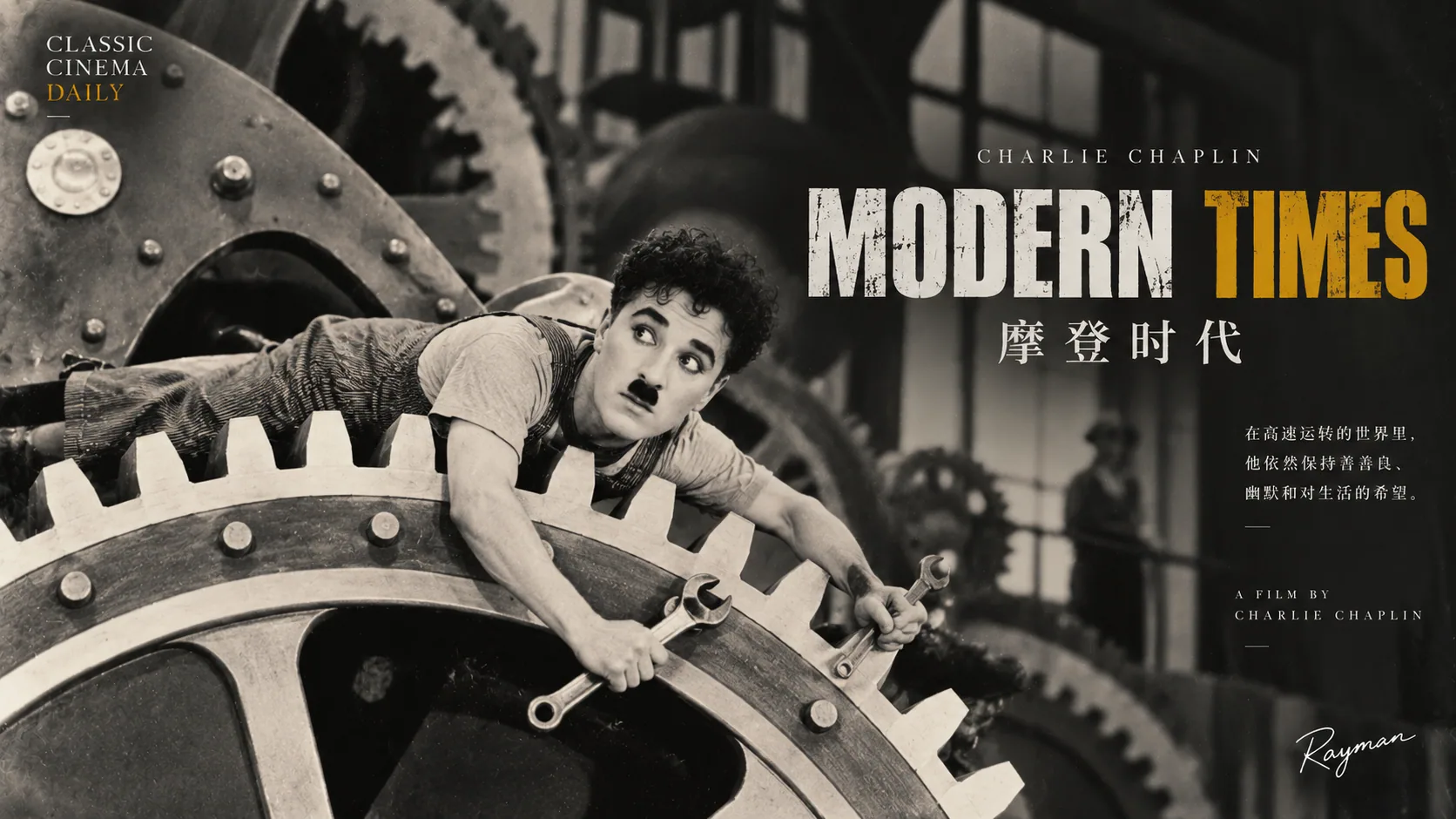
01Why this film today
Today is 2 October, Gandhi's birthday.
On 22 September 1931, at 45 Beckton Road in Canning Town, east London, two of the most famous men alive met in an ordinary house. One was Gandhi, newly arrived in London for the Round Table Conference. The other was Chaplin, on a European tour to promote City Lights.
They talked about machinery. Chaplin did not understand why Gandhi opposed modern technology in general, but he accepted the harder half of the argument: machinery made with only profit in mind puts people out of work and ruins lives.
Several accounts list that conversation among the seeds of Modern Times, alongside the misery Chaplin saw across Depression-era Europe. Four years later he made the film: a man driven mad by the assembly line, swallowed by the machine and spat out again. So today's pick is not arbitrary.
The second reason is structural. The archive now holds twelve films, from Metropolis (1927) to Parasite (2019), spanning nine decades — and the 1930s are the one decade still missing. Modern Times is the least arguable landmark of that decade; with it in place, the timeline closes.
Third, it stands exactly on the sound barrier. Metropolis, already here, is silent. Modern Times is the work of a man who, in the first years after cinema learned to talk, deliberately chose not to. It was shot in 1934–35, seven years after The Jazz Singer, when Hollywood had long since gone over to sound — and Chaplin still insisted on intertitles, letting only machines, footsteps and music make noise.
The last point is a coincidence, but a clean one: yesterday's film was Pather Panchali, from India. Today's film was seeded by India too — by Gandhi.
02Film details
- Chinese title
- 摩登时代
- English title
- Modern Times
- Director
- Charlie Chaplin / 查理·卓别林
- Year
- 1936
- Country
- United States / 美国
- Language
- English (intertitles)
- Genre
- Comedy / Social satire / Drama / 喜剧 / 社会讽刺 / 剧情
- Runtime
- 87 min
03About the film
美国,大萧条最深的几年。
一个男人在工厂的流水线上拧螺丝。传送带的速度由别人决定,他只需要跟上。他跟不上。
接下来是一连串的错位:一次精神崩溃,一次被当成闹事者的逮捕,几份做不长的工作——船厂的、百货公司的、餐馆的。他在这些地方反复遇到同一个姑娘。她叫 Ellen,父亲失业后死了,两个妹妹被福利机构带走,她在码头边偷香蕉给她们吃。
两个人凑到一起,因为除此之外没有别的办法。
影片讲的就是这段日子:想活下去,想有个家,想要一点点体面,而每一次努力都被外面的世界碾过去。全片没有一句完整的对白,只有一首歌——而那不是任何一种语言。
(这里不再往下说。)
04Why it is a classic
One man, the whole film
Chaplin directed, wrote, produced and scored Modern Times, and edited it too (with Willard Nico). He was born in London in 1889 and spent his childhood in the worst poverty of Victorian London — his father drank himself to death, his mother was committed to an asylum, and he and his brother spent time in a workhouse. He became one of the richest and most famous performers alive, and spent his career filming the poor.
That is at its most direct here. Nobody in the film speaks for the powerful; the protagonist has exactly one identity from beginning to end — a man who wants a job.
Why he would not let the Tramp speak
The Jazz Singer brought sound to cinema in 1927. When Chaplin began preparing this film in 1934 he intended it as a talkie: he wrote a dialogue script and enclosed the studio's open-air stage to experiment with recorded sound. He then scrapped the results.
His conclusion was a long-standing conviction: once the Tramp spoke English, the character's universality would be gone. He had huge audiences in non-English-speaking territories, and the Tramp was legible to all of them precisely because he used no language at all.
So he reverted to a silent format with synchronised sound effects, music and sparse dialogue, still using English intertitles. In 1936 that was a decision taken against the entire industry, and it drew criticism. The result: this is the last time he played the Tramp, and the only time the Tramp makes a sound — gibberish.
The two machines
The two most famous sequences are both about machinery. One is the assembly line, running faster and faster until the worker loses control and is swallowed by the gears. The other is the automatic feeding machine, pitched to the factory by an inventor named Billows, which promises to feed workers without stopping the line and then goes wrong.
The second is pure slapstick, but its target is specific: any technology whose purpose is to eliminate downtime. Ninety years on, the joke needs no explaining.
Camera and speed
Rollie Totheroh, Chaplin's regular cameraman since the 1910s, shot it with Ira Morgan. Most of the film was shot at silent speed, 18 frames per second, and projected at sound speed, 24 — which made the slapstick look even more frenetic than it was performed. Today's circulating prints correct the discrepancy, so what you see is the rhythm Chaplin intended.
The famous blindfolded skating sequence used a matte painting: the audience sees the Tramp spinning near a precipice, while Chaplin skated on flat ground. At one moment his rear skate briefly disappears behind the painting; he left it in.
The score, and a melody that became a standard
Chaplin composed the score himself, with Alfred Newman assisting, and David Raksin and Edward B. Powell handling arrangement and synchronisation — Raksin went on to score Laura and The Day After. By his account Chaplin would hum tunes, often in the washroom, and tell Raksin to write them down.
The romance theme was later given lyrics and became the pop standard "Smile", first recorded by Nat King Cole. The 2019 film Joker used Jimmy Durante's cover in its trailer, and its protagonist watches scenes from Modern Times.
The trouble it caused, and where it ended up
After release, Germany's Tobis Film sued Chaplin, arguing the assembly-line sequence plagiarised René Clair's À nous la liberté (1931). The suit failed; Tobis sued again after the Second World War — widely read as retaliation for The Great Dictator — and settled out of court. Clair himself was an outspoken admirer of Chaplin, was embarrassed by the suit, and was never part of it.
Its influence runs long: Disney's Der Fuehrer's Face (Donald Duck alternately assembling shells and saluting Hitler's portrait) and the "Job Switching" episode of I Love Lucy (Lucy and Ethel stuffing chocolates into their mouths and hats) both come directly from the assembly-line sequence. Sartre, Beauvoir and Merleau-Ponty named their journal Les Temps Modernes after the film.
When the Library of Congress created the National Film Registry in 1989, Modern Times was among the first 25 films chosen. The AFI ranked it 81st on its 1998 100 Years...100 Movies list and 78th in the 2007 revision; the BBC's 2017 poll of 253 critics placed it 12th among the greatest comedies ever made. Rotten Tomatoes records 98%.
05What to notice
两台机器,一个对象。流水线把人逼疯,「自动喂食机」则在午饭时间继续往工人嘴里塞玉米——后者是纯粹的笑料,但它讽刺的目标很具体:任何以取消停机时间为目的的技术。
18 帧拍,24 帧放。影片大部分按默片速度 18 帧/秒拍摄,放映却按有声片的 24 帧/秒,打闹动作因此看起来比拍摄时更疯狂。今天的通行版本纠正了这个速度差。
他第一次出声,说的是谁也听不懂的话。片中那首歌是 Léo Daniderff 的《Je cherche après Titine》,卓别林用混合了法语和意大利语腔调的胡言乱语唱完。这是流浪汉在银幕上唯一的「台词」,也是这个角色最后一次出现在电影里。
悬崖是画上去的。蒙眼溜冰段落用蒙版绘景做出深渊:卓别林其实在平地上滑,绘景只是贴上去的。有一瞬间他的后轮从绘景后面露了出来,他没删这个穿帮。
主题旋律变成了《Smile》。卓别林写的浪漫主题后来被填词成为流行标准曲,Nat King Cole 最早录制。2019 年《Joker》的预告片用了 Jimmy Durante 的翻唱版,片中主角也看了《Modern Times》的片段。
一场没赢的官司。德国 Tobis Film 起诉卓别林抄袭 René Clair 的《À nous la liberté》,败诉;二战后再次起诉并庭外和解。而 Clair 本人是卓别林的崇拜者,从未参与诉讼。
06Before you watch
它是什么。87 分钟,黑白,1936 年美国出品,卓别林自编自导自演自制片自配乐。影片并非纯默片,而是「部分有声片」:默片格式加同步音效、音乐、少量对白,信息主要靠英文字幕卡交代。
不要期待的东西。全片没有一句完整的对白。如果你不习惯读字幕卡,前五分钟会觉得别扭——那是设计,不是修复出问题。另外它不是一部靠情节推进的片子,结构更像一串彼此咬合的段子,每个段子都在讲同一件事。
人名。主角没有名字,片尾字幕里就叫「一个工厂工人」(A Factory Worker)——也就是流浪汉。女主角叫 Ellen,字幕里写作「the Gamin」(流浪女孩),由 Paulette Goddard 扮演,她当时是卓别林的伴侣。
版本。看 2010 年代之后由 Criterion 与 mk2 联合修复的版本,画面稳定、速度正确。老版录像带常见的加速感来自 18/24 帧速度差没有被纠正。
强度。没有暴力画面,没有血腥。但有两处会让今天的观众不太舒服:监狱段落里流浪汉误吸了走私的可卡因(在 1934 年开始执行的《海斯法典》下相当大胆),以及结尾处精神崩溃的表演。除此之外它是一部温和、好笑的电影。
一句话建议。如果你只想看一部卓别林,这部最合适:它最短、最好笑,也最直接地说明他到底在关心什么。
07In one line
He spent a whole film proving that a machine can do anything for a man except live his life for him.