9 min
Metropolis
大都会
1927
Fritz Lang
Germany · Science Fiction / Drama / German Expressionism · 153 min
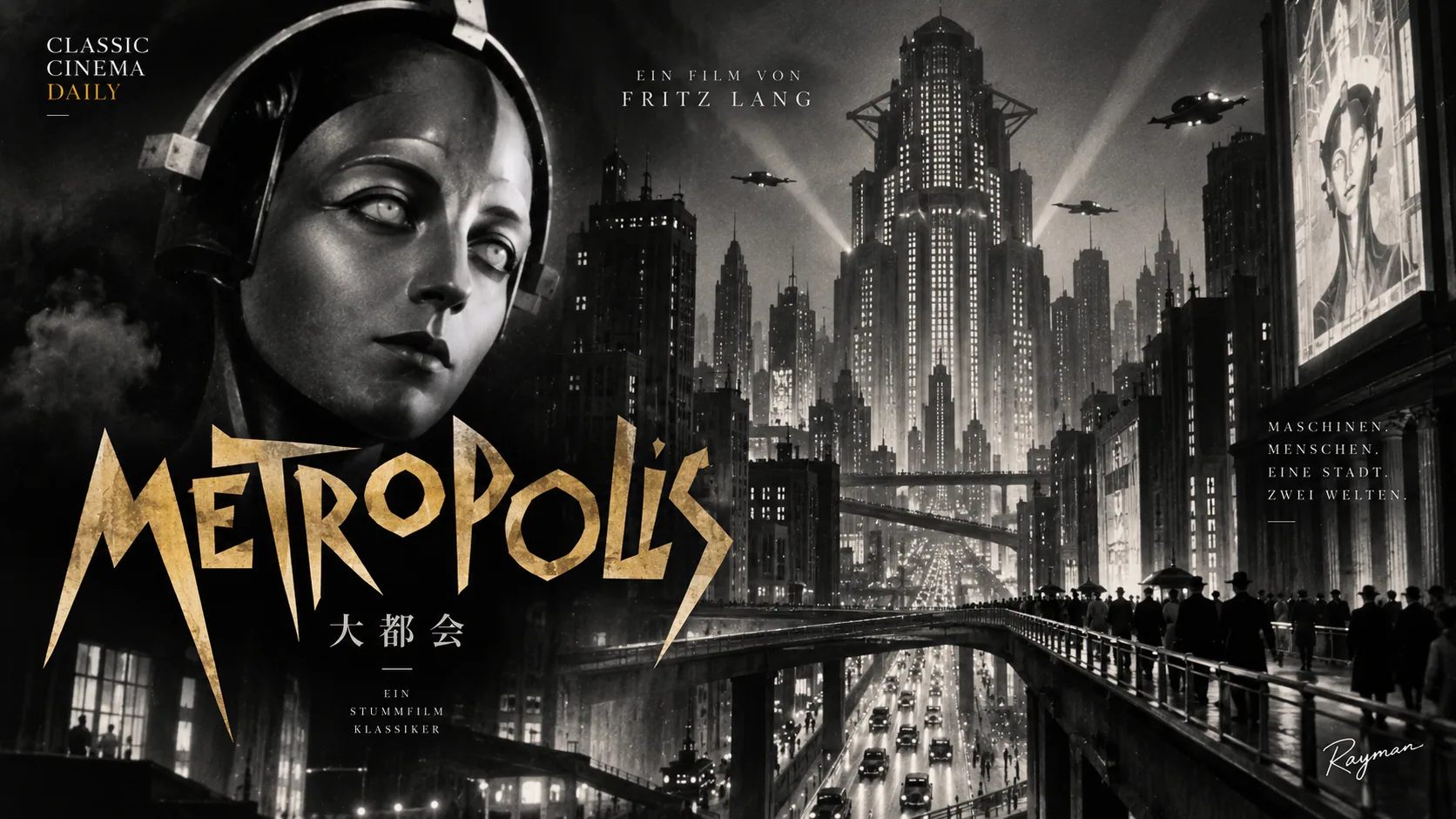
A city sliced in two: gardens and towers above, machines and workers below. When the ruler's son follows a woman named Maria down into the depths, his father still holds another card — an inventor who can build a human being. Out of plaster, mirrors and one robot, Fritz Lang wrote the first draft of a century of urban science fiction.
01Why this film today
The eight films already in this archive run from 1948 to 2019 — not one predates the end of the Second World War. Today fills in the earliest gap: Germany, 1927, silent, German Expressionism. The archive's first German film and its first silent film.
It pairs surprisingly well with today's other pick, Close-Up. Sixty-three years apart — one the most expensive industrial production of Weimar Germany, the other a low-budget 16mm hybrid by an Iranian director — both ask the same question: what happens when a manufactured image starts acting on its own? In Metropolis, an inventor's machine-double replaces the real Maria and a city catches fire. In Close-Up, a broke film buff borrows a director's name and ends up genuinely inside a film. One turns the runaway copy into allegory; the other lets it happen inside a documentary.
There is a technical reason too. The Metropolis you can watch today is a version only reassembled in 2010. A 16mm print found in Buenos Aires in 2008 brought back roughly 25 minutes that had not been seen since 1927. Before 2010, nobody had really seen this film.
02Film details
- Chinese title
- 大都会
- English title
- Metropolis
- Director
- Fritz Lang / 弗里茨·朗
- Year
- 1927
- Country
- Germany / 德国
- Language
- Silent (German intertitles)
- Genre
- Science Fiction / Drama / German Expressionism / 科幻 / 剧情 / 德国表现主义
- Runtime
- 153 min
03About the film
大都会是一座被垂直分开的城市。地面上是花园、体育场和摩天楼,是统治者与他们的孩子生活的地方;地面下是机器大厅,工人穿着同样的制服,按班次操作庞大的机器,住在地下宿舍里。
城市的统治者是 Joh Fredersen。他的儿子 Freder 从小生活在上层,直到有一天他在花园里遇见一个带着一群工人孩子的年轻女子——Maria。她告诉那些孩子,地上的人和地下的人是兄弟。Freder 跟着她往下走,第一次看见机器大厅,看见一台机器在一次事故中吞掉了一个人。他回到地上,去质问父亲。
Fredersen 的反应不是悔改,而是派人去查 Maria 是谁。他找到的是发明家 Rotwang——一个住在古怪老房子里、装着一只假手的科学家。Rotwang 手里有一项技术:他能造出一个与人无异的机械人。
这是影片前半段能说的部分。后半段会发生什么,本文不写。
04Why it is a classic
Director and origins
Fritz Lang, born in Vienna in 1890, began directing around 1919. Metropolis was produced by UFA (Universum Film A.G.) at the Babelsberg studio outside Berlin, with Erich Pommer producing. The screenplay was written by Thea von Harbou with Lang — von Harbou was then his wife, and her 1925 novel of the same name was written almost in parallel with the script, conceived from the outset as a film treatment.
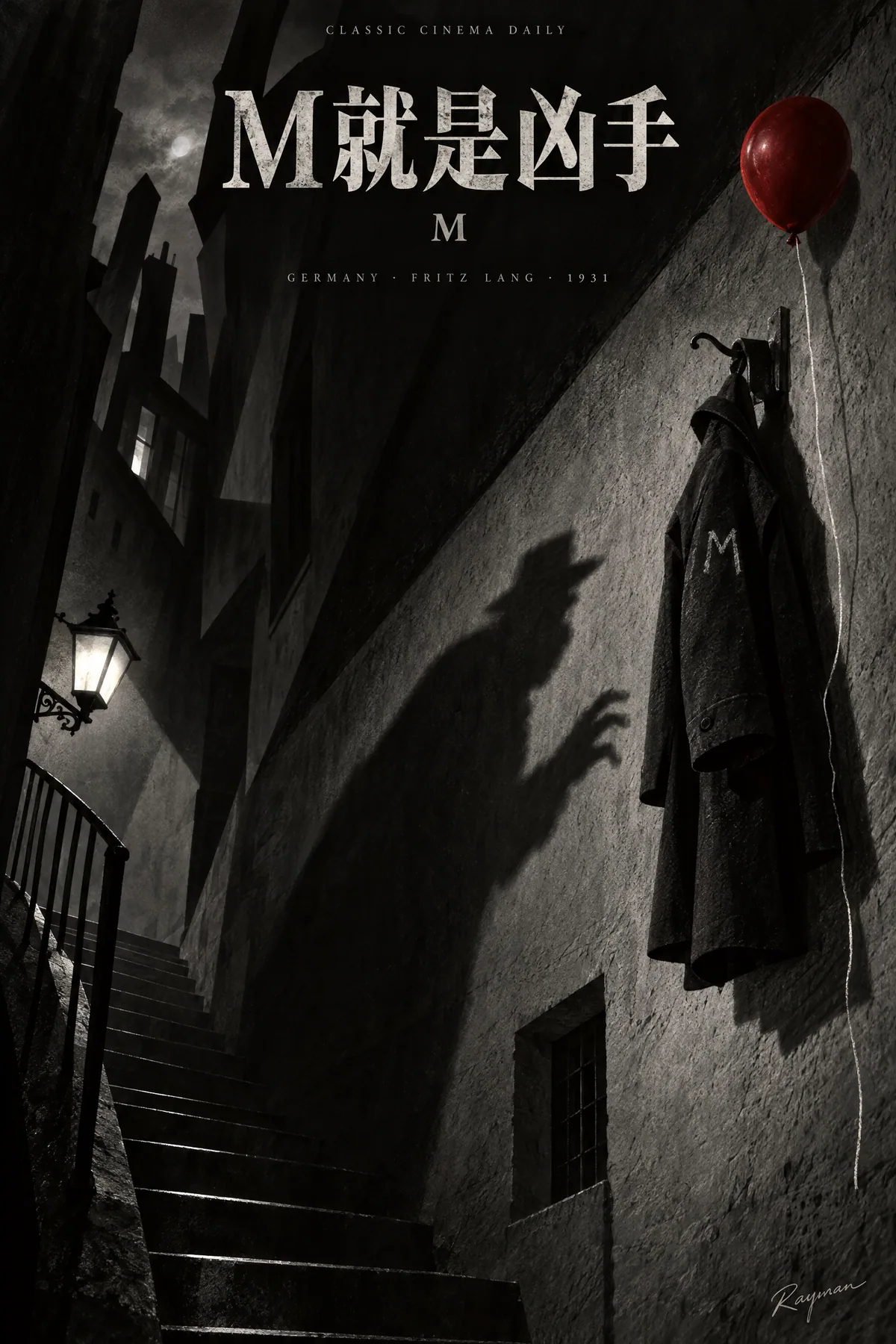
Lang on the film's origin: 'the film was born from my first sight of the skyscrapers in New York in October 1924.' He went on to make M (1931), then left for the United States and continued directing in Hollywood.
A city built to order
Production design was by Otto Hunte, Erich Kettelhut and Karl Vollbrecht, entirely constructed inside the studio. The film's spatial logic has exactly one axis: vertical. Above ground sit the Eternal Gardens, the stadium and the towers; below sit the machine halls and the workers' dormitories. Elevators and shafts are the only connections. When Maria tells the workers' children the story of the Tower of Babel — a tower that collapsed because it was built too high — the sequence doubles as the film's architectural diagram.
The city's Art Deco design is widely credited with helping to popularise the style in Europe and America.
Craft: one mirror and one robot
Special-effects specialist Eugen Schüfftan developed the Schüfftan process for the film: a mirror combined the live actors with miniature sets on a single negative, so performers appeared to stand inside enormous architecture. Two years later Hitchcock used it in Blackmail (1929).
The Maschinenmensch was designed by the sculptor Walter Schulze-Mittendorff, who first took a full plaster cast of Brigitte Helm's body and then built the shell around it. The problem was material — it had to read as metal yet allow limited movement. His solution was a material called plastic wood. Helm plays both Maria and the machine in the film. Cinematography was by Karl Freund and Günther Rittau; Freund later went to Hollywood and shot Dracula (1931).
Music
Gottfried Huppertz wrote a complete orchestral score for the film — one of the earliest full-length original scores of the silent era. The 2010 restoration was screened with the Berlin Radio Symphony Orchestra performing Huppertz's score, conducted by Frank Strobel.
Eighty years of cuts
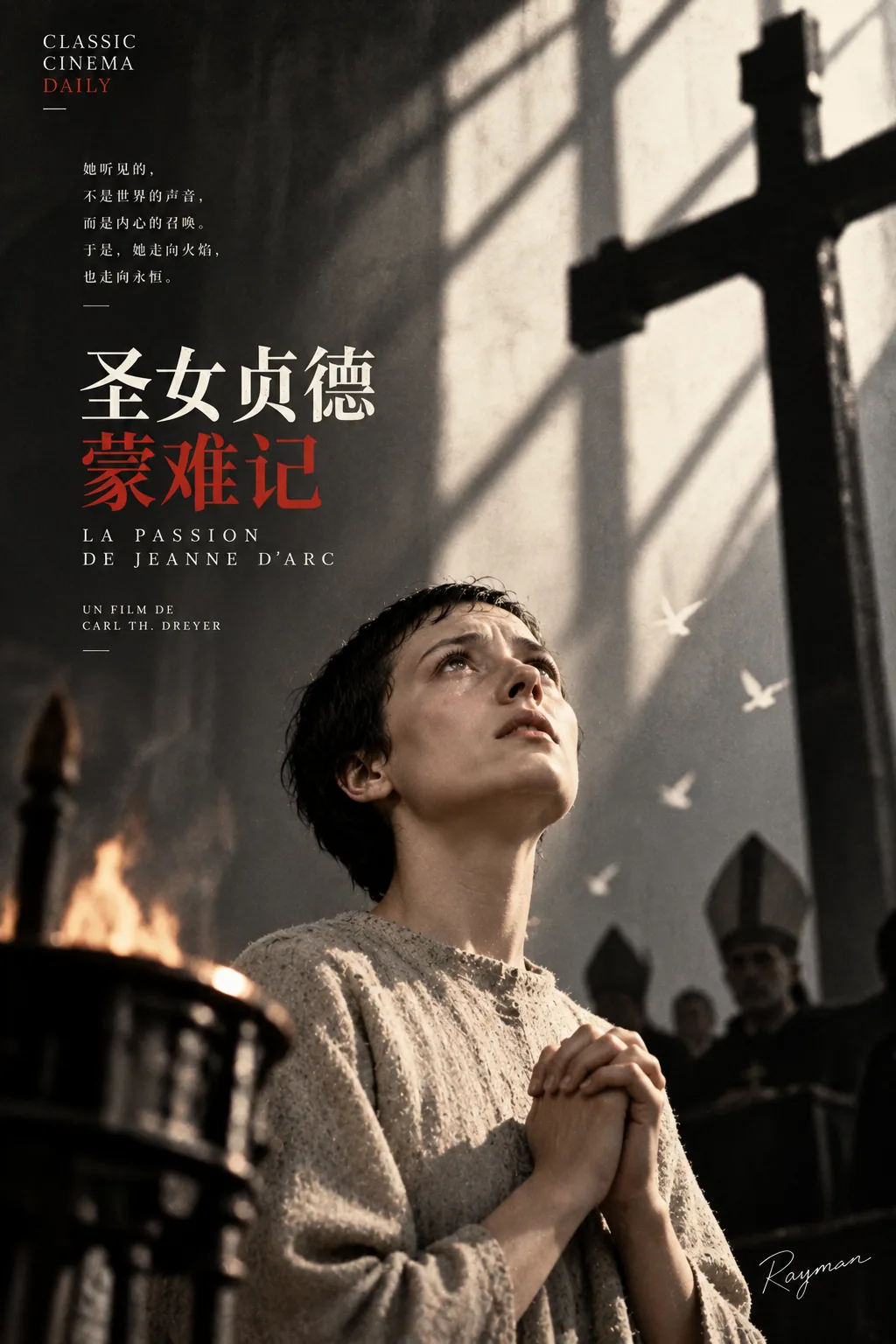
Metropolis premiered at the UFA-Palast am Zoo in Berlin on 10 January 1927; the German release ran 153 minutes (4,189 metres of film). It was cut repeatedly thereafter: a 91-minute version appeared in 1936, the American release ran about 116 minutes, and in 1984 Giorgio Moroder issued a colourised version with a pop soundtrack.
The turn came in the 2000s. In 2005 the researcher Michael Organ found a print at the National Film Archive of New Zealand containing eleven previously missing scenes. On 1 July 2008, Berlin announced that a 16mm reduction negative of the original had been found at the Museo del Cine in Buenos Aires, traced by the Argentine film historian Fernando Martín Peña and the museum's director Paula Felix-Didier. It restored roughly 25 minutes unseen since 1927 — close to a fifth of the film.
The restoration was supervised by the Friedrich-Wilhelm-Murnau-Stiftung with the Deutsche Kinemathek and the Museo del Cine; the team included Anke Wilkening, Martin Koerber and Frank Strobel. It premiered on 12 February 2010 at the Friedrichstadtpalast as the gala screening of the 60th Berlinale, with a simultaneous outdoor projection at the Brandenburg Gate broadcast live by Arte. The North American premiere followed on 25 April 2010 at Mann's Chinese Theatre, Los Angeles, at the TCM Classic Film Festival. Two passages were too damaged to restore — the monk's sermon and the fight between Rotwang and Fredersen — and are represented by explanatory title cards.
In 2001 the film was inscribed on UNESCO's Memory of the World register, the first film so distinguished. On 1 January 2023 it entered the public domain in the United States.
Standing
Sight & Sound's 2022 critics' poll placed it 67th (35th in 2012). Rotten Tomatoes records 97% from 126 reviews, averaging 9.1/10; Metacritic 98/100. Roger Ebert: 'Metropolis is one of the great achievements of the silent era, a work so audacious in its vision and so angry in its message that it is, if anything, more powerful today than when it was made.' Martin Scorsese included it among his '39 Essential Foreign Films for a Young Filmmaker'.
05What to notice
最后一条字幕就是全片的论点。影片结束于一句话:The Mediator Between the Head and the Hands Must Be the Heart(头与手之间的调解者,必须是心)。这是整部片子被引用最多的一行字,也是 1927 年德国电影对阶级问题给出的一份答案。
那具机器人不是道具,是一件雕塑作品。Walter Schulze-Mittendorff 先给 Brigitte Helm 做了石膏全身模,再在模外构建外壳。它后来成了银幕机器人的原型之一——此后无数机器人的造型,都能在这里找到更早的版本。
Schüfftan process:用镜子骗过摄影机。演员站在微缩模型前,摄影机透过一面刮去部分镀层的镜子,把两者的影像合在同一张底片上。这是实拍,不是后期合成。两年后希区柯克把它用进了《Blackmail》(1929)。
巴别塔是全片的结构说明书。Maria 向工人们的孩子讲述巴别塔的故事:塔造得太高,工人们彼此听不懂对方的话,塔就倒了。Metropolis 就是那座塔,而影片里的分裂不是语言,是楼层。
两段永远补不回来的影像。2010 年修复版是今天能看到的最完整版本,但其中两段——修士的布道、Rotwang 与 Fredersen 的打斗——胶片损坏到无法恢复,只能用两张说明性字幕卡替代。所以「最完整的《Metropolis》」里,仍然留着两个洞。
片尾的地下洪水是纯实拍。地下城市被水淹没、孩子们被困的那一段,没有任何数字手段可用,全部靠布景、机械装置和摄影完成,是当时技术上最难处理的段落之一。
06Before you watch
版本。看 2010 年的修复版,通常叫 The Complete Metropolis(148 分钟),这是目前最完整的版本。1927 年德国首映版是 153 分钟,两者差异主要来自放映速度和那两段损坏的影像。避开 1984 年的 Giorgio Moroder 版本——那一版染了色、换了流行配乐,是另一件东西。
默片。全片没有对白,靠德语字幕卡和 Huppertz 的配乐推进。现在的流通版本基本都配了完整配乐。字幕卡的文本量不小,建议找字幕质量可靠的版本。
表演风格。这是 1920 年代的表现主义表演:动作幅度大、表情明确、身体先于台词。前二十分钟需要一点适应期,之后会开始觉得这套语言很有效。
人名。中文译名不统一,建议记英文:Joh Fredersen(城市统治者)、Freder(他的儿子)、Maria、Rotwang(发明家)、Josaphat(Fredersen 的助手)、Grot(心脏机器的看守)。
不要先查剧情。中段有一次真正的转折——关于那个「Maria」究竟是谁。提前知道会损失相当一部分观看体验。
片长与强度。148 分钟,黑白(部分段落有染色),默片。片中有一场机器事故和一个相当阴暗的结局,但没有血腥画面。
07In one line
Built from plaster, mirrors and one robot in 1927, it wrote the first draft of every city science-fiction film that followed.