9 min
Close-Up
特写
1990
Abbas Kiarostami
Iran · Docufiction / Drama / Documentary · 98 min
Tehran, 1989. A broke film buff named Hossain Sabzian tells a woman on a bus that he is the director Mohsen Makhmalbaf. Two weeks later he is arrested for impersonation. Abbas Kiarostami obtained permission to film the trial, then had everyone involved — the family, the journalist, even the judge — replay themselves on camera. No narration. No category.
01Why this film today
The archive already holds France 1960, Japan 1954, Italy 1948, Sweden 1957, Germany 1927, Britain and America 1968, America 1972, Hong Kong 2000 and South Korea 2019. The 1990s are empty. So is Iran.
Today fills that slot, and the reason is more specific than a gap. Yesterday was 29 September. On that date in 2006, Hossain Sabzian died in Tehran — twenty years ago exactly. That August he had suffered respiratory failure on the Tehran metro, slipped into a coma and never woke. For the last years of his life he sold DVDs at a bus terminal in south Tehran.
Sabzian was a man who briefly became the subject of a film and was then forgotten by cinema. Close-Up gave him a genuine close-up — one of the rare cases in film history where a work actually changed the life of the person it filmed, even if the change did not last.
It pairs unexpectedly with today's other pick, Metropolis: a 1927 German industrial epic against a 1990 Iranian 16mm hybrid; one about a copy replacing a real person, one about a real person borrowing someone else's name. Sixty-three years apart, both ask what happens when an image starts acting on its own.
02Film details
- Chinese title
- 特写
- English title
- Close-Up
- Director
- Abbas Kiarostami / 阿巴斯·基亚罗斯塔米
- Year
- 1990
- Country
- Iran / 伊朗
- Language
- Persian
- Genre
- Docufiction / Drama / Documentary / 纪录剧情混合 / 剧情 / 纪录
- Runtime
- 98 min
03About the film
德黑兰,1989 年前后。一个叫 Hossain Sabzian 的男人在公交车上遇到一位女士,她手里拿着一本与 Makhmalbaf 的作品《The Cyclist》有关的书。Sabzian 告诉她:我就是 Mohsen Makhmalbaf——那部片子的导演。女士说她的儿子们很喜欢电影。
接下来的两个星期里,Sabzian 以导演的身份几次去他们家,说要用他们的房子拍一部新片,让两个儿子演角色。他还向其中一个儿子借了 1,900 tomans 当车费。
后来事情败露了。Ahankhah 家的父亲开始怀疑,尤其是当他看到杂志上一张 Makhmalbaf 更年轻、头发更黑的照片时。他请来记者 Hossain Farazmand 到家里确认,记者证实这个人不是 Makhmalbaf。警察上门把 Sabzian 带走,记者拍下照片,准备发一篇题为「假 Makhmalbaf 被捕」的报道。
Abbas Kiarostami 读到了这篇报道。他做了一件当时不太有人做的事:去监狱见了 Sabzian,帮他提前了开庭日期,并从法官那里拿到了拍摄庭审的许可。
影片由三种材料拼成:法庭上真实发生的审判;Kiarostami 让当事人重演此前发生的事;以及 Sabzian 本人面对镜头说话。所有角色都由本人扮演——包括法官、记者、司机和士兵。
04Why it is a classic
Director and origins
Abbas Kiarostami was born in Tehran in 1940 and died in 2016. His career began at Kanoon, the Institute for the Intellectual Development of Children and Young Adults — first commercials, then short films for children, starting with The Bread and Alley (1970). Where Is the Friend's Home? (1987) brought his first international attention.
In 1989 he read the journalist Hassan Farazmand's report on the Sabzian case in the Iranian magazine Sorush and immediately suspended a feature then in pre-production to pursue it. The production company was Kanoon, the producer Ali Reza Zarrin, the cinematographer Ali Reza Zarrindast, and the editing was done by Kiarostami himself. The film runs 98 minutes, in Persian.
A film that belongs to no existing category
Close-Up is assembled from three kinds of material: the trial, filmed as it actually happened; reconstructions in which Kiarostami had the participants replay earlier events; and Sabzian speaking directly to camera. Everyone on screen plays themselves — Sabzian, the Ahankhah family, the journalist Hossain Farazmand, the judge, the driver, the soldiers.
The crucial point is that the film gives the viewer no signal as to which is which. There is no narration, no explanatory caption, no interviewer visible on screen. Kiarostami asked Sabzian to re-enact himself in front of a camera, which erases the line between acting and being: a man arrested for impersonating a director is asked by a real director to perform that impersonation once more.
The critic Jonathan Rosenbaum: 'No other film does more to interrogate certain aspects of the documentary form itself.'
The ending
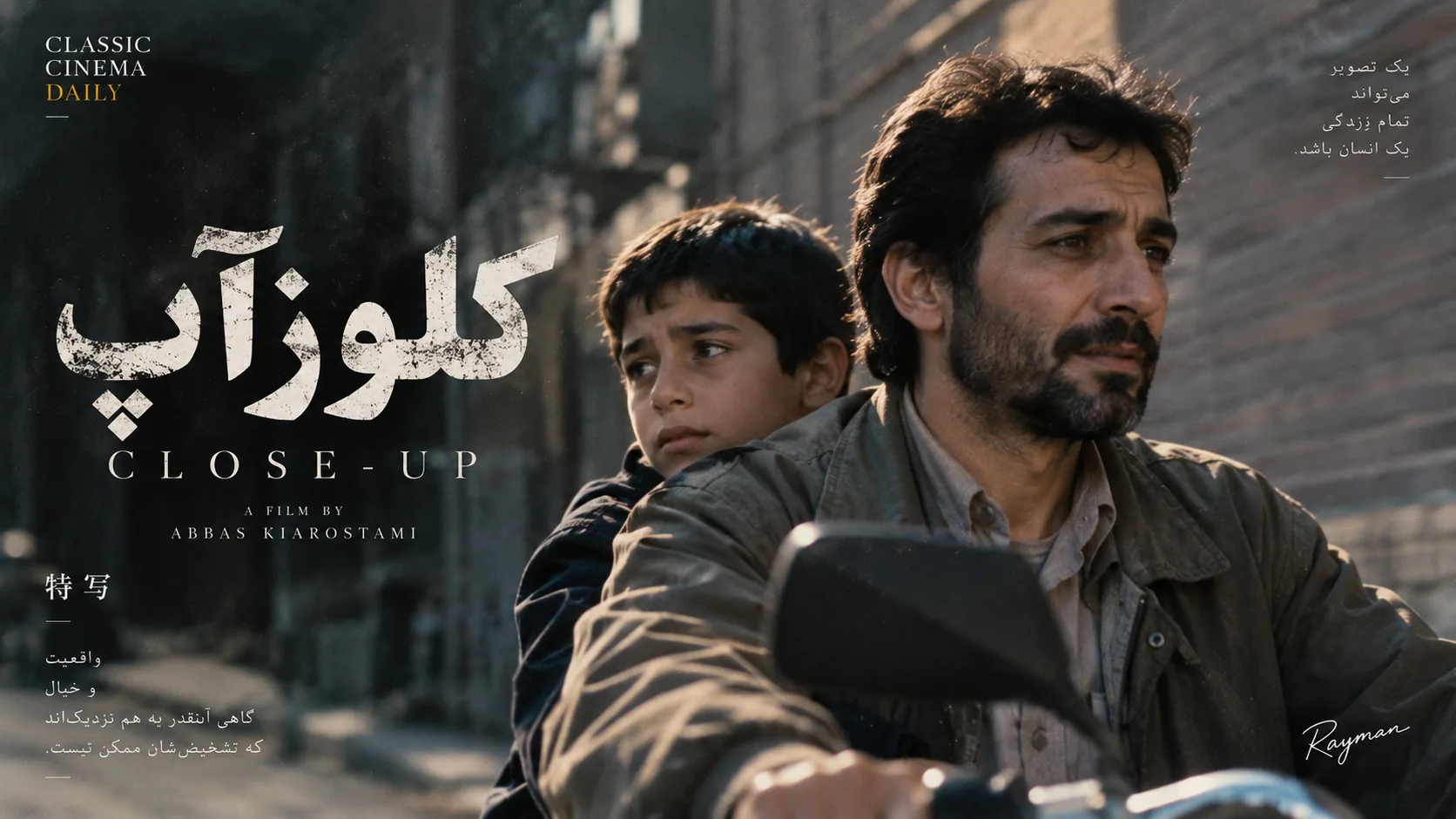
In the final sequence Sabzian rides pillion on a motorcycle holding a boom microphone, the crew's car following. The sound in this passage is incomplete — the recording equipment failed and the conversation survives only in fragments. It is the most discussed few minutes in the film, and Kiarostami's last ambiguity: a man is finally inside a film, and the film cannot quite hear him.
After the trial, the real Mohsen Makhmalbaf appears and drives Sabzian to the Ahankhah house, stopping on the way to buy flowers. Meeting Mr. Ahankhah, he says: 'I hope he'll be good now and make us proud of him.' Sabzian smiles.
The man
Hossain Sabzian was born in 1954, had no prior record, and was a father in financial difficulty. At his trial he said repeatedly that he had posed as Makhmalbaf out of love for the man's films, in which he felt his own suffering reflected. To a friend who happened upon him at a bus station he said: 'I dreamt of being a general, but ended up a foot soldier.'
He later sold DVDs at a bus terminal in south Tehran and died in Tehran on 29 September 2006. The Iranian director Azadeh Akhlaghi made a documentary about him, The Film School of Hossein Sabzian, which premiered at the Busan Film Festival and was screened alongside Close-Up two weeks after his death.
Standing
The 2012 Sight & Sound critics' poll placed it among 'The Top 50 Greatest Films of All Time'. In 2022 it ranked 17th with critics, and joint 9th in the directors' poll — tied with Persona and In the Mood for Love, the latter already in this archive. Rotten Tomatoes records 89% from 19 reviews, averaging 8.5/10; Metacritic 92/100. Awards include the Quebec Critics' Award at the 1990 Montreal International Festival of New Cinema and Video, and the FIPRESCI Prize at the 1992 Istanbul International Film Festival.
Notably, on its Iranian release the film was received almost uniformly negatively at home. It was recognised abroad first, and only later rediscovered by its own country.
Kiarostami's later work includes the final two parts of the Koker trilogy, Life, and Nothing More... (1992) and Through the Olive Trees (1994); A Taste of Cherry, which won the Palme d'Or in 1997; The Wind Will Carry Us (1999); and Certified Copy (2010).
05What to notice
那篇报道的标题是「假 Makhmalbaf 被捕」(Bogus Makhmalbaf Arrested)。记者 Hossain Farazmand 是 Ahankhah 家请来确认身份的,他后来在片中饰演自己——包括那段他去家里当场拆穿 Sabzian 的重演。
1,900 tomans。Sabzian 向 Ahankhah 家的一个儿子借了 1,900 tomans 当车费。这笔小钱在庭审上被反复提起:它是整件事里唯一实际发生的金钱往来,也是它从「艺术讨论」滑向「欺诈指控」的支点。
起点是一本书,不是一句谎话。他在公交车上手里拿着一本 Makhmalbaf 作品《The Cyclist》的书,正是这本书让那位女士先开了口。整件事的起点是一次被认出来的阅读,而不是一次预谋。
全片没有配乐。没有一段非叙事性的音乐,没有情绪引导。这是它比多数纪录片更冷的原因,也是观众必须自己决定「该不该同情这个人」的原因。
那束花。Makhmalbaf 载 Sabzian 去 Ahankhah 家的路上停下车买了一束花。这个动作没有解释、没有评论,它出现在影片最接近和解的位置上。
一次技术故障成了最后一句话。结尾摩托车段落的收音出了问题,声音断断续续。这个意外没有被修掉,它成了影片的收尾方式。
06Before you watch
它是什么。98 分钟,波斯语(片中有少量阿塞拜疆语对白),1990 年伊朗出品,16mm 与 35mm 混合拍摄。它不是纪录片,也不是剧情片,通常被称为 docufiction。
不要期待的东西。没有旁白,没有出现在画面上的采访者,没有解释性字幕告诉你哪一段是实拍、哪一段是重演。这是刻意的。看的时候需要自己在三种材料之间做判断。
要先知道的一件事。镜头里所有人都是本人,没有职业演员。庭审是真实发生的,Kiarostami 拿到法官许可才拍。
人名。Hossain Sabzian(冒充者)、Mohsen Makhmalbaf(被冒充的导演)、Ahankhah 一家(被骗的家庭)、Hossain Farazmand(记者)。中文资料里 Hossain 有时写作 Hossein。
结尾。最后几分钟的声音是残缺的,那不是你的播放器坏了。
强度。没有暴力画面,没有血腥。全片的分量来自一个普通人在法庭上谈论自己为什么爱电影——这是电影史上最著名的「自白」段落之一。
07In one line
A film about a man who pretended to be a director, in which everyone involved ended up genuinely acting.