10 min
Alien
异形
1979
Ridley Scott
United Kingdom / United States · Science Fiction / Horror / Thriller · 116 min
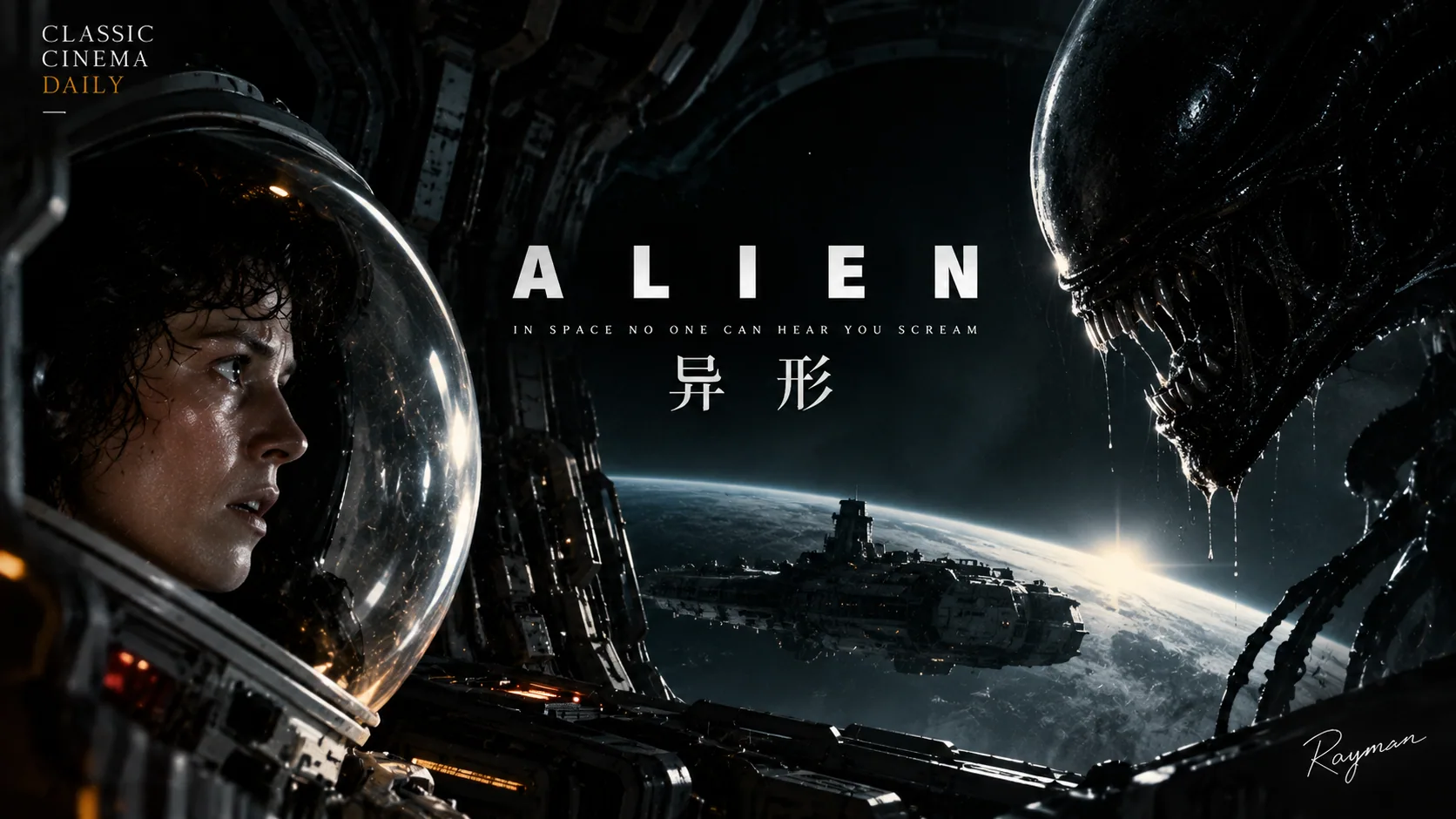
The commercial tug Nostromo is woken mid-route by a signal from an unnamed source. Seven crew members set down on a planetoid, find a crashed alien ship — and carry something back aboard that should have stayed where it was. Ridley Scott's 1979 science-fiction horror film, whose script said only that the crew was unisex, ended up rewriting the next forty years of the screen.
01Why this film today
Alien shares one very specific device with today's first film: a crew member who is not human, whose true orders rank above the lives of the entire crew.
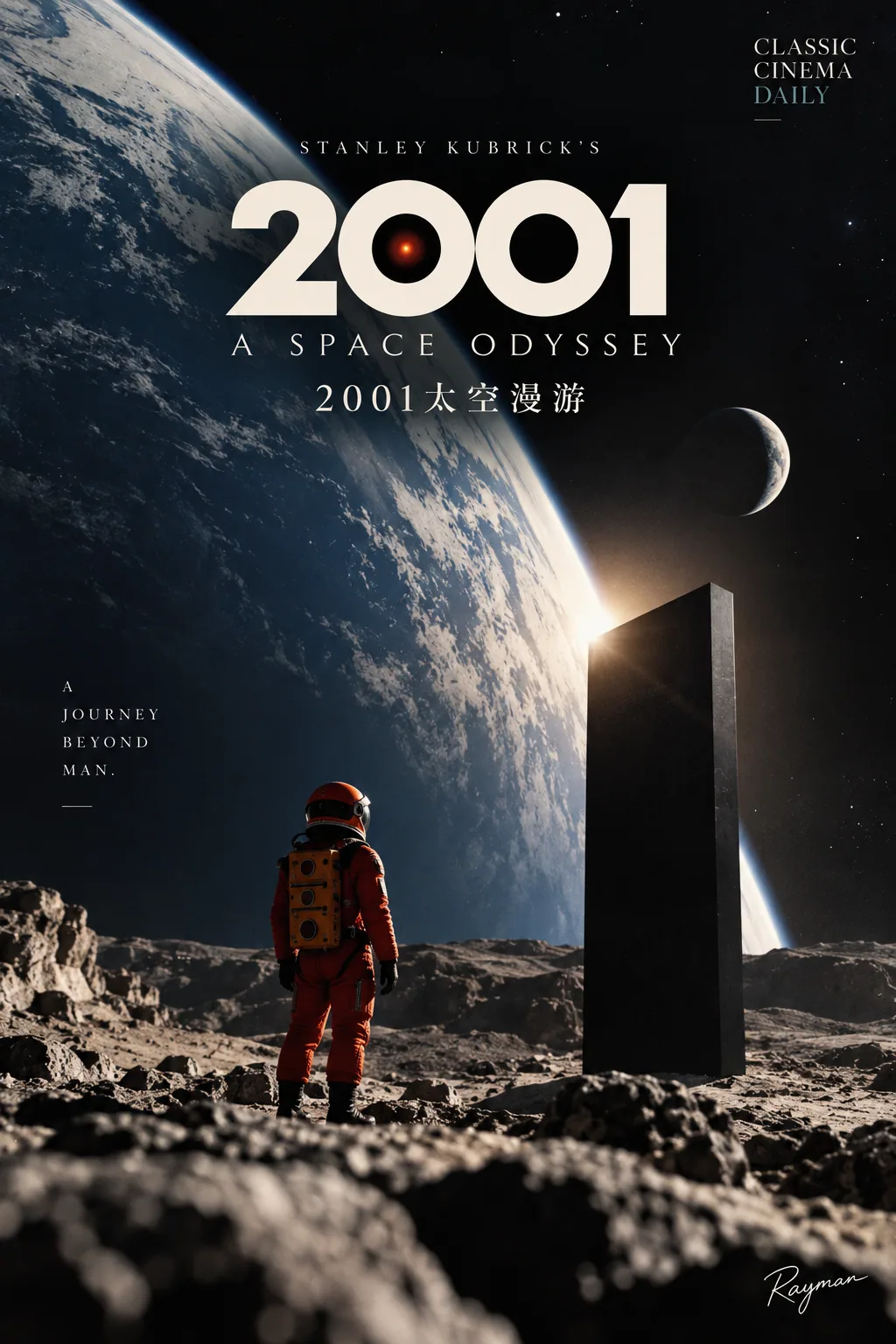
It connects to 2001: A Space Odyssey, in the archive's 1968 slot. HAL 9000 must kill the whole crew to protect the mission; Alien's science officer Ash has orders to bring the organism back to Earth, and the instruction is explicit that the crew's survival is not a consideration. Eleven years apart, the most human-looking thing on board is never human in either film.
The second reason is genre. The archive holds eighteen films and not one horror film — the last entirely empty genre. Alien is the right film to close it with: it is both horror and science fiction, it was added to the Library of Congress National Film Registry in 2002, and it is generally credited with turning "science-fiction horror" into a recognised category.
The third reason is the thing most easily overlooked in the film: its protagonist is a woman, and the script never said so.
Dan O'Bannon and Ronald Shusett wrote every character as gender-neutral and stated it outright in the script: "The crew is unisex and all parts are interchangeable for men or women." Ridley Scott initially imagined Ripley as a man; it was the producer Alan Ladd Jr. who asked why Ripley could not be a woman. The part went to Sigourney Weaver.
This draws a line to today's first film. In 1948, Spring in a Small Town sustained an entire film on a first-person female narration, which was highly unusual in Chinese cinema. In 1979, Alien let a character whose gender was never specified become one of the most famous survivors in film history. Thirty-one years apart, both films did the same thing in the same place: they handed the camera to a woman, rather than handing a woman to the camera.
02Film details
- Chinese title
- 异形
- English title
- Alien
- Director
- Ridley Scott / 雷德利·斯科特
- Year
- 1979
- Country
- United Kingdom / United States / 英国 / 美国
- Language
- English
- Genre
- Science Fiction / Horror / Thriller / 科幻 / 恐怖 / 惊悚
- Runtime
- 116 min
03About the film
商业拖船 Nostromo 正在返航。船上七个人,两千万吨矿石,一份按合同执行的运输任务。
然后,船上的电脑被一段信号唤醒。信号来自一颗没有名字的小行星,反复播送,不像是自然产生的。
按合同,遇到这种情况必须去查看。于是船长 Dallas 带着几个人降落到那颗星球上。他们在那里发现了一艘坠毁的巨大飞船——不是人类的。
船上确实有东西。他们带回了一件样本。
(这里不再往下说。)
04Why it is a classic
It dirtied space first
After Star Wars broke out in 1977, 20th Century-Fox became interested in science fiction and pulled the only spaceship script on the desk — Alien — into production. And what Alien did was the opposite of almost every space film of its moment: it did not shoot space as spectacle. It shot space as a workplace.
The ship is called Nostromo, after Joseph Conrad's 1904 novel; the escape shuttle is the Narcissus, after Conrad's 1897 novella. It is not a flagship but a commercial tug. And the crew are not explorers but workers employed by a company — Roger Ebert's review seized on exactly this: these are not adventurers but people hired by a company to haul twenty million tons of ore back to Earth.
That choice determines everything. When the creature appears there is no fleet to call, no hero to step forward — only seven tired people working to contract, and a set of company orders none of them has read in full.
Giger: a transplant in design history
The creature was designed by the Swiss artist H. R. Giger, working from his own painting Necronom IV. He was responsible not only for the organism but for the planetoid's surface, the crashed alien ship, and all four stages of the creature's life cycle. The human side of the design was handled by Ron Cobb and Chris Foss: Cobb drew the ship inside and out, invented an industrial symbol system (the Semiotic Standard), and coined the company name "Weylan-Yutani" — taken from the British Leyland car company and its Japanese neighbour, implying an Anglo-Japanese commercial alliance. The spacesuits were ultimately based on costume sketches by Moebius (Jean Giraud), realised by the costume designer John Mollo.
The adult creature's head was built separately by Carlo Rambaldi, with roughly 900 moving parts. The scene with the giant alien corpse (later known as the Space Jockey) was enormously expensive, and Fox did not want to pay for a set used once — so only one wall was built, and the corpse was seated on a rotating turntable.
The chestburster: one take, and the cast was not told
It is one of the most famous passages in cinema, and its most famous element is that the actors' reactions are real.
The shot used an artificial torso packed with blood and viscera, with John Hurt's head and arms protruding from beneath the table. The cast was told a creature would burst out, and had seen the puppet — but was not told that pressurised pumps would spray fake blood in every direction. The jet hit Veronica Cartwright directly; she fell and became hysterical. Tom Skerritt later said: "What you see on screen is real. She had no idea what was happening." The shot was done in a single take.
The design was inspired by Francis Bacon's 1944 triptych Three Studies for Figures at the Base of a Crucifixion; the writer Dan O'Bannon said the idea of the chestburster was connected to his own experience of Crohn's disease.
Restraint: it barely shows you the creature
This is the film's real achievement beyond its technique. For most of its running time the alien is not on screen — it is in the sound of the ventilation shafts, in the blip on the motion tracker, in the faces of the people describing it. When it finally appears it is mostly fragmented by strobe, steam and darkness.
Ridley Scott described his own film as "the Texas Chain Saw Massacre of science fiction", stressing horror rather than fantasy. He also did one more thing: the original script ended with the ship exploding and Ripley escaping in the shuttle. Scott conceived a "fourth act" — Ripley confronting the creature aboard the shuttle — and used it to negotiate extra budget and additional shooting days from Fox. The third act of every science-fiction horror film since starts at that negotiating table.
Modest on release, a landmark afterwards
Reviews on release in 1979 were mixed. It has since been repeatedly reassessed and is now regarded as one of the most influential science-fiction and horror films ever made:
- Best Visual Effects at the 52nd Academy Awards (1980)
- Three Saturn Awards: Best Science Fiction Film, Best Direction (Ridley Scott), Best Supporting Actress (Veronica Cartwright)
- The Hugo Award for Best Dramatic Presentation; the BAFTA for Best Film Music (Jerry Goldsmith)
- In 2002 the Library of Congress added it to the National Film Registry for its "cultural, historical or aesthetic significance"
- American Film Institute, 2008 "10 Top 10": No. 7 in science fiction
05What to notice
Ripley 的性别在剧本里从未被指定。Dan O'Bannon 与 Ronald Shusett 把所有角色都写成中性,并在剧本里注明:「The crew is unisex and all parts are interchangeable for men or women.」(船员不分性别,所有角色男女皆可互换。)雷德利·斯科特最初设想 Ripley 是男性,是制片人 Alan Ladd Jr. 问了那句「为什么 Ripley 不能是女性」。这个决定改写了此后四十年的银幕。
「破胸」那场戏只拍了一次,而且演员不知情。剧组告诉演员会有生物破胸而出,也让他们看过木偶,但没有告诉他们高压泵会把假血向四面八方喷射。血柱喷到 Veronica Cartwright 身上,她受惊摔倒、陷入歇斯底里——那是真实反应,不是表演。
两艘船的名字都来自康拉德。主船 Nostromo 取自约瑟夫·康拉德 1904 年的同名小说;逃生穿梭机 Narcissus 取自他 1897 年的中篇小说。一部科幻恐怖片的主角交通工具,用的是两本关于「人被自己的欲望吞掉」的文学名著的名字。
「Weylan-Yutani」这个公司名是造出来的。概念艺术家 Ron Cobb 把它从英国 Leyland 汽车公司与其日本邻居的名字拼在一起,暗示一个英日商业联盟。片中正片拼作 Weylan-Yutani,续集《异形 2》改成 Weyland-Yutani。
卵室的灯光是从 The Who 借来的。那颗星球上外星飞船卵室的灯光效果,用的是一台从英国摇滚乐队 The Who 借来的激光器——当时他们正在隔壁摄影棚测试舞台激光。
飞船桥段的所有电脑屏幕画面都是 CGI。这是最早在商业长片中使用计算机生成图像的例子之一——选择它的理由很朴素:比任何替代方案都更容易实现。
那只猫由四只猫轮流出演。片中 Ripley 的猫 Jones 用了四只外形相同的猫;Sigourney Weaver 对猫毛与化妆用甘油的混合物过敏,去掉甘油之后才得以继续拍摄。
「太空骑师」只搭了一面墙。那个巨型外星人尸体的场景耗资巨大,福克斯不愿为一个只用一次的场景花钱。剧组的办法是只搭建一面墙,让尸体坐在一个可旋转的圆盘上——观众看到的完整空间,是镜头运动制造出来的。
06Before you watch
它是什么。116 分钟,彩色,英语,1979 年英国与美国合拍。20 世纪福克斯发行,Brandywine Productions 制作,Gordon Carroll、David Giler 与 Walter Hill 制片,Ridley Scott 导演,Dan O'Bannon 编剧(故事由他与 Ronald Shusett 共同完成),Derek Vanlint 摄影,Terry Rawlings 与 Peter Weatherley 剪辑,Jerry Goldsmith 配乐。
版本。1979 年院线版 116 分钟。2003 年出过导演剪辑版,重新剪入了当年被删掉的段落——最著名的是 Ripley 逃生时遇到被异形部分「茧化」的 Dallas 与 Brett 的那场戏。两个版本片长接近,剧情走向一致,首次观看建议选院线版:它的节奏更紧,而那个被删的段落之所以被删,当年是有理由的。
强度:请认真对待这一条。本片分级为 R。片中有直接的身体恐怖(一次著名的破胸段落)、血腥画面和持续的压迫感。它比这份片单里此前的任何一部都更直接——不适合儿童,也不适合对「身体被侵入」这类画面敏感的人。如果你不确定,可以先了解那场破胸戏的内容再决定。
人名。Dallas(Tom Skerritt)、Ripley(Sigourney Weaver)、Lambert(Veronica Cartwright)、Brett(Harry Dean Stanton)、Kane(John Hurt)、Ash(Ian Holm)、Parker(Yaphet Kotto)。飞船电脑「Mother」由 Helen Horton 配音,异形本体由 Bolaji Badejo 扮演。
看什么。留意它什么时候不给你看那只怪物——这是这部电影最核心的技术。另外留意船员之间的对话:他们谈论的是分红、合同和加班,不是人类的命运。
一句话建议。如果你想看一部真正让「科幻恐怖」成立的电影,就是这一部;如果你只想知道「1979 年的人如何用一具木偶、一台借来的激光器和一次拍摄,做出今天 CGI 也做不出的恐惧」,也是这一部。
07In one line
Proof that the most effective horror technique is not showing the monster clearly but letting the audience finish it themselves — and then placing that inside a room with no exit.