12 min
Ashes and Diamonds
灰烬与钻石
1958
Andrzej Wajda
Poland · Drama / War / Thriller · 103 min
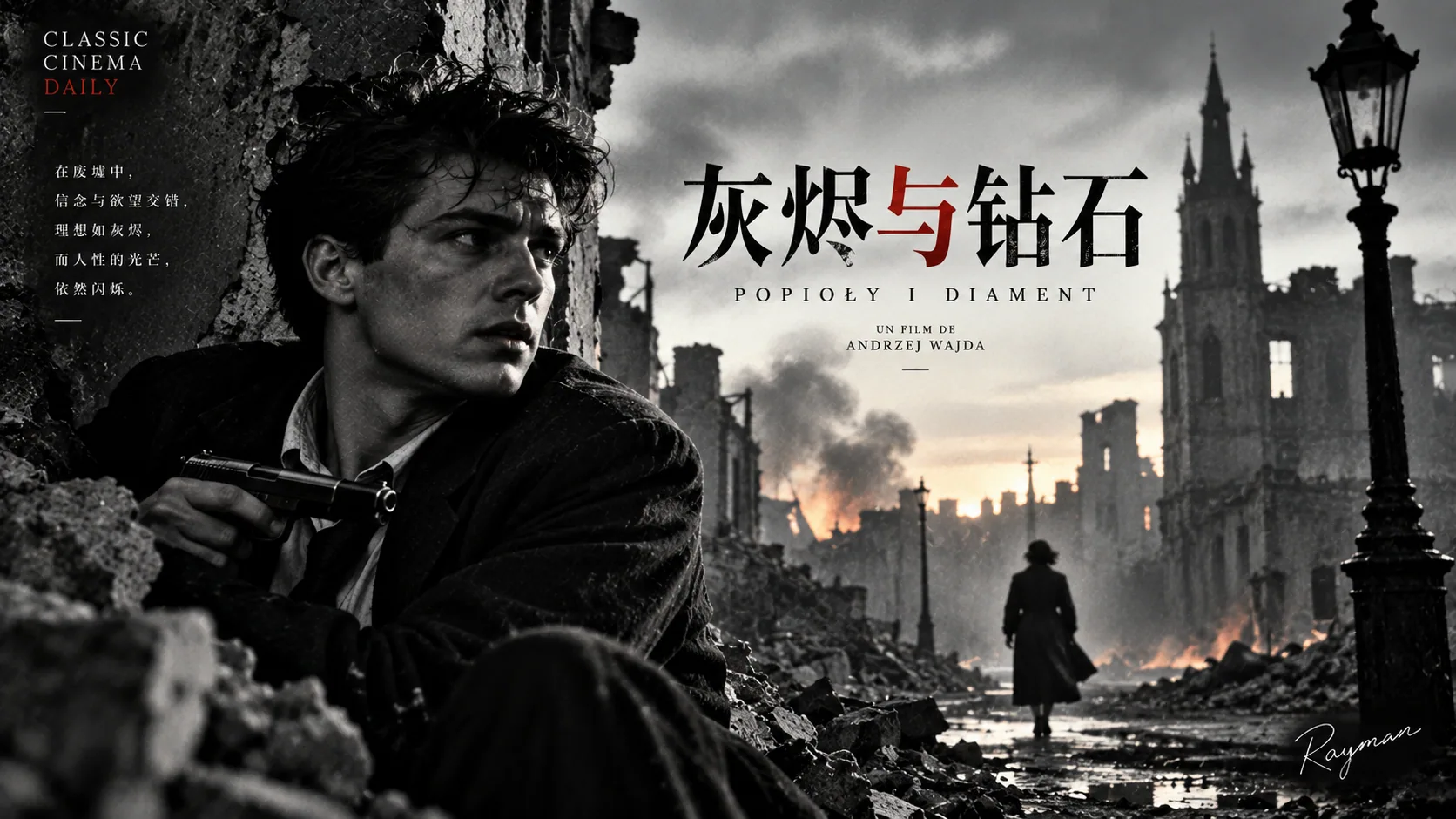
8 May 1945, the day the war in Europe ended. A former Home Army soldier is ordered to assassinate a local Communist Party secretary — and falls in love in a hotel ballroom in a small Polish town. The final film of Wajda's war trilogy, and the crowning achievement of the Polish Film School.
01Why this film today
Today, 7 October, is the 77th anniversary of the founding of the German Democratic Republic.
On this day in 1949 the GDR came into being — the moment the Soviet bloc's hold over Eastern Europe acquired its first formal state.
Ashes and Diamonds depicts the beginning of that process.
The film takes place on 8 May 1945, the day Germany surrendered and the war in Europe ended, in a small Polish town. On that single day two forces are fighting for the country: the Home Army, loyal to the Polish government-in-exile in London, and the Polish Workers' Party, which is taking power.
Maciek Chełmicki, a young Home Army soldier, is ordered to kill Szczuka, the new regime's local party secretary.
Four days ago, on 3 October, the film marked 68 years since its Polish premiere. It opened officially on 3 October 1958; around 1,722,000 Poles saw it in its first year.
Why recommend it today?
First, it is the archive's first film from Eastern Europe outside the Soviet Union. Of the previous 22 entries, Come and See (1985) is Soviet; Poland, Czechoslovakia and Hungary were a blank. Poland is filled in today.
Second, it completes a Cold War line with the other film running today. In Poland in 1945 the communists were taking power; in Indonesia in 1965 communists were being massacred. The two films are the northern and southern ends of the same Cold War — one shot while it was happening, one shot forty years later.
Third, two joints already exist on the site. Spring in a Small Town (1948) is also set just after the war, also in a house the war has rewritten, also about a love that arrives too late — only on the Yangtze rather than in Poland. And Breathless (1960): Cybulski's Maciek and Belmondo's Michel are both young men whose bodies run out before their era does, both dying pointlessly in the closing minutes. Breathless came two years later, but this film had already struck that pose.
02Film details
- Chinese title
- 灰烬与钻石
- English title
- Ashes and Diamonds
- Director
- Andrzej Wajda / 安杰伊·瓦伊达
- Year
- 1958
- Country
- Poland / 波兰
- Language
- Polish
- Genre
- Drama / War / Thriller / 剧情 / 战争 / 惊悚
- Runtime
- 103 min
03About the film
1945 年 5 月 8 日。欧洲的战事在这一天结束。
波兰的一座小城里,两名男子在一座乡村小教堂外等待一个人。他们的任务是:在他出现的时候开枪。
事情出了差错。他们杀错了人。
命令随即重下——任务没有取消。于是当天晚上,两个人在一家酒店的餐厅里,坐在一场庆祝战争结束的宴会中间,等着那个人再次出现。乐队在演奏,人们在跳舞,有人在为死去的战友点燃酒杯。
Maciek Chełmicki 就是在那里遇见 Krystyna 的。
他二十四五岁,戴墨镜,穿一件不太合身的夹克。他本来应该只在这里待几个小时。他本来应该只做一件事。
(这里不再往下说。)
04Why it is a classic
The crowning achievement of the Polish Film School
Ashes and Diamonds (Polish title Popiół i diament) is a Polish film of 1958, 103 minutes, black and white, in Polish. Directed by Andrzej Wajda, from Jerzy Andrzejewski's 1948 novel — a set text in Polish schools at the time. The screenplay was written by Andrzejewski and Wajda and finalised in January 1958. Cinematography by Jerzy Wójcik, editing by Halina Nawrocka, music by Filip Nowak.
It closes Wajda's war trilogy, after A Generation (1954) and Kanał (1956). Marek Hendrykowski calls it the most important achievement of the Polish Film School.
Squeezing a novel into a single day
In November 1957 Wajda wrote to Andrzejewski proposing a decisive change: cut the subplot of the judge Antoni Kossecki, compress the whole story into one day, and make Maciek the sole centre. Andrzejewski agreed.
That decision is the film's form. The novel is a multi-stranded social panorama; the film became a film about the last twenty-four hours, set on 8 May 1945, the day Germany surrendered. The future of an entire country is folded into one man's final day.
Form: an aspect ratio Polish cinema had never used
The film was shot in 1:1.85, unprecedented in Polish cinema at the time. Its principal studio set was the dining room of the Monopol Hotel; location work used St Barbara's Church in Wrocław and a chapel near Trzebnica. Shooting ran from March to June 1958, over 60 days.
Performance: a man who refused his costume
Maciek is played by Zbigniew Cybulski, championed by assistant director Janusz Morgenstern (Wajda had considered Tadeusz Janczar). Cybulski refused the partisan uniform proposed by costume designer Katarzyna Chodorowicz and insisted on "1950s-style dark glasses, a jacket and tight jeans."
That refusal defines the film: a soldier of 1945 wearing the clothes of the 1950s. Polish audiences were not watching a period piece; they were watching a young man of their own moment. Cybulski's performance was compared to James Dean, and he became the face of a generation.
Three scenes people remember
- The burning glasses. In the bar, Maciek and Andrzej set fire to glasses of rectified spirit in memory of fallen comrades. The film's most famous scene is not in the novel — Morgenstern invented it.
- The inverted Christ. Sheltering from the rain in a bombed church, Maciek recites from memory a poem written on the wall. An inverted crucifix hangs in the church; Time Out London lists it among the film's most powerful images.
- The death in the rubbish dump. At the end, Maciek dies in agony on a garbage heap. The critic Richard Peña calls it one of the most powerful and most quoted endings in cinema.
The title comes from a poem
It is taken from Cyprian Norwid's play Za kulisami-Tyrtej: whether a starry diamond will remain at the bottom of the ashes, the dawn of an everlasting victory. It is the same poem Maciek finds on the church wall and recites from memory.
Censorship: it nearly did not open
Its release was itself a fight. Party intellectuals objected to a Home Army soldier as the protagonist. It took Andrzejewski himself, backed by other writers, to convince activists of the Polish United Workers' Party (PZPR) that the film's ideological message was sound; without the novelist's intervention Wajda's film might never have been released.
It was barred from the Cannes competition and sent instead to Venice, where it won the FIPRESCI prize. Around 1,722,000 people saw it in Poland in its first year. It received two BAFTA nominations: Zbigniew Cybulski for Best Actor and Andrzej Wajda for Best Film.
After 1989: the film was put on trial too
This is not an uncontested film. After 1989 Polish critics revisited it: Andrzej Werner accused it of historical simplification; Waldemar Chołodowski argued it implied that representatives of the underground should be isolated from society; Krzysztof Kąkolewski regretted that for years it served as the outside world's window on postwar Poland. Others, including Tadeusz Lubelski, hold that Wajda's version treats the underground more warmly than either of the two rejected adaptations.
Its influence
- Martin Scorsese, Hayao Miyazaki, Francis Ford Coppola, Paweł Pawlikowski and Roy Andersson all name it among their favourite films
- In 2013 Scorsese selected it for Martin Scorsese Presents: Masterpieces of Polish Cinema
- In a 2024 Letterboxd interview, Scorsese and Leonardo DiCaprio called it a key inspiration for The Departed (2006)
- Roger Waters said the film had a huge effect on him as a young man; Pink Floyd's "Two Suns in the Sunset" (1983) references it
- Rankings: Empire's 100 Best Films of World Cinema (2019) #38; BBC's 100 Greatest Foreign-Language Films (2018) #99; Village Voice's 100 Best Films of the 20th Century (2001) #86; third-greatest Polish film in the 2015 poll by the Polish Film Museum in Łódź
- Rotten Tomatoes 96% (27 reviews)
05What to notice
全片只发生在一天之内。 故事设定在 1945 年 5 月 8 日——德国投降、欧洲战事结束的那一天。1957 年 11 月,Wajda 写信给原著作者 Andrzejewski,提议删掉小说里的法官线索、把故事压缩成一天、以 Maciek 为中心;这个改动决定了影片的全部形式。
墨镜是演员自己坚持的。 Zbigniew Cybulski 到片场后拒绝服装师建议的游击队员制服,坚持穿五十年代风格的墨镜、夹克和紧身牛仔裤。于是一个 1945 年的士兵,身上穿着 1950 年代的衣服——波兰观众看到的不是历史剧,而是一个和自己同时代的年轻人。
点燃酒杯不在原著里。 Maciek 与 Andrzej 在酒吧为阵亡战友点燃装满精馏酒精的酒杯——这个全片最著名的场景,是副导演 Janusz Morgenstern 想出来的。1961 年,Wojciech Jerzy Has 在《How to Be Loved》里对它做了戏仿;1992 年 Wajda 自己在《Pierścionek z orłem w koronie》里又把它重拍了一次。
倒置的基督,与墙上那首诗。 Maciek 与 Krystyna 躲雨时进入一座被炸毁的教堂,墙上题着一首诗,Maciek 凭记忆背出;教堂里挂着一尊倒置的基督像。这首诗出自波兰诗人 Cyprian Norwid 的剧作《Za kulisami-Tyrtej》,也正是片名的来源。
1:1.85 的画幅在波兰前所未有。 影片以 1:1.85 宽银幕拍摄,1958 年 3 月在弗罗茨瓦夫开拍,6 月完成,共 60 个拍摄日。棚内主要布景是 Monopol 酒店的餐厅,实景包括弗罗茨瓦夫的圣芭芭拉教堂和 Trzebnica 附近的一座小教堂。
片名来自一句诗。 Norwid 的原句大意是:灰烬之中,是否还留着星一般的钻石——那是永恒胜利的黎明。(原文:czy zostanie / Na dnie popiołu gwiaździsty dyjament, / Wiekuistego zwycięstwa zaranie)
它差点没能公映。 党内知识分子不满把家乡军士兵 Maciek 作为主角。最终由原著作者 Andrzejewski 出面说服波兰统一工人党(PZPR),影片才得以发行。它被禁止参加戛纳主竞赛,转送威尼斯后赢得国际影评人协会(FIPRESCI)奖。首年波兰观影人次约 172.2 万。
它影响了《无间道风云》。 2024 年接受 Letterboxd 采访时,Martin Scorsese 与 Leonardo DiCaprio 称本片是《The Departed》(2006)的核心灵感之一。Roger Waters 也说过本片对他年轻时影响巨大,Pink Floyd 1983 年的 "Two Suns in the Sunset" 歌词参考了它。
06Before you watch
它是什么。103 分钟,黑白,波兰语,1958 年波兰出品(KADR 制片厂)。导演 Andrzej Wajda,原著 Jerzy Andrzejewski(1948),摄影 Jerzy Wójcik,剪辑 Halina Nawrocka,音乐素材 Filip Nowak。1958 年 10 月 3 日在波兰正式首映。
可以不看前两部。它是 Wajda「战争三部曲」的第三部(前两部为《A Generation》1954、《Kanał》1956),但故事完全独立,直接看没有障碍。
🔴 需要一点历史背景。影片不解释自己。1945 年 5 月的波兰,一边是忠于伦敦流亡政府的家乡军(Home Army),一边是正在接管政权的波兰工人党;Maciek 接到的命令,是这场斗争的一个切面。建议进片前先了解「1945 年波兰政权交接」这一件事,否则影片里那些沉默、疲惫和「为什么还要继续」的对话会失去一半重量。
强度。有枪击与死亡,包括误杀平民;但几乎没有血腥,暴力多数发生在画外或只有一瞬间。它情感上比视觉上沉重。
版本。无重大版本争议;Criterion 有修复版。黑白摄影是这部影片的语言,尽量看清晰的版本。
人名。Zbigniew Cybulski(Maciek Chełmicki)、Ewa Krzyżewska(Krystyna)、Wacław Zastrzeżyński(Szczuka)、Adam Pawlikowski(Andrzej)、Bogumił Kobiela(Drewnowski)。注意 Szczuka 的饰演者 Wacław Zastrzeżyński 是一位几乎没有电影经验的戏剧演员。
一句话建议。如果你想看一部关于「战争结束了,但没有人知道该怎么活下去」的电影,这是最精确的一部。
07In one line
On the day the war ended, a young man under orders to kill dances in a hotel ballroom — Wajda folds the fate of an entire country into his last twenty-four hours.