5 min
Citizen Kane
公民凯恩
1941
Orson Welles
United States · Drama / Mystery / Biographical · 119 min
Welles's debut at twenty-five: a newspaper magnate dies with one word on his lips, and a reporter interviews everyone who knew him without ever solving it. It stood at number one in Sight & Sound for fifty years.
01Why this film today
Today is Frost's Descent, the last solar term of autumn. The classical almanac puts it as: the air turns austere and congeals, and dew becomes frost — moisture leaving its first visible shape on a cold surface.
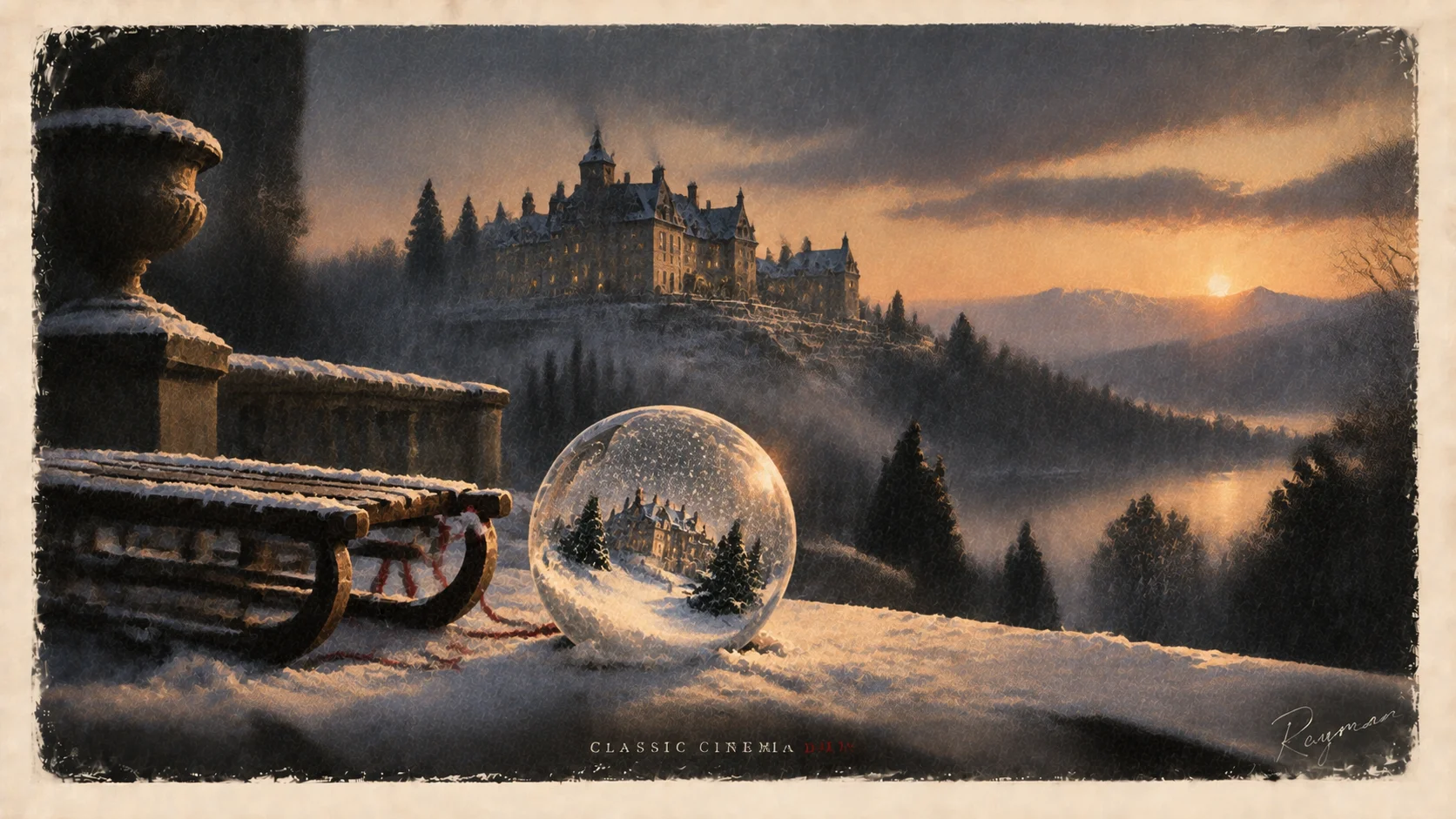
The most famous image in Citizen Kane means exactly that: a man dies in an empty palace holding a glass snow globe, where it snows forever and nothing ever melts. His whole life is an attempt to get back to one snowy afternoon.
After Frost's Descent the shape is still there. It has just frozen.
Tonight's other film, Mirror, has an actual mirror in it — a woman sees her aged self inside it. Both films ask the same question: can a whole life be held in a single object? In one, the answer is thrown into a furnace. In the other, the answer never shows its face.
02Film details
- Chinese title
- 公民凯恩
- English title
- Citizen Kane
- Director
- Orson Welles / 奥逊·威尔斯
- Year
- 1941
- Country
- United States / 美国
- Language
- English
- Genre
- Drama / Mystery / Biographical / 剧情 / 悬疑 / 传记体
- Runtime
- 119 min
03About the film
佛罗里达,一座叫 Xanadu 的庄园。一个富可敌国的老头死在自己的卧室里,最后一句话是一个词:Rosebud。
全世界的报纸都在猜这个词的意思。一家新闻纪录片公司派记者 Jerry Thompson 去问——问他的第二任妻子、他的生意伙伴、他最好的朋友、他的管家。每个人都能讲出一段凯恩,每个人讲的都不是同一个人。
一部关于「一个人到底是什么」的电影,而它的主角从头到尾都在被别人描述。
04Why it is a classic
It held first place in five consecutive Sight & Sound decennial critics' polls, from 1962 to 2002 — fifty years without a change. It also topped the American Film Institute's 100 Years...100 Movies list in 1998 and again in 2007, and entered the Library of Congress National Film Registry in its inaugural group of 25 films in 1989.
It received nine Academy Award nominations and won one: Best Original Screenplay, for Herman J. Mankiewicz and Orson Welles.
Technically it is still the most dissected film in the canon: Gregg Toland's deep-focus photography, Robert Wise's editing, Bernard Herrmann's score, and the structure in which five people remember one man. The film scholar David Bordwell made the important correction that it invented none of its celebrated devices — deep focus, ceilings, chiaroscuro, temporal jump-cuts had all been used by German Expressionist films in the 1920s. What it did was put them all in one film for the first time.
Budget: $839,727. 99% on Rotten Tomatoes (137 reviews, 9.9/10 average).
And it was a failure on release. William Randolph Hearst forbade his newspapers from mentioning it, it did not recoup its costs, and it faded almost out of view until French critics — André Bazin above all — reassessed it and it was re-released in the United States in 1956.
05What to notice
雪球里的雪,有一半是补上去的。 那个从雪球推近到凯恩嘴唇的镜头是光学印片机做的,印片机会让画面颗粒变粗。威尔斯的解决办法是叠一层落雪盖住颗粒。也就是说,这颗永远在下雪的玻璃球里,有一部分雪是为了让画面干净才撒上去的。霜是冷把水汽冻成看得见的形状;这颗球里的雪,是剪辑台造出来的形状。
每一堂布景都盖了天花板。 好莱坞当时的惯例是不拍天花板——棚顶要留给灯。威尔斯的剧组给每个景都做了天花板,很多是薄纱布做的,麦克风藏在里面;地板里挖了摄影机坑,用来拍低角度。他说摄影机应该拍到眼睛能看到的东西,假装没有天花板是坏习惯。
焚化炉那场戏拍了九条,第九条把烟道烧着了。 塞尔兹尼克(Selznick)的摄影棚里有一座真能烧的焚化炉。拍到第九条时炉子太热,烟道起火,Culver City 消防队全副装备赶到现场。演员 Paul Stewart 回忆,威尔斯对这场混乱「非常高兴」。
赫斯特真的动手了。 苏珊·亚历山大这个角色被认为影射赫斯特的情人 Marion Davies,这是赫斯特要毁掉这部片的主要原因。他旗下所有报纸禁止提及;专栏作家 Hedda Hopper 写文章称它是「对一个伟人的恶毒而不负责任的攻击」。
「Rosebud」的来历至今没有定论。 Mankiewicz 在法庭证词里说自己做过精神分析,Rosebud 在他身上扮演过类似的角色;而 Patrick McGilligan 2015 年的威尔斯传记里记载,Mankiewicz 说过这个词取自一匹名马 Old Rosebud,他在 1914 年肯塔基德比上押过它。两个说法都出自本人,互相矛盾。一部关于「一个词解释不了一生」的电影,连这个词本身的出处都解释不了。
06Before you watch
黑白,英语,119 分钟。
结构是「五个人回忆一个人」,时间线故意打乱。开头十分钟是一段仿新闻纪录片的蒙太奇(News on the March),信息密度极大,人名、年代、事件一起砸过来——看不懂不要回退,后面会一遍遍重来。
注意声音。这是最早大量借用广播剧技巧的主流电影之一:对白互相压过去,场景之间用声音硬切。它往往比画面更早告诉你时间已经跳了。
别指望谜底有答案。这部电影的立场是:没有哪个词能解释一个人的一生。
07In one line
I don't think any word can explain a man's life. Thompson says this after interviewing everyone who knew Kane. The whole film exists to make that sentence stand, not to refute it.