4 min
Battleship Potemkin
战舰波将金号
1925
Sergei Eisenstein
Soviet Union · Historical drama / Silent film / Epic · 74 min
Eisenstein's 1925 five-act reconstruction of a failed mutiny: sailors refuse a bowl of maggoty meat, and the Odessa Steps becomes the most quoted sequence in cinema. Voted the greatest film ever made at Brussels in 1958.
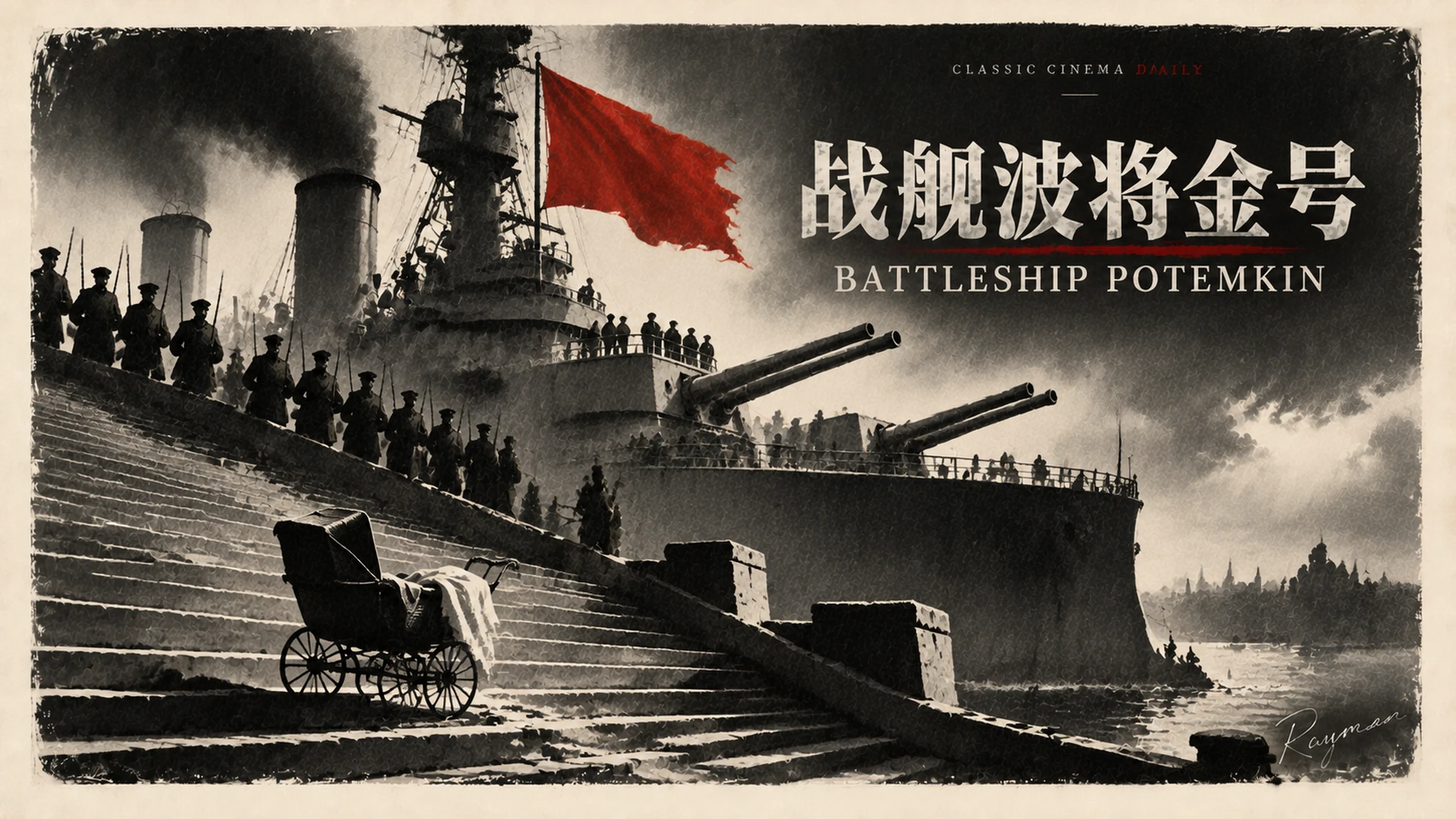
01Why this film today
If The Rules of the Game is an evening party in a château, this is breakfast on a warship — the same story of a small closed society collapsing in a matter of days, and the same history of suppression: banned in Britain until 1954, then X-rated there until 1987.
Frost's Descent is about freezing — moisture setting into frost overnight, everything slowing and fixing in place. Eisenstein is the exact opposite: meaning is produced when two shots collide. One film keeps everything inside the frame; the other cuts everything apart and rebuilds it.
Put together, they are the two poles of film grammar: to cut, and not to cut.
02Film details
- Chinese title
- 战舰波将金号
- English title
- Battleship Potemkin
- Director
- Sergei Eisenstein / 谢尔盖·爱森斯坦
- Year
- 1925
- Country
- Soviet Union / 苏联
- Language
- Silent film / Russian intertitles
- Genre
- Historical drama / Silent film / Epic / 历史剧情 / 默片 / 史诗
- Runtime
- 74 min
03About the film
1905 年,波将金号装甲巡洋舰停靠在敖德萨。水兵们发现配给的肉上爬满了蛆。舰长说,洗一洗就能吃。
有人不肯吃。舰长下令:把带头的人抓起来,就地枪决。
行刑队举枪,命令下达——枪没有响。
全片五幕:人与蛆、甲板上的戏剧、死者要求公道、敖德萨阶梯、独自面对舰队。
04Why it is a classic
At the 1958 Brussels World's Fair, a poll of critics named this 1925 silent film the greatest film ever made.
In Sight & Sound it placed 4th in the first poll (1952), stayed in the top ten for the next five editions, fell to 11th in 2012 and 54th in 2022.
What it actually changed was the status of editing. For Eisenstein, meaning is not inside a shot but between two shots: a face cut against a bowl of soup produces anger; three stone lions cut in sequence produce awakening. The method became known as montage and supplies half of film grammar.
100% on Rotten Tomatoes (51 reviews), 97 on Metacritic.
It was never a neutral film. Goebbels wrote after seeing it that it was a marvellous film without equal in cinema, and that anyone without firm political convictions could become a Bolshevik after watching it — which is its own testimony to the film's power.
05What to notice
那场屠杀在历史上并没有那样发生。 1905 年敖德萨确实爆发了大规模骚乱,军队向人群开枪,死亡数以百计——但不是在大白天,也不是在阶梯上。罗杰·伊伯特写过:「事实上敖德萨阶梯上并没有沙皇的屠杀,这几乎没有削弱那场戏的力量……讽刺的是,爱森斯坦做得太好了,以至于今天人们谈起那场流血,就像它真的发生过一样。」
三尊石狮子是三个不同的雕像。 睡着的、睁眼的、站起来的,三个镜头剪在一起,就成了「人民醒了」。这是蒙太奇理论最简洁的一次演示。
红旗是逐格染上去的。 当时的正色胶片会把红色拍成黑色,所以拍摄时用的是一面白旗;首映前,爱森斯坦手工把 108 格画面染成红色。
八段剧本只留下一段。 原剧本由 Nina Agadzhanova 写成,共八段;爱森斯坦最后只拍波将金号兵变这一段。1925 年 3 月 31 日开拍,全部在敖德萨实景完成——当时那里是苏联的电影制作中心之一,也才找得到合适的军舰。
配乐是十二天写出来的。 首版配乐由 Edmund Meisel 作曲,因为审查放行太晚,他只有十二天时间。
06Before you watch
默片,俄语字幕卡,74 分钟,黑白。看点是节奏与剪辑,不是表演——演员动作偏大,那是默片的语言,不是过火。
尽量找带 Edmund Meisel 配乐的版本:这部片子的节奏本来就是为那段音乐设计的。
它是一部宣传片,立场极其明确。今天看它,值得注意的恰恰是这一点:当一种立场被彻底做成了形式,它就有多难被反驳。 抱着「看一部 1925 年的宣传片如何运作」的心态,会比抱着「看一部老电影」的心态收获更多。
敖德萨阶梯一段有踩踏、流血与婴儿车滑落的镜头。没有血腥特写,冲击力仍然很强。
07In one line
The film that turned editing into argument — voted the greatest film ever made at Brussels in 1958, in 74 minutes, without a single spoken word.