11 min
The Act of Killing
杀戮演绎
2012
Joshua Oppenheimer
Denmark, Indonesia, Norway, United Kingdom · Documentary / History · 122 min
After the 1965 anti-communist purge in Indonesia the killers were never tried — they took power instead. Four decades on, the director asked them to restage their killings in the style of their favourite film genres. They agreed enthusiastically, and directed and starred in it themselves.
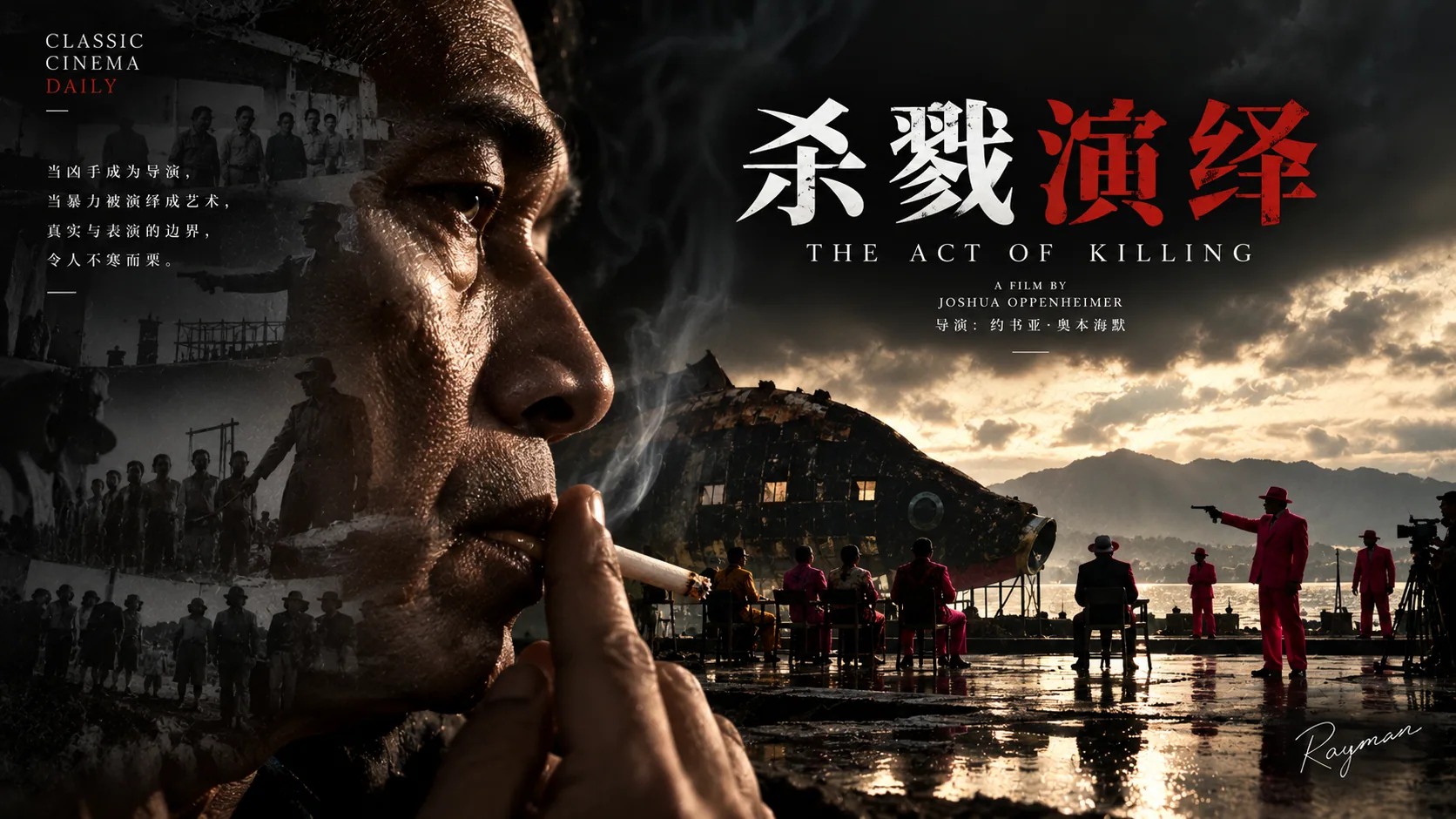
01Why this film today
In October 1965, Indonesia began a purge.
After the events of 30 September that year, Suharto moved to replace Sukarno; over the following months members of the Indonesian Communist Party (PKI), trade-union and peasant-organisation cadres, intellectuals and ethnic Chinese — anyone identified as a communist or a sympathiser — were killed in large numbers. Estimates of the dead range from half a million to well over a million, depending on the scholar. This month marks 61 years since the purge began.
What this film is about is the killers' later lives.
The purge was never accounted for in Indonesia. The paramilitary groups and gangsters who carried it out — the largest being Pancasila Youth — were not prosecuted; they entered the state instead. Four decades later they still operate openly on the streets of Medan and still take pride in what they did.
Joshua Oppenheimer did not use the usual documentary method. He did not interrogate, gather evidence or accuse. He asked them what kind of films they liked best, and then invited them to restage what they had done in the genre of their choice — gangster picture, film noir, musical. He gave them a crew, costumes and cameras.
The result is a documentary directed by, written by and starring the killers themselves.
Why recommend it today?
First, it is the first documentary in this archive. All 22 previous entries were fiction (Close-Up, 1990, is docufiction and only a partial fit). The genre sat at zero; today it does not.
Second, it is the archive's first film from Southeast Asia, and its first from Indonesia.
Third, it forms a sharp pair with a film already on the site. Close-Up (1990) has an ordinary man, Sabzian, re-enact himself in front of a camera after impersonating a director. This film has a group of men who were never tried re-enact themselves. Both refuse to explain their subjects; both put the act of re-enactment itself in front of the audience — but one is about a man who longs to be seen, and the other about men history has already forgiven.
And the plainest reason: what is most disturbing here is not the violence but how smoothly it all goes. The killers cooperate, enjoy themselves, and treat the whole thing as an honour. Accepting the BAFTA, Oppenheimer spoke of Britain and America's "collective responsibility" for these crimes; that passage was cut from BAFTA's own online video.
02Film details
- Chinese title
- 杀戮演绎
- English title
- The Act of Killing
- Director
- Joshua Oppenheimer / 约书亚·奥本海默
- Year
- 2012
- Country
- Denmark, Indonesia, Norway, United Kingdom / 丹麦 / 印度尼西亚 / 挪威 / 英国
- Language
- Indonesian
- Genre
- Documentary / History / 纪录片 / 历史
- Runtime
- 122 min
03About the film
故事从棉兰一间电影院的门外开始。
Anwar Congo 年轻时在那里倒卖黑市票。后来他成了一支处决队的头目——按他自己的说法,他亲手杀过「多达一千人」。
四十多年后,一位丹麦导演找到了他,并且问了一个听上去几乎荒谬的问题:
你们最喜欢什么类型的电影?
Anwar 和他的朋友们回答了。他们挑了黑帮片、黑色电影、歌舞片。导演给了他们剧组、服装和摄影机,请他们把自己当年做过的事——勒死、刺死、把尸体丢进河里——按照自己挑的类型重演一遍。
他们答应了。他们甚至很兴奋。
然后,镜头一直没有停。
(这里不再往下说。这部影片的过程本身就是它的内容,请不要提前去查结局。)
04Why it is a classic
A documentary that handed the camera to the killers
The Act of Killing (Indonesian title Jagal, "Butcher") is a 2012 documentary, 122 minutes, in Indonesian, co-produced by Denmark, Indonesia, Norway and the United Kingdom. It was directed by Joshua Oppenheimer with Christine Cynn and an anonymous Indonesian co-director — anonymity that is stated in the credits because the risk is real.
The executive producers are Werner Herzog and Errol Morris, which is a useful clue: both have spent careers on the line between the real and the performed, and this film is what is left after that line is erased.
Method: not interviews, but a commission
The central figure is Anwar Congo, a former black-market ticket scalper outside a Medan cinema who became a death-squad leader. In the film he estimates that he personally killed "as many as 1,000 people."
Oppenheimer's method was to ask the men which film genres they loved, then fund and crew those films. So stranglings, stabbings and bodies thrown into rivers are restaged in the manner of film noir; there are musical-style production numbers; there is a film-within-the-film called Arsan dan Aminah. Anwar and his friends operated cameras and designed scenes themselves.
From roughly 1,000 hours of footage, 35 hours went to the edit; the finished film runs 122 minutes (the director's cut runs 167). The sound was mixed in the soap-opera studios of the state broadcaster TVRI, an institution also within this organisation's orbit.
Structure: one man's psychological arc
What actually moves the film is Anwar Congo himself. He begins cheerfully, treating his methods as anecdotes and demonstrating them on the spot; midway he plays a victim in a restaged execution and has a genuine panic attack; at the end he returns to the rooftop where he used to kill, and begins to retch while recounting it.
The director's cut ends there: a man who was never tried, collapsing at the scene of his own crimes, undone by his own memory.
The argument it caused
The film did not rest on praise. Nick Fraser, the commissioning editor of BBC Storyville, called it a "snuff film" and publicly urged that it not receive an Oscar; Robert Cribb of the Australian National University criticised it for supplying almost no historical context, distilling 1965 into an abstract story about "human nature."
Both criticisms deserve to be taken seriously. The film really does not explain the purge, and it does not give the victims' side equal time — Oppenheimer addressed that with the companion film The Look of Silence (2014), which follows a victim's family as they confront the man who killed a brother.
Reception
- Rotten Tomatoes 95% (163 reviews, 8.8/10 average); Metacritic 92/100 (34 reviews, "universal acclaim")
- BAFTA Award for Best Documentary (67th); European Film Award for Best Documentary, 2013; Asia Pacific Screen Award; Academy Award nomination for Best Documentary Feature (86th)
- BFI's 2015 poll of the greatest documentaries: #19; BBC's 2016 critics' poll of the greatest films since 2000: #14; The Guardian's best films of the 21st century: #16; The New York Times' 100 Best Films of the 21st Century (June 2025): #82
- In 2013 it topped the year-end lists of Sight & Sound, The Guardian and LA Weekly
Its Indonesian release is a piece of underground film history in itself
The film was never submitted to the Indonesian censorship board. Screenings began secretly on 1 November 2012; on 10 December, Human Rights Day, it played in at least 50 venues across 30 cities; between May and August 2013, 1,096 DVDs were distributed to 118 cities in 29 provinces; on 17 August 2013, Indonesian independence day, 45 public screenings were held; on 30 September 2013, the local day of remembrance for the massacres, it was given a free online screening for Indonesian audiences only; on 17 December 2013 it went up on YouTube.
05What to notice
一个在电影院门外长大的人。 Anwar Congo 年轻时是棉兰一家电影院门外倒卖黑市票的小贩;影片把他重演处决的段落,刻意拍成黑色电影(film noir)的样式——勒死、刺死、把人丢进河里。一个在电影院门外长大的人,最后被请回电影里,把自己的杀人过程拍成了电影。 这是全片最冷的一层结构。
杀人的组织后来变成了合法的政治力量。 影片中最重要的组织是潘查希拉青年团(Pancasila Youth),当年参与屠杀的准军事团体之一。四十年后,它的成员仍在棉兰街头公开活动,以那段历史为荣;片中另一位主要人物 Herman Koto 曾作为该组织的候选人参加 2009 年印尼立法选举,轻松落败。影片最刺人的地方,是这些人根本不需要隐藏。
他自己给出的数字是「多达一千人」。 Anwar Congo 在片中估计自己亲手杀过 as many as 1,000 people。这个数字无法核实,影片也没有试图去核实它——它只是让说出这句话的人,继续站在镜头前面。
一部被拍成歌舞片的杀人重演。 片中那部「片中片」叫《Arsan dan Aminah》。Anwar 和同伴们挑选类型、设计场面,甚至自己掌摄影机。当凶手获得了导演权,他会拍出什么——这才是这部影片真正的问题。
1,000 小时剪成 35 小时。 影片素材总量约 1,000 小时,进入剪辑的有 35 小时;声音部分在印度尼西亚国家电视台 TVRI 的肥皂剧录音棚里完成混音,而 TVRI 同样处在这个组织的势力范围内。这部影片的制作条件本身,就是它要讲的故事的一部分。
金鱼雕塑。 片中反复出现的巨大金鱼雕塑,来自一家 1997 年亚洲金融危机期间倒闭的餐厅。这组镜头是最后拍摄的,导演把它当作 Anwar Congo 那种「热病幻梦」的象征。
结尾的干呕。 影片最后,Anwar Congo 回到他当年反复杀人的那个屋顶,一边讲述,一边开始干呕。一个从未被审判过的人,在自己犯罪的现场,被自己的记忆击倒。
印尼的放映史本身就是一部地下电影史。 影片未送审查,2012 年 11 月 1 日起秘密放映;12 月 10 日国际人权日在 30 座城市至少 50 个场所同时放映;2013 年 5–8 月向 29 个省、118 座城市分发 1,096 份 DVD;2013 年 8 月 17 日独立日公开举行 45 场放映;2013 年 9 月 30 日获得仅面向印尼观众的免费在线放映权;2013 年 12 月 17 日上线 YouTube。
06Before you watch
它是什么。122 分钟,印度尼西亚语,2012 年丹麦 / 印度尼西亚 / 挪威 / 英国合拍。导演 Joshua Oppenheimer,执行制片人 Werner Herzog 与 Errol Morris。另有导演剪辑版 167 分钟(含更多重演段落)与约 95 分钟的电视版。片名在印尼语里叫 Jagal,意思是「屠夫」。
🔴 强度提醒:这是本站目前最需要预警的一部。 影片里几乎没有血腥画面——它一次也没有展示当年杀戮的真实影像。它展示的是杀人者平静地、甚至愉快地讲述和重演自己做过的事:勒死、刺死、把尸体丢进河里。片中有一位当事人因为在重演中扮演受害者,而真的惊恐发作。如果你对这类内容敏感,请先确认自己的状态再看。
它不是一部「揭露真相」的影片。 它不给历史背景,不给死亡人数,也不给受害者的证词——这一点被不少历史学者批评过。建议在进片之前,先花十分钟了解 1965 年印尼事件的基本事实:9 月 30 日事件、苏哈托上台、对印尼共产党及其被指认同情者的大规模清洗。有了这个背景,影片的力量才完整。
它和姊妹片的关系。《The Look of Silence》(2014)是它的灵性续作,跟着一位受害者的家人去面对凶手。两部一起看是完整的;只看这一部,会缺掉受害者那一边的声音。
人名。Anwar Congo(中心人物,前处决队头目)、Herman Koto、Adi Zulkadry、Ibrahim Sinik(《Medan Pos》记者,片中充当重演的「顾问」)。
一句话建议。如果你想看一部关于「人如何与自己做过的恶共处」的电影,这是最不留退路的一部;如果你想看一部把凶手定罪的电影,这部不是——它做的是更难受的事:让凶手自己写剧本。
07In one line
The killers were never tried; they were handed a camera instead. What is most frightening about this film is how little directing it needed.