5 min
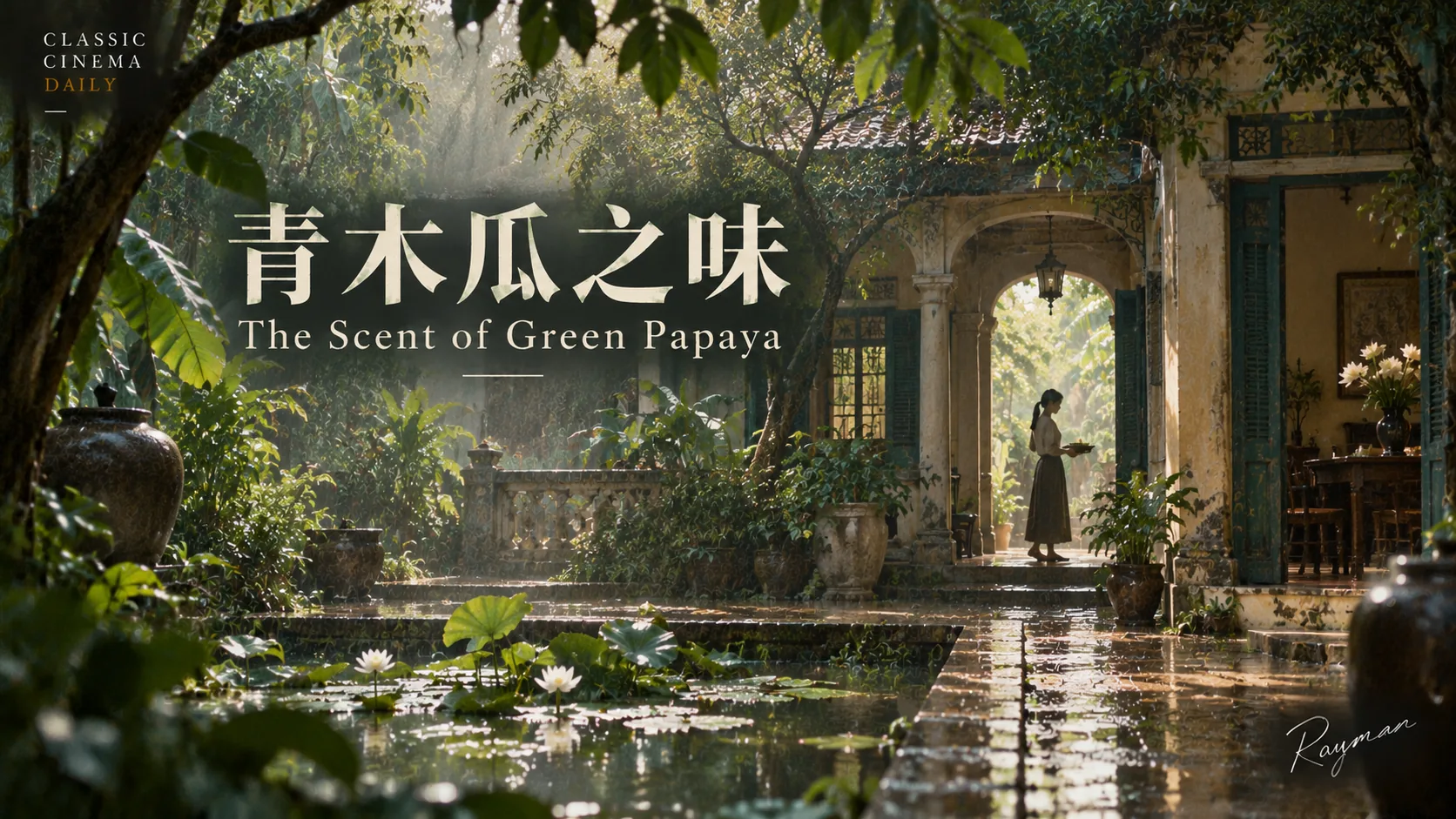
The Scent of Green Papaya
青木瓜之味
1993
Tran Anh Hung
France / Vietnam · Drama · 104 min
Saigon, 1951: ten-year-old Mùi is sent to work as a servant for a family quietly sliding from wealth into poverty. Ten years later, no longer affordable, she moves to a household whose master is a pianist — and is seen for the first time. Shot entirely on a soundstage in France; Caméra d'Or at Cannes 1993 and an Academy Award nomination.
01Why this film today
The second film picks up the question the first one asked: a woman doing housework in someone else's home — how does the camera look at her?
Jeanne Dielman uses a fixed camera, real time and 201 minutes to film repetition as a prison. The Scent of Green Papaya uses a drifting camera, soft light and 104 minutes to film the same labour as a way of knowing the world. Neither has much plot; both are built out of repeated gestures, and in both the repetition breaks at one point — one towards destruction, one towards an opening door.
Their origins are mirror images. Akerman's film came after years of experimental shorts and was paid for by a Belgian government grant; Tran Anh Hung's is a debut feature, built entirely inside a studio at Bry-sur-Marne, about a country he had not seen in sixteen years.
02Film details
- Chinese title
- 青木瓜之味
- English title
- The Scent of Green Papaya
- Director
- Tran Anh Hung / 陈英雄
- Year
- 1993
- Country
- France / Vietnam / 法国 / 越南
- Language
- Vietnamese
- Genre
- Drama / 剧情
- Runtime
- 104 min
03About the film
1951 年,西贡。十岁的 Mùi 被送到一户人家做女佣。这家人曾经富有,现在正在安静地败落:丈夫一次次带着家里的钱出走,最后一次连妻子的首饰一起带走;婆婆卧病在楼上,把儿子的离开怪在儿媳头上;三个男孩各自沉默。
Mùi 不太说话,也不抱怨。她对这个世界保持着一种几乎过分的专注——看蚂蚁搬食,看木瓜剖开后渗出的汁,看米在锅里涨开。
十年后,这户人家已经养不起她。她去了另一户人家,主人是一位钢琴家。
04Why it is a classic
Tran Anh Hung's first feature won the Caméra d'Or at Cannes in 1993, the César for Best First Work in 1994, the BFI's Sutherland Trophy, and a nomination for the Academy Award for Best Foreign Language Film at the 66th ceremony.
Its most famous fact is that it was not shot in Vietnam. The crew originally planned to shoot on location and made several scouting trips to Ho Chi Minh City, then abandoned the plan as too cumbersome and reconstructed downtown Saigon inside a studio at Bry-sur-Marne, east of Paris. The Vietnam on screen is a set.
The cast is almost entirely non-professional, found through a long casting process in France; some spoke little Vietnamese or different dialects. The one performer brought from Vietnam was the old servant. Mùi as an adult is played by Tran Nu Yên-Khê, the director's wife. Cinematography by Benoît Delhomme, music by Tôn-Thât Tiêt — the first of three collaborations.
05What to notice
西贡是搭出来的。 陈英雄原本打算在越南实景拍摄,为此多次回到胡志明市看景;最终因拍摄条件过于麻烦而放弃,改在法国 Bry-sur-Marne 的摄影棚里重建市中心。片中那条街、那些木窗、那种湿热的黄光,全部是布景与灯。
演员几乎全是素人。 漫长的选角之后,除了从越南请来的一位老仆,其余演员都来自法国;有些人几乎不会说越南语,有些人只会不同的方言。演成年 Mùi 的 Tran Nu Yên-Khê 是陈英雄的妻子。
两段结构,两个演员。 影片分 1951 年与十年后两段:十岁的 Mùi 由 Man San Lu 扮演,二十岁的 Mùi 由 Tran Nu Yên-Khê 扮演。时间跳跃不靠字幕,靠屋子的质地、光线的变化和人物的位置完成。
**奖项清单:**1993 年戛纳金摄影机奖、法国电影青年奖;1994 年凯撒奖最佳处女作、BFI 萨瑟兰奖;第 66 届奥斯卡最佳外语片提名。
全球票房约 170 万美元,在当年的艺术片里算相当不错。摄影 Benoît Delhomme 另凭本片入围 1993 年 Camerimage 金蛙奖。
06Before you watch
104 分钟,越南语。它几乎没有戏剧冲突,也不解释人物动机——很多情绪靠光线、器物和声音传达:剖开的木瓜、米在锅里、蝉在院子里。如果你习惯靠对白跟剧情,前二十分钟可能会有点迷路,这是正常的。
知道它在法国摄影棚里拍成,会改变你的观看方式。 那些过于完美的光、过于安静的院子,不是纪录,是重建——这部片拍的是记忆里的越南,不是地理上的越南。
片中有一段雇主与女佣之间的情感关系,今天的观众可能会觉得不适;它属于 1990 年代那类「被观看的东方」的典型文本,值得带着这个意识去看。
适合晚上安静地看,不要一边刷手机。
07In one line
The same gesture — a woman working in someone else's house — becomes 201 minutes of stillness in Akerman and 104 minutes of breathing in Tran. Neither film offers an answer, but The Scent of Green Papaya gives one thing more: it believes that the person nobody looks at has been looking all along.