5 min
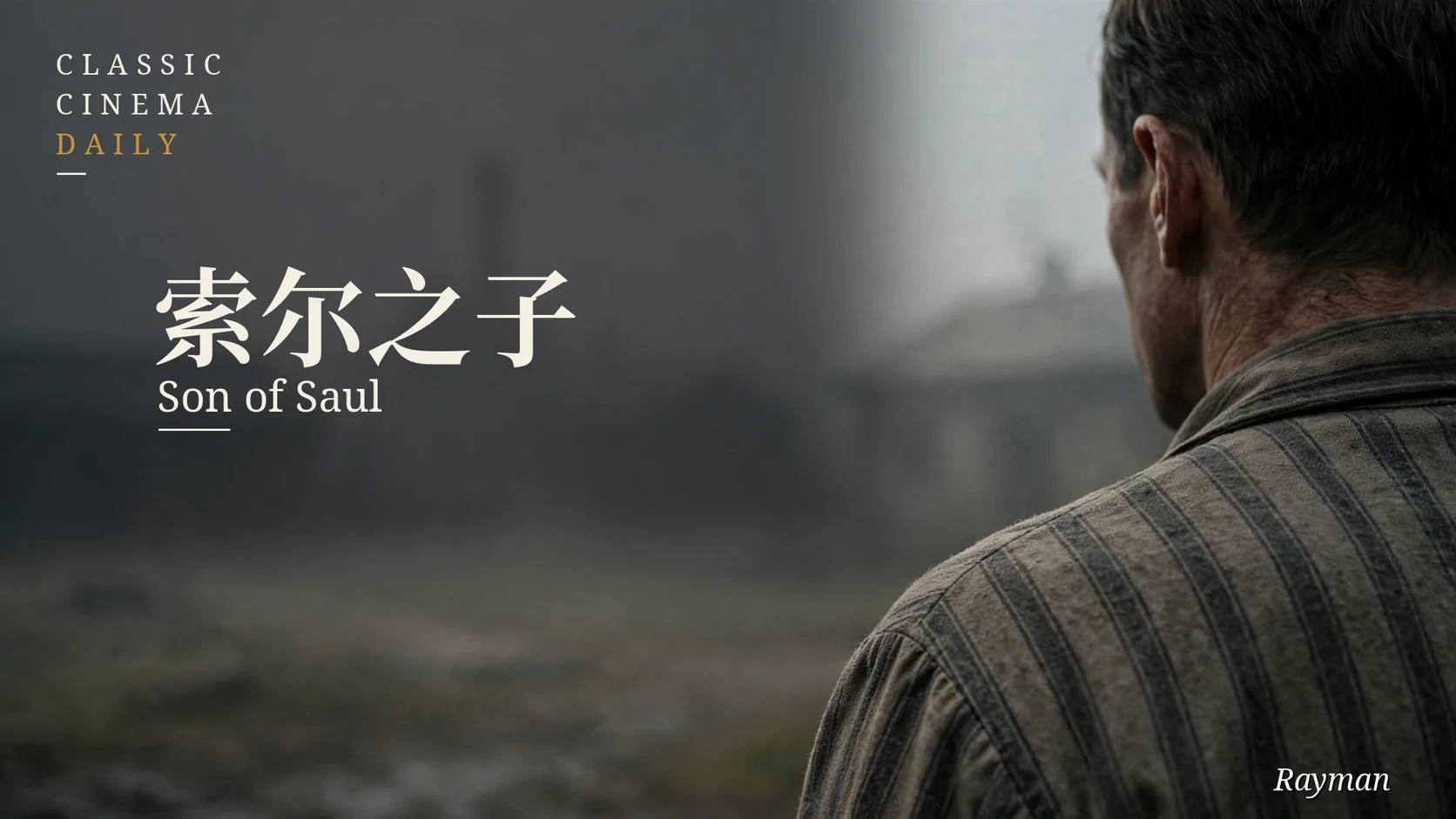
Son of Saul
索尔之子
2015
László Nemes
Hungary · Historical drama / Drama / Holocaust film · 107 min
October 1944, Auschwitz-Birkenau. Saul, a Hungarian Jewish prisoner in the Sonderkommando, moves bodies from the gas chambers to the crematoria. Among the dead he sees a boy still breathing — and then decides to give him a proper Jewish burial. A 40mm lens stays at his back; 107 minutes, 85 shots.
01Why this film today
Both of tonight's films are about footage that gets cut — one that must be kept, one that must be destroyed.
In Son of Saul the Sonderkommando risk their lives to get hold of a camera and photograph the burning pits, because an image is evidence. In Cinema Paradiso the village priest vets every screening and orders every kiss and embrace removed; the projectionist keeps the cut frames in a pile on the projection-room floor and splices them back in before the print travels to the next town.
One insists on being seen; the other forbids it. And the two films answer in opposite ways: Son of Saul narrows the frame until you can see only the back of one man's head, pushing the atrocity out of focus and into sound; Cinema Paradiso opens the whole screen and lets a Sicilian town's entire appetite crowd into one hall.
02Film details
- Chinese title
- 索尔之子
- English title
- Son of Saul
- Director
- László Nemes / 拉斯洛·奈迈施
- Year
- 2015
- Country
- Hungary / 匈牙利
- Language
- Hungarian / German / Polish / Yiddish / Russian / Slovak / Czech / Greek
- Genre
- Historical drama / Drama / Holocaust film / 历史剧情 / 剧情 / 大屠杀题材
- Runtime
- 107 min
03About the film
1944 年 10 月,奥斯维辛-比克瑙。索尔·奥斯兰德是匈牙利犹太人,在特遣队服役——那是营里最残酷的岗位:把毒气室里的人送进焚尸炉,再清理现场。他做得熟练、麻木、不发一言。
某一天,他在死者中间看见一个还在呼吸的男孩。营里的医生随后结束了他的呼吸,并吩咐解剖。
从那一刻起,索尔开始做一件在这个地方毫无意义的事:他要找到一个拉比,要为这个孩子办一场合乎教规的葬礼。为此他必须在这个营里走动、交换、撒谎、冒犯所有人。
镜头从头到尾跟着他。你几乎看不见别的。
04Why it is a classic
László Nemes's feature debut premiered in competition at the 68th Cannes Film Festival on 15 May 2015 and won the Grand Prix. It went on to take Best Foreign Language Film at the 88th Academy Awards — only the second Hungarian film to do so, after István Szabó's Mephisto in 1981 — and the Golden Globe for Best Foreign Language Film, a first for Hungary.
The form is the argument. Shot on 35mm with a single 40mm lens in the 1.375:1 Academy ratio, the film keeps its background permanently out of focus: you see Saul's face and shoulder, and nothing else — including the atrocity. It runs 85 shots, none of them establishing.
Sound carries what the image refuses. Post-production took five months of sound design; voices in eight languages were recorded and layered over the production track. Sound designer Tamás Zányi described it as 'a kind of acoustic counterpoint to the intentionally narrowed imagery.'
Rotten Tomatoes records 96% positive from 233 reviews, averaging 8.9/10; Metacritic's weighted score is 91. The budget was €1.5 million — potential partners in France, Israel, Germany and Austria all turned the project down, and it was ultimately financed by the Hungarian National Film Fund (70%), Hungarian tax credits (25%) and the Claims Conference (5%).
05What to notice
剧本来自一本证词集。 2005 年奈迈施给贝拉·塔尔当助手、参与《The Man from London》的拍摄时,读到了《The Scrolls of Auschwitz》——特遣队成员留下的证词汇编,全片由此而来。他与 Clara Royer 从 2010 年开始写,2011 年完成初稿,之后几年一直在做史料核查,历史学者 Gideon Greif、Philippe Mesnard、Zoltán Vági 提供了支持。
主演是个诗人,不是演员。 Géza Röhrig 是住在纽约的匈牙利诗人,1980 年代以来没再演过电影,原本被考虑的只是配角。奈迈施坚持让演员说自己角色的母语,于是片中出现八种语言——这也是它声音设计极其复杂的原因。
28 天拍完,布景由建筑师设计。 全片在布达佩斯 Budafok 用 35mm 拍了 28 天。焚尸炉的复原布景由建筑师、自由派活动家 László Rajk 设计——他此前参与过奥斯维辛-比克瑙国家博物馆匈牙利常设展的展陈设计。
85 个镜头、107 分钟。 平均一个镜头七十多秒,但没有一个镜头是为了让你看清「这里是什么地方」。奈迈施把观众的位置固定在索尔身后半步,你能看见的永远只是他能看见的。
它在匈牙利本土是卖座片。 2015 年 6 月 11 日上映,卖出超过 22 万张票,是 2010 年喜剧《Üvegtigris 3》以来匈牙利国产片的最好成绩。同年 12 月 13 日由 Sony Pictures Classics 在北美发行。
06Before you watch
107 分钟,匈牙利语、德语、意第绪语、波兰语、俄语等多种语言混杂。这不是一部靠「看懂剧情」成立的电影——它故意不给全景、不给解释、不给你一个可以抓住的叙事支点。
建议:不要在疲惫的时候看,也不要边看边做别的事。它的信息大量在画外音里——远处的喊叫、门后的动静、脚下的声音。如果你只盯着字幕,会漏掉很多。
不要期待它「呈现」大屠杀。 它做的恰恰相反:把摄影机绑在一个人身上,只让你看见一个人能看见的东西。这种限制是这部片全部的道德立场,不是技术炫技。
片中几乎没有直接的血腥特写,但整体压迫感极强,看完可能需要一点缓冲时间。
07In one line
It refuses to show you the camp and shows you the back of one man's neck instead — and because you cannot see, the sound never leaves you.