5 min
Blow-Up
放大
1966
Michelangelo Antonioni
United Kingdom / Italy · Psychological mystery / Drama · 111 min
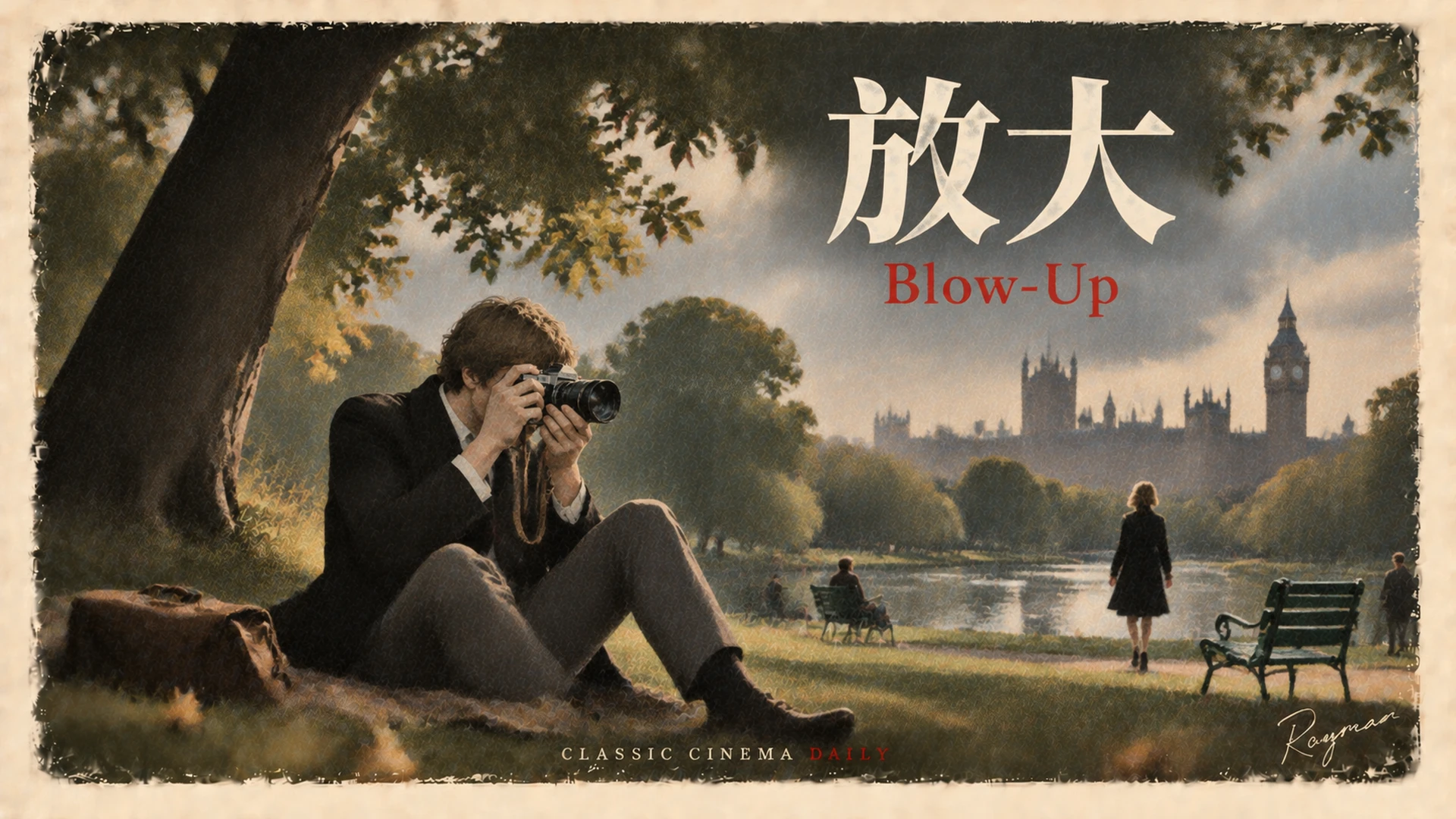
A celebrated London fashion photographer snaps a pair of lovers in a park, then enlarges the negatives until a body surfaces in the grain. Antonioni's first English-language film turns a murder into a parable about seeing.
01Why this film today
Frost's Descent fell two days ago and the Beginning of Winter is under a fortnight away — the stretch of the year when the light goes fastest. Two black-and-white films, both landing at the hour when light stops being reliable.
The pairing is not arbitrary. In 1980 Martin Scorsese put Antonioni's Blow-Up on his own list of 39 essential foreign films for a young filmmaker. Fourteen years later he made Raging Bull. An ocean and fourteen years apart, the two films do the same thing: they let a man fix on something he cannot possibly prove, until the looking consumes him.
Even the endings interlock. Thomas throws back an imaginary tennis ball for a troupe of mimes and then, for the first time, hears the sound of the ball being hit. Jake recites On the Waterfront to himself in a dressing-room mirror, performing for someone who is not there.
02Film details
- Chinese title
- 放大
- English title
- Blow-Up
- Director
- Michelangelo Antonioni / 米开朗基罗·安东尼奥尼
- Year
- 1966
- Country
- United Kingdom / Italy / 英国 / 意大利
- Language
- English
- Genre
- Psychological mystery / Drama / 心理悬疑 / 剧情
- Runtime
- 111 min
03About the film
伦敦,1960 年代中期。一个时尚摄影师刚拍完一屋子模特,累了,把整个摄影棚扔在那里,自己开车出门。
他路过一个公园,停下来,看见一对情人,年纪差得很明显。他躲进树丛,举起相机,把他们拍了下来。女人追上来要底片,他不给,还一边后退一边继续拍她。
回到暗房,他把底片冲出来,一次一次放大。相纸上的颗粒越来越粗,粗到某个程度,他看见了拍摄当时没看见的东西。
04Why it is a classic
Antonioni's first entirely English-language film marks the point where he moved from the Italian films' failure of communication to something harder: the unverifiability of reality itself. He said as much on release — the film is not about man's relationship with man, it is about man's relationship with reality.
At Cannes in 1967 it took the festival's highest prize, then formally called the Grand Prix du Festival International du Film. That same year the National Society of Film Critics gave it both Best Film and Best Director. It was nominated for Best Director and Best Original Screenplay at the 39th Academy Awards, and for three BAFTAs in 1968.
In the United States it was denied approval under the Production Code and condemned by the National Legion of Decency; MGM released it through a subsidiary, Premier Productions. It returned roughly $20 million on a $1.8 million budget and is widely credited with hastening the Code's abolition two years later.
The reviews were never unanimous. Andrew Sarris called it a mod masterpiece; Bosley Crowther found it fascinating but the wanderings redundant; Pauline Kael thought it vague and vacuously symbolic, and argued that audiences took it for art precisely because they could not explain it. Ingmar Bergman, who generally disliked Antonioni, called it a masterpiece. Rotten Tomatoes: 87% from 54 reviews, 8.3/10. Metacritic: 82 from 15 critics.
05What to notice
砸吉他那个人是 Jeff Beck。 俱乐部那场戏里台上是 The Yardbirds,唱的是〈Stroll On〉——那一年 Jimmy Page 还在这个乐队里。Beck 因为音箱的杂音发作,把吉他砸了,琴颈扔进人群,一群人扑上去抢。Thomas 抢到手,跑出去,跑远了却随手把它扔掉;一个路人捡起来看了看,也扔了。给这部片子做过评论音轨的 Peter Brunette 说,这是全片最直接的注脚:一件东西的意义完全取决于它在什么场合里,一离开那个场合,它就是一截断木头。
原著不是英国人的。 故事取自阿根廷作家 Julio Cortázar 的短篇〈Las babas del diablo〉(《魔鬼的涎水》)。Cortázar 本人在片中客串了一个流浪汉,就在公园附近。
主角有真人原型。 Thomas 的灵感之一,是当时伦敦最红的时尚摄影师 David Bailey。Sean Connery 曾被邀请演这个角色,因为 Antonioni 不肯把剧本给他看而拒绝;Terence Stamp 本来定了,开机前不久被换成 David Hemmings——Antonioni 是在舞台上看到他演 Dylan Thomas 的戏之后改的主意。
公园是真的。 主要外景在伦敦东南的 Maryon Park。Jane Birkin 在这里第一次登上银幕(演那个金发的女孩),超模 Veruschka 演她自己,开场那场摄影棚的戏就是她的工作现场。
结尾那场球是假的。 一群哑剧演员在草地上打一场不存在的网球。球飞出界外,其中一个人朝 Thomas 示意,他把相机放下,弯腰捡起一个不存在的东西,扔了回去——然后,球被击打的声音出现了。紧接着画面淡出,只剩草地。全片唯一一次「听见」发生在什么都看不见的时候。
06Before you watch
黑白,111 分钟,节奏是 Antonioni 的节奏:大量没有对白的游荡、很长的空镜、对话常常答非所问。如果你在等一个「谁干的」的答案,会失望——这不是推理片,凶手从头到尾没有一张清楚的脸。
建议把耐心留给中间那些看起来「什么都没发生」的段落,尤其是暗房里反复放大的那一段:那是全片的核心动作,也是唯一一次让你和主角同时看见。
另外,1966 年伦敦的时装、模特和摇滚现场在这里是实景记录,不是布景。看的时候可以顺便当作一份时代切片。
07In one line
"It is not about man's relationship with man, it is about man's relationship with reality." — Michelangelo Antonioni