3 min
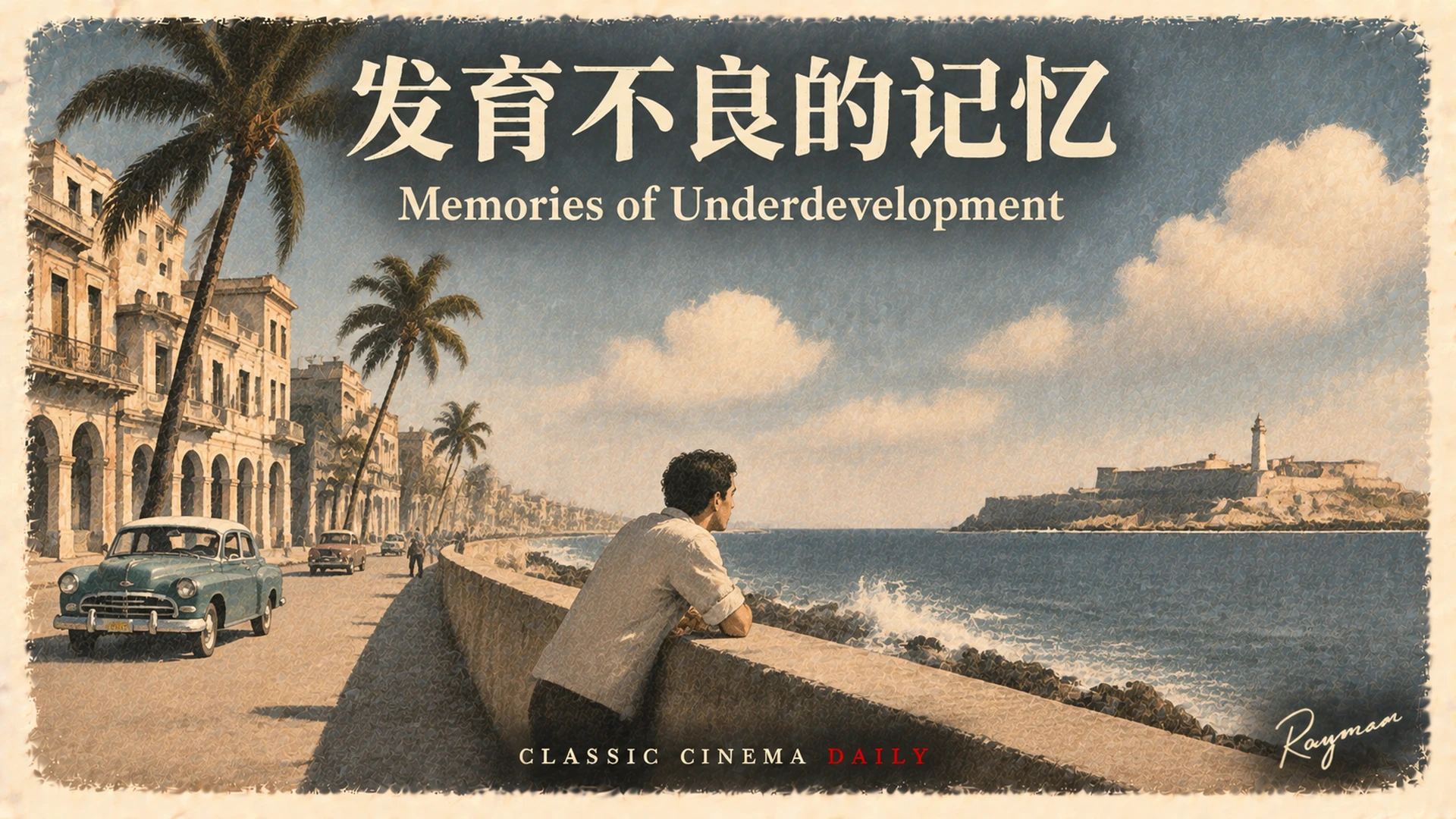
Memories of Underdevelopment
发育不良的记忆
1968
Tomás Gutiérrez Alea
Cuba · Drama · 97 min
1960s Havana, after the Cuban Revolution. The bourgeois intellectual Sergio stays when his wife and parents flee to Miami, yet grows estranged in a country redefining itself as 'underdeveloped'. Tomás Gutiérrez Alea's fragmented, subjective camera records one man's slipping out of step with his time.
01Why this film today
It shares today's other film — 4 Months, 3 Weeks and 2 Days (2007) — in asking the same question: when the world is rewritten, do you stay or leave? Only this one turns the camera on the man who stays yet can no longer tune to the frequency of his time. From 1968 to 2007, two systems and two continents apart, the question does not change.
02Film details
- Chinese title
- 发育不良的记忆
- English title
- Memories of Underdevelopment
- Director
- Tomás Gutiérrez Alea / 托马斯·古铁雷斯·阿莱亚
- Year
- 1968
- Country
- Cuba / 古巴
- Language
- Spanish
- Genre
- Drama / 剧情片
- Runtime
- 97 min
03About the film
Sergio是哈瓦那的一名家具销售员,身上还带着革命前资产阶级知识分子的从容。妻子和父母在革命后前往迈阿密,他选择独自留在古巴。 影片没有明确的故事线,更像一段被记忆切碎的内心独白:他回顾从革命到导弹危机之间的社会变迁,穿插与女友Elena、与Hanna的情感,也不断打量这座正在变形的城市。镜头常常越过他的肩膀,把哈瓦那的街景、游行、拆迁塞进他的视线,仿佛记忆本身就是这样无序地涌来。
04Why it is a classic
It is one of the most frequently cited works of Cuban cinema and the wider 'Third Cinema' movement, and it made its director, Tomás Gutiérrez Alea, the most internationally recognised name in Cuban film. The film appears in The New York Times' top ten of 1968 and in the Sight & Sound 2022 critics' poll (tied for 169th), and was screened in the Cannes Classics strand in 2016. What is singular is the method: Alea braids documentary street footage, intertitles and fiction into a fragmented grammar that mimics the workings of memory, to film how a man slips out of step with his time. It neither defends Sergio nor judges him — it simply lays on screen a dislocation that belongs both to one person and to a nation in transition.
05What to notice
导演Tomás Gutiérrez Alea兼任联合编剧,影片改编自Edmundo Desnoes的同名小说,小说与电影在古巴几乎是互为注解的文本。
叙事采用高度主观、碎片化的结构,大量插入哈瓦那街头的真实素材与字幕卡,刻意模仿记忆如何无序地涌来。
男主角Sergio由Sergio Corrieri饰演;角色被设定为选择留在革命后古巴的资产阶级知识分子。
影片获《纽约时报》评为1968年十佳影片之一,并入围《视与听》2022年影评人榜(并列影史第169)。
评论聚合上,烂番茄96%(27篇影评)给出正面评价,平均8.4/10。
06Before you watch
影片节奏缓慢、内心独白密集,且大量使用字幕卡与文献式素材,对习惯线性叙事的观众可能显得疏离。建议把它当作一段「思绪」而非一个「故事」来进入:你不需要追着情节跑,只要跟着Sergio的目光,看一座城市和一个人的频率如何一点点错位。 片中涉及1960年代古巴革命后的社会变迁,部分历史背景若不了解也不影响观看——它的核心始终是一个人的内心状态。
07In one line
It does not judge the man who stayed; it simply leaves on screen the dislocation of falling out of step with one's time.