6 min
Vertigo
迷魂记
1958
Alfred Hitchcock
United States · Psychological thriller / Mystery / Romance · 128 min
A San Francisco detective with a fear of heights is hired to follow a friend's wife, and follows her far enough to lose the line between the woman and the shadow she has become in his memory. Hitchcock's 1958 psychological thriller, ranked first in the 2012 Sight & Sound poll.
01Why this film today
Frost's Descent has passed and the Beginning of Winter is a little over a week away — the stretch of the year with the longest shadows, when the sun sits low and four in the afternoon already looks like dusk.
Both films today are about memory, and they run in opposite directions. Vertigo is a man seized by his memory: he returns again and again to the same crossing, the same bell tower, the same back of the same woman, trying to do one thing over. Waltz with Bashir is a man abandoned by his memory: he knows he was in Lebanon in 1982 and cannot recall a single frame of it, so he goes from friend to friend asking what happened.
One is a 1958 American colour widescreen film; the other a 2008 Israeli animation. One pushes colour to its limit; the other is almost entirely yellow and brown. Fifty years apart, they ask the same question: when memory fails, what is left to confirm what you did?
Vertigo goes first. It is the better-looking of the two, and the colder.
02Film details
- Chinese title
- 迷魂记
- English title
- Vertigo
- Director
- Alfred Hitchcock / 阿尔弗雷德·希区柯克
- Year
- 1958
- Country
- United States / 美国
- Language
- English
- Genre
- Psychological thriller / Mystery / Romance / 心理惊悚 / 悬疑 / 爱情
- Runtime
- 128 min
03About the film
旧金山。一场屋顶追捕,一名警探悬在檐口,脚下是几十米的空。同事伸手去拉他,没拉住。事后调查认定他没有过失,他还是递了辞呈——他得了眩晕症,只要高度超过某个界限,整个世界就开始旋转、拉伸。
他叫 John "Scottie" Ferguson。此后他试着用一件钢制胸衣把自己慢慢练回去,没什么用。
然后是 Gavin Elster,大学同学,如今是船运公司的老板。Elster 请他吃晚饭,说了一件很荒唐的事:妻子 Madeleine 最近常常一个人出门,去美术馆在一幅十九世纪女人的肖像前坐很久,去墓地在一座碑前站着,去老旅馆开一间房又退掉。事后她说不清自己去过哪里。Elster 怀疑她被一个死去的人附了身,想请 Scottie 跟着她,看看她究竟在做什么。
Scottie 答应了。他跟着她穿过旧金山的街、金门公园、海边的悬崖。有一天,她跳进了海湾。
04Why it is a classic
To understand its standing you have to know how badly it was received.
Released on 9 May 1958, it was called "too long and slow" by Variety for what it dismissed as "basically only a psychological murder mystery"; the Los Angeles Times found the plot "too long to unfold" and bogged down in a maze of detail; John McCarten in The New Yorker said Hitchcock had "never before indulged in such farfetched nonsense." One survey of the British press found that of 28 reviews, six were favourably inclined with reservations, nine were very mixed, and thirteen almost wholly negative. It barely broke even, earning $3.2 million in North American rentals against a $2.48 million cost.
The one critic who saw it immediately was in Paris. Éric Rohmer, writing in Cahiers du Cinéma, argued that precisely because the form is pure, beautiful, rigorous, astonishingly rich and free, Hitchcock's films — with Vertigo at their head — are about ideas.
Then came half a century of revision. In the Sight & Sound decennial poll it entered at 7th in 1982, rose to 4th in 1992 and 2nd in 2002, and in 2012 took first place, displacing Citizen Kane after fifty years at the top. In 2022 it placed second, behind Jeanne Dielman — which this archive also holds. In 1989 it was one of the first 25 films chosen for the US National Film Registry. Rotten Tomatoes stands at 93%; Metacritic at 100, one of only fourteen films to hold that score.
It is also a technical watershed: the first film to use the dolly zoom, an in-camera effect that turns Scottie's acrophobia into something the audience feels in the body. The tower shaft could not be built at full scale, so the shot was made with a model and the camera turned on its side. It was shot in VistaVision and printed in Technicolor, and it remains Hitchcock's most exacting work in colour. The score is Bernard Herrmann's, the titles and poster Saul Bass's — the three of them together are the part that has never been successfully imitated.
05What to notice
「眩晕效果」是在地上拍出来的。 那个让背景向后塌陷、前景人物保持不动的镜头,是全片最著名的一处。实景塔井没法架设设备,剧组做了塔井模型,把摄影机横过来拍,再合成。这个手法由派拉蒙第二摄制组的摄影师 Irmin Roberts 设计,后来被叫作「Vertigo 效果」,如今已是电影语法的一部分——而 Roberts 在片尾并没有得到署名。
绿色是有档案的。 1996 年修复时,原底片已经褪色,三色分离母版又因收缩不均无法重新对齐。修复者 Robert A. Harris 与 James C. Katz 需要还原片中的绿——Madeleine 的裙子、旅馆走廊的霓虹、Scottie 家里的光。福特汽车公司提供了保存完好的绿色车漆样本作为参考色。这个细节说明:绿在这部片子里不是配色,是角色。
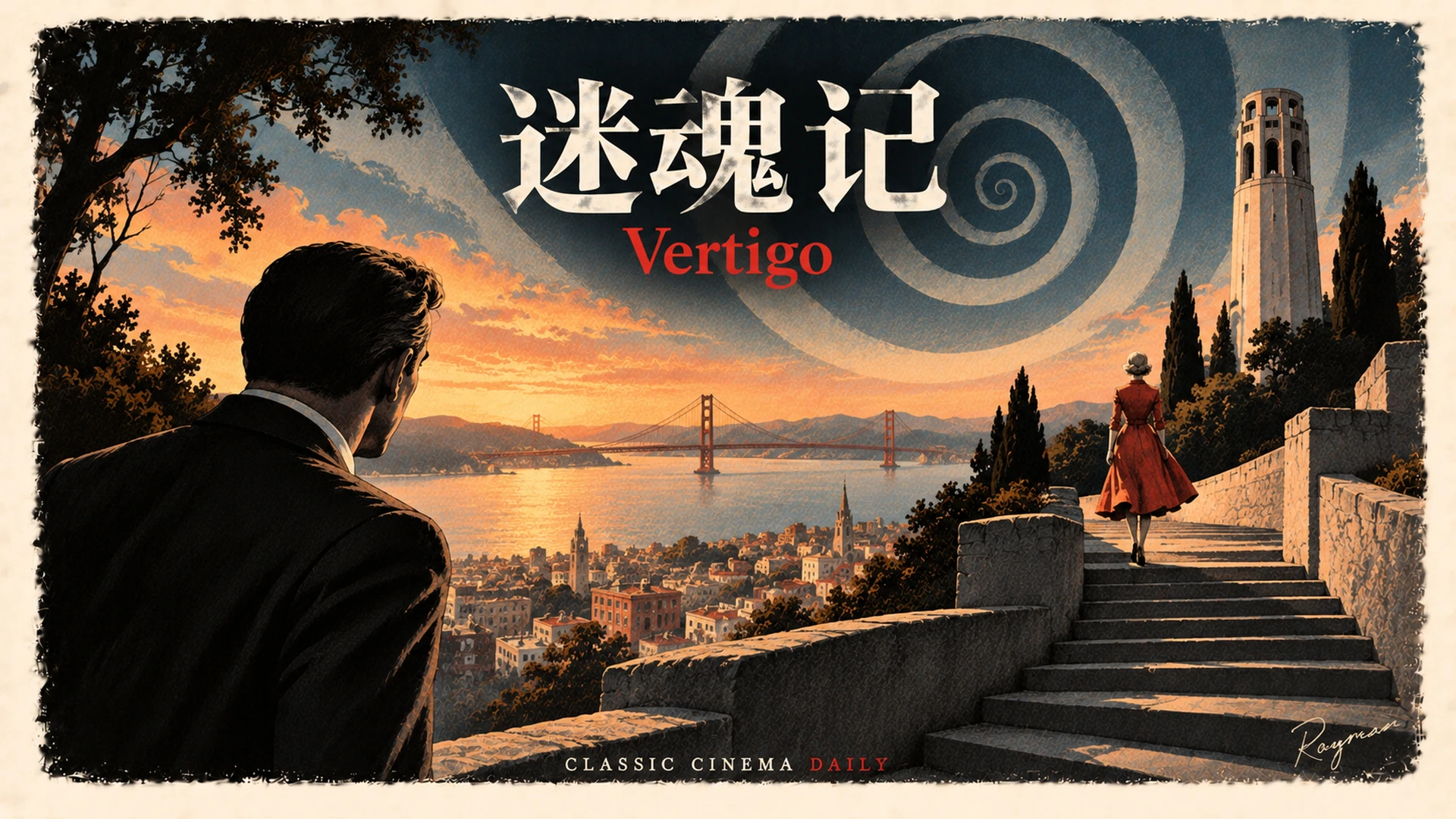
螺旋是它的语法。 海报与片头由 Saul Bass 设计,那些旋转的图案由动画师 John Whitney 用二战时期的机械计算机 Kerrison Predictor 画出李萨如曲线。Herrmann 的配乐也是螺旋结构。Martin Scorsese 说得准:这部片子讲执念,而执念就是一遍遍绕回同一个时刻,音乐则围绕螺旋与圆、满足与绝望展开。
配乐是在伦敦和维也纳录的。 美国乐手罢工,Herrmann 只能把乐队搬到欧洲,由 Muir Mathieson 指挥。整部配乐大量引用瓦格纳《特里斯坦与伊索尔德》——一部关于无法完成的爱、只能以死收场的歌剧。
那座钟楼不存在。 Mission San Juan Bautista 真实的钟楼远没有片中那么高,塔身是比例模型、接景画和特技摄影合成的。片中著名的「穆尔森林」其实是 Big Basin Redwoods State Park;两人初吻处那棵孤树,是专门运到现场的道具树。
06Before you watch
128 分钟,VistaVision,1.85:1,Technicolor。前四十分钟会很慢——这不是失手,是设计。希区柯克要你先跟着 Scottie 一起无所事事地跟车、等人、看一个女人的背影,等到你不耐烦,你才会和他一样容易上当。
留意三样东西:颜色(尤其绿)、圆形(螺旋、楼梯、发髻、镜头的旋转)、以及重复——同一段路、同一句话、同一件衣服会第二次出现。这部片子所有的恐怖都来自「第二次」。
最好的状态是不知道情节。如果你还没看过,别看简介、别读影评,直接看。
另外提醒一句:1996 年修复版在部分场景加了海鸥叫与雾笛,用来盖住旧音轨的杂音;2014 年的 4K 版把这些过量的音效去掉了。如果你看的是 4K 版,Cypress Point 那一段会比老版安静。
07In one line
"Hitchcock's film is about obsession, which means that it's about circling back to the same moment, again and again." — Martin Scorsese