4 min
Ugetsu
雨月物语
1953
Kenji Mizoguchi
Japan · Period drama / Fantasy / Ghost story · 96 min
Kenji Mizoguchi's 1953 film follows a potter who leaves home to sell his wares in a war-torn country and travels farther than he meant to. Low light, distant framing and fog on the lake make the return home the film's heaviest matter. Silver Lion at Venice; 50th in the 2012 Sight & Sound poll.
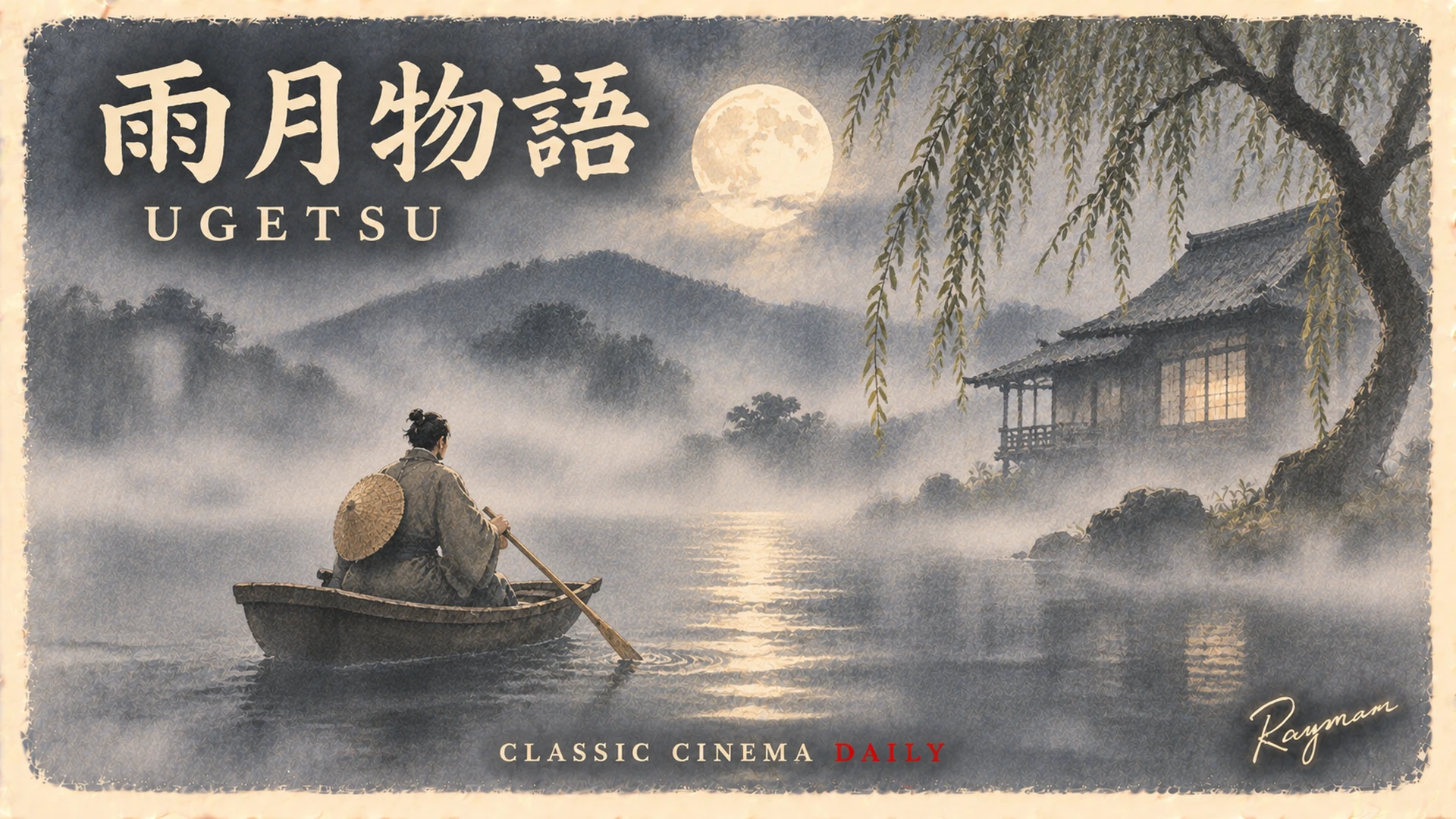
01Why this film today
Today, 7 November, is Lidong, the Start of Winter. A classical Chinese almanac defines the term: 'Li is the beginning; dong is the end; all things are gathered in and stored away' — the point in the year when whatever must be kept is brought indoors. Today pairs two films about boundaries. In Wings of Desire (1987), an angel voluntarily gives up eternity and folds himself into a body that can be cold and can be hurt. In Ugetsu (1953), a potter leaves home to sell his wares in a country at war, travels farther than he intended, and finds that returning is the hardest part. One contracts infinity into a finite life; the other folds half a lifetime into fog over a lake. Made 34 years apart at opposite ends of Eurasia, both ask the same question: with only one stretch of time, what is worth trading it for? What winter stores away is not only things, but time.
02Film details
- Chinese title
- 雨月物语
- English title
- Ugetsu
- Director
- Kenji Mizoguchi / 沟口健二
- Year
- 1953
- Country
- Japan / 日本
- Language
- Japanese
- Genre
- Period drama / Fantasy / Ghost story / 时代剧 / 奇幻 / 怪谈
- Runtime
- 96 min
03About the film
十六世纪,琵琶湖边的一个村子。战乱的军队随时会过境,一个陶工想趁乱把瓷器挑到城里卖个好价钱,妻子抱着孩子劝他别去;同行的内弟一心想当武士。渡湖那天,雾里漂来一条船,船上的人留下一句警告。影片从这里分成两条路:一条通向生意与奇遇,一条通向家里等的人。它不急着告诉你哪条更贵。
04Why it is a classic
It won the Silver Lion at the 14th Venice Film Festival in 1953, on Mizoguchi's first trip outside Japan, and is credited with helping to popularise Japanese cinema in the West. Sight & Sound placed it in the critics' top ten in both 1962 and 1972 and 50th in its 2012 poll of the greatest films ever made. Rotten Tomatoes records a 100% approval rating across 30 reviews (average 9.40/10), and the Village Voice ranked it 29th among the 100 best films of the twentieth century in 2000. Donald Richie called it 'one of the most perfect movies in the history of Japanese cinema', singling out the long opening panorama that moves from lake to shore to village and the upward-tilting panorama at the end that answers it. Its standing rests equally on form. Mizoguchi told cinematographer Kazuo Miyagawa that he wanted the film to unroll seamlessly like a scroll painting; Miyagawa kept the lighting low, filmed as near to sunset as possible and shot a large share of the film from cranes — he later claimed crane shots made up some 70 percent of it. Fumio Hayasaka's score draws on the geza music of Kabuki theatre, with the harp reserved for the presence of the supernatural. The screenplay takes two stories from Ueda Akinari's 1776 collection Ugetsu Monogatari and borrows the skeleton of an 1883 Maupassant short story for the samurai subplot. Screenwriter Yoshikata Yoda said that as the film developed, the question of how war makes women suffer kept surfacing until it became the dominant theme: a ghost story on the surface, a film about war and its cost underneath. This archive already holds Kurosawa's Rashomon in its 1950 slot; the two films face each other across the years in which Japanese cinema reached Western audiences.
05What to notice
剧本由上田秋成 1776 年〈雨月物语〉中的〈浅茅之宿〉与〈蛇性之淫〉两篇取材,另把莫泊桑 1883 年短篇 Décoré! 的骨架借给想当武士的那条副线;编剧为川口松太郎与依田义贤,制片大映。
沟口要求影片「像卷轴画一样无缝展开」;摄影宫川一夫把光压得很低、尽量贴近日落拍摄,大量镜头由升降机取景,他后来自称这类镜头约占全片七成。沟口本人不碰摄影机、也不参与布光设计。
渡湖那场并非在琵琶湖上拍,而是在摄影棚的水池里加烟完成,副导演得在冷水里推船;朽木宅邸的布景以京都桂离宫为依据。
配乐早坂文雄采用歌舞伎的 geza 音乐,鼓、笛与吟诵之外,竖琴只在超自然存在出现时响起,铃铛声则出现在不合常理的地方。京町子的妆容仿能面,用引眉(hikimayu)画法。
1953 年威尼斯银狮奖;《视与听》1962、1972 两届影评人十佳、2012 年影史第 50;烂番茄 30 篇评论 100%。1954 年 9 月在纽约上映,2016 年 4K 修复版入选戛纳经典单元。本站 1950 年格里已有 Rashomon。
06Before you watch
96 分钟,日语,黑白。它常被叫作怪谈,但前半段完全按战乱年代的生活片拍,异样是慢慢渗进来的,不必先找类型规则。摄影刻意压暗、多用远景与升降机,人物常常不居中,看惯特写的人可能要适应一会儿。故事设定在十六世纪,改编自十八世纪的怪谈小说集,两者年代不同属原作与改编的正常差异,不是穿帮。影片把许多地方留着不解释,结局值得留到最后再看。
07In one line
Mizoguchi turns a life into fog: leaving home looks like a business trip, until you find that time never waits where you left it.