4 min
The Searchers
搜索者
1956
John Ford
United States · Western / Adventure / Drama · 119 min
Texas, 1868, three years after the Civil War. Ethan Edwards comes back to his brother's ranch; a Comanche raid takes his family. With his part-Native nephew he spends five years crossing the wilderness for an abducted child — a search that gradually stops resembling a rescue.
01Why this film today
Frost's Descent passed seven days ago, the leaves are nearly gone, and the Start of Winter is eight days off — the stretch of the year when the ground comes closest to bare. That is exactly the terrain of these two films. In 1956 two films appeared about a single man crossing hostile ground, pointing in opposite directions: Ford pushed the horizon out with VistaVision, Bresson compressed the frame into one cell and let sound come from off-screen. Taken together they also close the archive's last gap among canonical directors — John Ford and Robert Bresson.
02Film details
- Chinese title
- 搜索者
- English title
- The Searchers
- Director
- John Ford / 约翰·福特
- Year
- 1956
- Country
- United States / 美国
- Language
- English
- Genre
- Western / Adventure / Drama / 西部 / 冒险 / 剧情
- Runtime
- 119 min
03About the film
1868 年,德州。内战结束三年后,伊森·爱德华兹骑马回到兄弟的农场。他打过仗,也做过一些不便说明的事,回来时身上还穿着邦联的军大衣,带着一批新铸的金币。他在这个家里既是亲人也是异类:他对这个家的忠诚,和他对这个家的怨恨一样深。 然后一支科曼奇人队伍血洗了农场。伊森和混血的侄子马丁出发去找被掳走的孩子。原以为是一次追击,很快就变成了一场以年为单位的行走——穿过四季、雪原和不断后退的地平线。 越往后走,你越会怀疑:他到底是在找那个孩子,还是在找别的东西。
04Why it is a classic
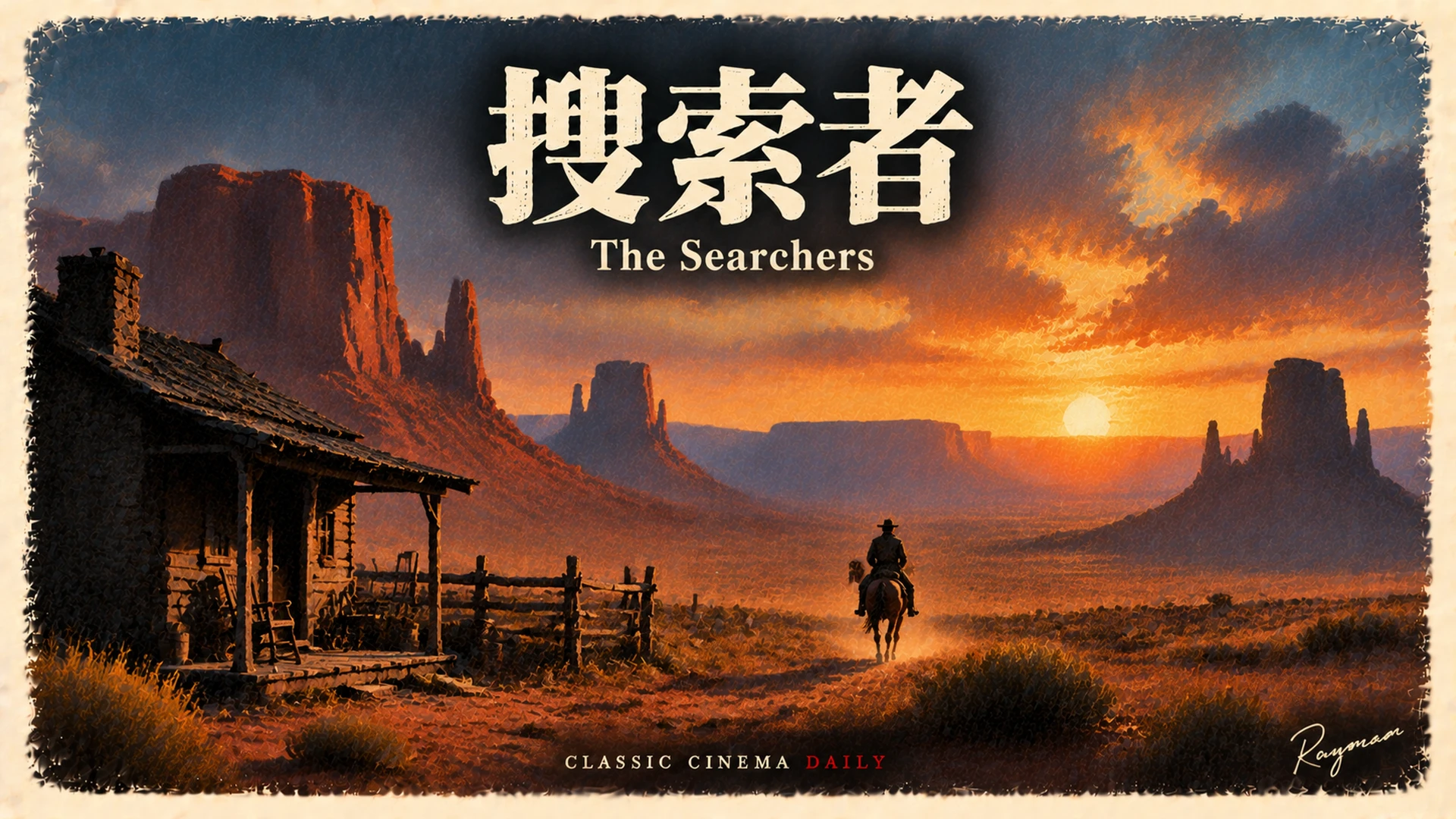
On release in 1956 it was simply a Western that did good business on a budget of $3.75 million. What turned it into the greatest of its genre happened over the following sixty years: the American Film Institute named it the greatest American Western in 2008, placed it 12th on its 2007 list of 100 greatest American films, and Sight & Sound's 2012 critics' poll ranked it 7th of all time. The real weight lies in what Ford did to the genre's grammar. The Western's default sentence was civilisation against savagery, with a clear border and a clean ending. The Searchers dismantles it: the child Ethan is looking for has grown up on the other side, and his own obsession with blood purity brings him closer to the savagery he names than any of his enemies. John Wayne — the actor who had long embodied the American good guy on screen — plays a man hollowed out by hatred. Ford made him do it, and it remains the least Wayne-like performance of his career. Then there is the image. Winton C. Hoch shot it in VistaVision in Monument Valley, pressing figures into the space between red rock and sky until a person looks like a mistake. The ending that film history keeps quoting — a doorway splitting the dark interior from the bright waste, a man standing on the threshold, at home on neither side — delivers the whole verdict without a line of dialogue.
05What to notice
改编自 Alan Le May 1954 年的小说,剧本由 Frank S. Nugent 执笔。Nugent 此前已为福特写过《关山飞渡》,两人合作到福特晚年。
摄影师 Winton C. Hoch 用 VistaVision 宽画幅拍摄,外景在犹他州纪念碑谷——福特自 1939 年《关山飞渡》起就反复回到这里,这里几乎是他自己的取景地。
配乐出自 Max Steiner,好莱坞黄金时代最重要的配乐家之一,作品还包括《乱世佳人》与《卡萨布兰卡》。他的主题在这里用得极省,大量场面只有风和环境声。
影片的时间跨度约五年,福特靠季节、光线和人物面貌的变化来标记流逝,几乎不用闪回,也不靠旁白解释。
结尾的门框构图被反复分析:摄影机留在黑暗的室内,看着人物走向明亮的荒原,门框把画面切成两半。这个镜头没有任何台词,却成了整部电影的结论。
06Before you watch
片长 119 分钟。前四十分钟节奏偏慢,大量时间花在建立人物关系而不是推进事件——这是有意的,福特的兴趣不在「找到没有」,而在「找的人变成了什么」。 需要提前知道的是:这是一部 1956 年的好莱坞电影,它对科曼奇人的呈现带着那个时代的印记,也带着伊森本人的种族偏见。影片没有替这种偏见辩护,但也没有给它一个舒服的出口。看的时候请把「伊森的视角」和「影片的视角」分开——这两者并不重合,而这个缝隙正是它至今仍被反复讨论的原因。 建议看宽银幕版本,不要在手机上裁切观看。构图是这部片子的主要语言,裁掉两侧,等于抽掉一半的论证。
07In one line
A man can spend five years searching for a child without once asking whether he still deserves to bring her home.