4 min
A Man Escaped
死囚越狱
1956
Robert Bresson
France · Drama / War / Prison film · 99 min
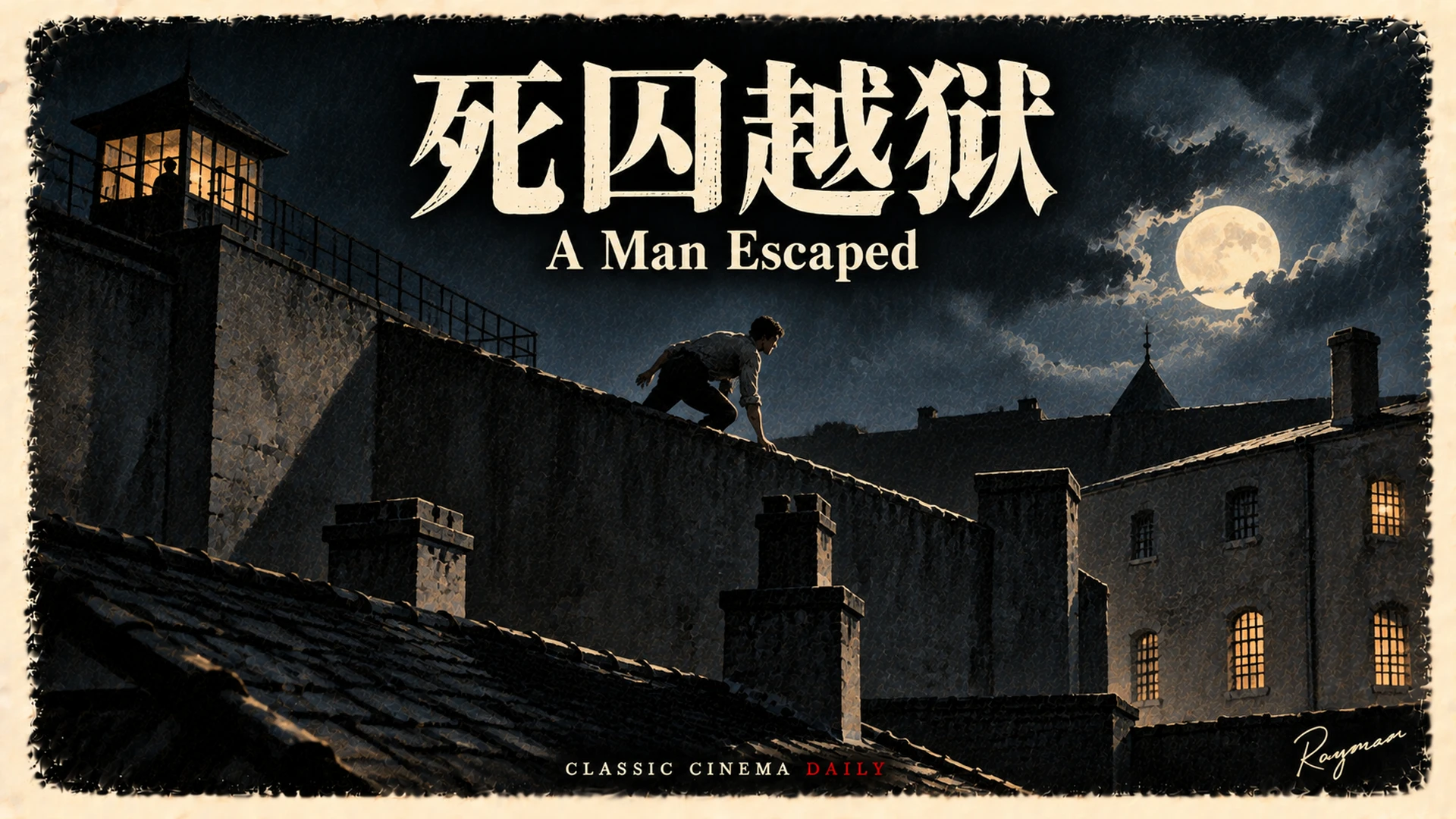
Lyon, 1943. A Resistance member is imprisoned by the occupying Germans and waits to be shot. He makes no speeches; he does one thing — converts a spoon, a few planks and an enormous amount of time into a route through the wall. Bresson films the escape as a rite of attention and discipline.
01Why this film today
The second half of today's pairing points the opposite way. Ford's camera keeps pushing outward, to the horizon; Bresson's keeps drawing inward, to a window, a door, the edge of a spoon. The second pentad of Frost's Descent is ending and the leaves are down — a season of subtraction. Bresson spent his career subtracting: no professional actors, no score, no explanation of motive. A Man Escaped, from that same year of 1956, is the most radical of those reductions, and the only time he won Best Director at Cannes.
02Film details
- Chinese title
- 死囚越狱
- English title
- A Man Escaped
- Director
- Robert Bresson / 罗伯特·布列松
- Year
- 1956
- Country
- France / 法国
- Language
- French, German
- Genre
- Drama / War / Prison film / 剧情 / 战争 / 监狱
- Runtime
- 99 min
03About the film
1943 年,里昂。一个年轻的抵抗运动成员被德军逮捕,关进蒙吕克监狱,罪名足够让他被枪决。影片把他叫作方丹。他瘦,安静,进牢房后做的第一件事不是想办法申诉,而是开始观察:墙的厚度、门板的层数、放风的时间、看守换班的间隔。 他有一把勺子、一块床板、一双眼睛,和大量无法打发的时间。他把这些东西拆开、重新组合,变成一个计划。 布列松几乎不让你看到暴力。你听到的是走廊里的脚步、钥匙串的响动、远处被带走的人。整部电影的重心不在「能不能出去」,而在「一个人如何在等待死亡的时候,仍然保持精确」。
04Why it is a classic
At Cannes in 1957 Bresson won Best Director for it, and Sight & Sound's 2012 critics' poll placed it 69th of all time. It adapts the memoir of André Devigny, who escaped Montluc prison in Lyon in 1943 and wrote the account after the war. Bresson himself was taken prisoner by the Germans in 1940 and held in a POW camp for over a year, which gave him first-hand knowledge of time under confinement. Technically it is the textbook on off-screen sound. Bresson insisted that what matters should not be shown but should happen outside the frame, with sound making you believe it is there. There is almost no score; the only music is Mozart's Great Mass in C minor, and it surfaces at a handful of precise moments. He also refused professional actors, calling them models and asking them not to express or perform emotion but simply to perform actions. The result is that Fontaine does not look like a hero; he looks like a man at work. That is the point: the escape is restored to the status of a craft.
05What to notice
原片名 Un condamné à mort s'est échappé,直译是「一个被判死刑的人逃走了」。布列松把结局写进片名,等于提前告诉你结果,然后把全部张力放在「怎么做到」上。
主演 François Leterrier 当时是哲学系学生,此前没有表演经验;他后来转行做导演。布列松要的正是这种「没有被表演训练改造过的脸」。
摄影 Léonce-Henri Burel 是法国默片时代的老将,曾为阿贝尔·冈斯的《拿破仑》掌镜。布列松找他,是要一种不带现代修饰的影像。
片中呈现的越狱手法——勺柄改成的凿子、撕成条的床单、编成绳的衣物——来自 Devigny 回忆录记载的真实做法,不是编剧的想象。
莫扎特《C 小调大弥撒》只在几个段落响起,而且每次都和「牢里的人与外面的人互相传递消息」有关。音乐在这里不是情绪,是关系的标记。
06Before you watch
99 分钟,黑白,法语与德语对白。节奏是慢的,但和福特那种「建立关系」的慢不同——布列松的慢是重复:同样的动作、同样的走廊、同样的等待。 这不是一部靠悬念驱动的越狱片。如果你期待的是戏剧化的反转和爆发,会失望;它的紧张来自精确,每一次成功的动作都让你更怕下一次失败。 建议戴耳机,或者用好一点的音响看。这部片子的信息有一半在画外——脚步的方向、钥匙的轻重、门外的沉默。用笔记本外放看,等于丢掉一半。
07In one line
He spent the time allotted to his death measuring the thickness of a door.