6 min
8½
八部半
1963
Federico Fellini
Italy / France · Avant-garde comedy-drama / Psychological drama · 138 min
A famous director cannot decide what his next film is about, and everyone around him demands an answer. Fellini turned his own creative block into the film itself, and won the Oscar for Best Foreign Language Film.
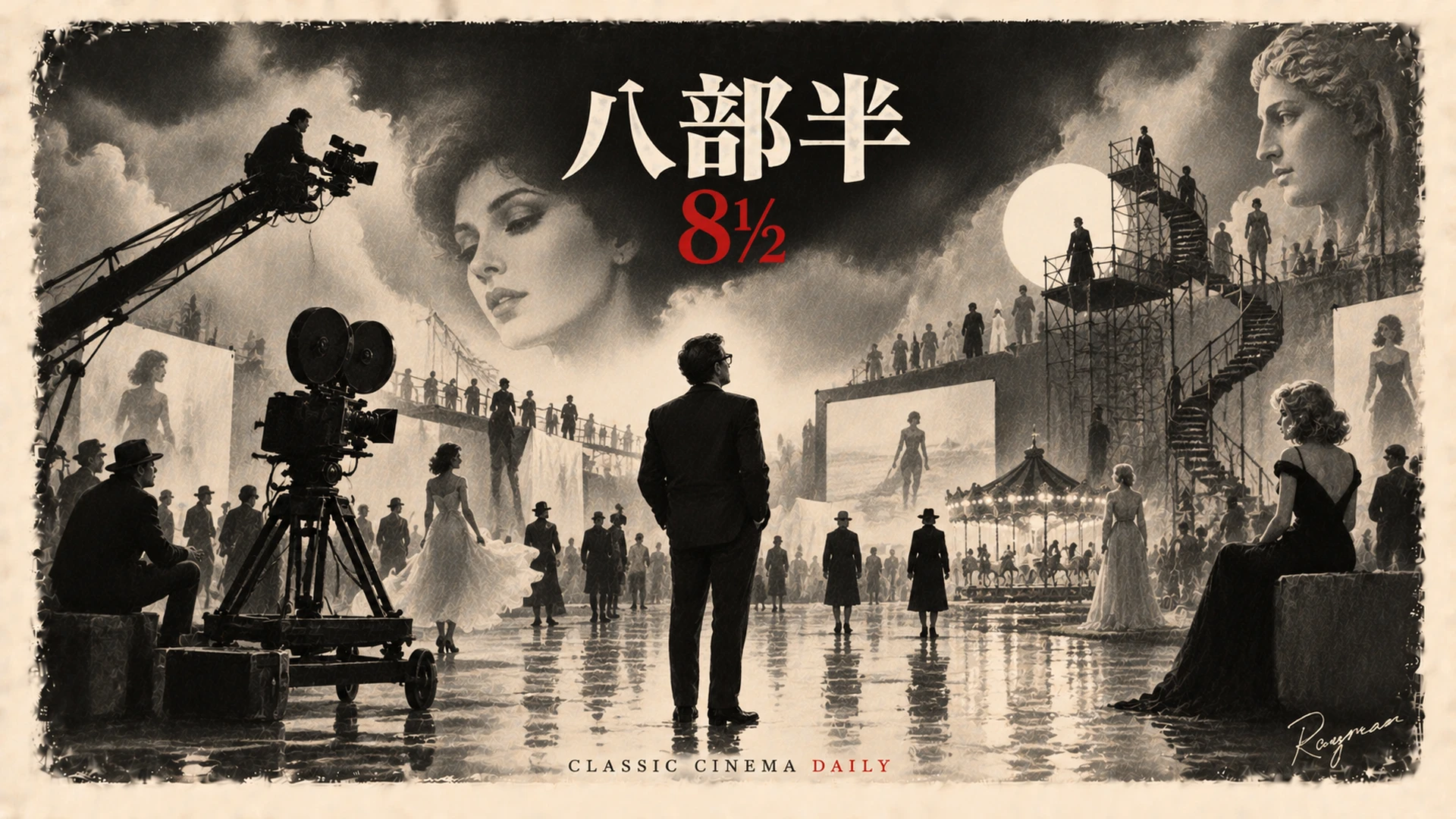
01Why this film today
Frost's Descent has just passed and the Beginning of Winter is under a fortnight away — the weeks when things withdraw inward. The two films today run in opposite directions: 8½ pulls every action back into one man's head; The General throws every action outward for seventy-nine minutes without stopping.
Nor is it an arbitrary pair. One is a 1963 Italian film in black and white, Fellini's last; the other a 1926 American silent, the one Keaton said he was proudest of. One has far too many words and cannot say a single thing clearly; the other has almost none, and his whole town misreads him.
Together they ask the same question twice: when you are misjudged, do you explain, or do you act?
8½ goes first. The light is going fastest now, and almost all of it happens indoors, inside one head.
02Film details
- Chinese title
- 八部半
- English title
- 8½
- Director
- Federico Fellini / 费德里科·费里尼
- Year
- 1963
- Country
- Italy / France / 意大利 / 法国
- Language
- Italian
- Genre
- Avant-garde comedy-drama / Psychological drama / 先锋喜剧剧情 / 心理剧情
- Runtime
- 138 min
03About the film
一辆车堵在路上。车里的人透不过气,拍窗、踢门,四周车窗里全是面无表情的脸。他挣脱出来,整个人离开地面,飘在城市上空——然后被地面上的人拽了回去。
这是开场的一个梦。醒来的人是 Guido Anselmi,意大利名气最大的导演之一,此刻住在一处温泉疗养地,名义上是休养,实际上是在躲一部他已经答应要拍的电影。剧组已经住进来了,布景已经搭好,制片人天天问什么时候开机,而他连这部片子要讲什么都还没想清楚。
他请了一位影评人来听构思,被当面否掉。他的情妇来了,他把人安排到另一家旅馆。他的妻子也来了。还有一位他想象中的完美女人,一直在等他给出一个合适的说法。
04Why it is a classic
It is Fellini's eighth-and-a-half film by his own arithmetic: six features, one co-directed with Alberto Lattuada, and two short segments. The title is a self-referential joke, and so is the film — it is about a director who cannot make a film, and the film he cannot make is this one.
At the 36th Academy Awards in 1964 it won Best Foreign Language Film and Best Costume Design in black and white, with nominations for Director, Original Screenplay and Art Direction. That same year the New York Film Critics Circle named it Best Foreign Language Film, and it swept all seven Nastri d'Argento awards.
One thing is worth stating precisely: it screened at Cannes in April 1963 to near-universal acclaim and won nothing, because it was shown outside competition — Cannes required exclusivity, and the film was already Italy's official entry for Moscow. On 18 July 1963 it took the Grand Prix at the 3rd Moscow International Film Festival before an audience of eight thousand in the Kremlin; the jury included Satyajit Ray.
Then half a century of rankings: 10th in the 2012 Sight & Sound critics' poll and 4th among directors; 7th on the BBC's 2018 list of the greatest foreign-language films; on Italy's list of 100 films to be saved; on the Vatican's list of 45 important films.
The reviews were never unanimous. Pauline Kael called it a structural disaster, John Simon a disheartening fiasco, Judith Crist said it never touched her. Alberto Moravia called it a private monologue; François Truffaut found it complete, simple, beautiful and honest; Dwight Macdonald called it the most brilliant and entertaining movie since Citizen Kane. Roger Ebert wrote in 1993 that despite everyone else who has tried the same story, it remains the definitive film about director's block.
05What to notice
片名是算出来的,不是猜出来的。 六部长片、一部与 Alberto Lattuada 合导的《Variety Lights》、加上《L'amore in città》与《Boccaccio '70》里的两个短片段,凑成八部半。原来的工作名叫《La bella confusione》(美丽的混乱),是编剧 Ennio Flaiano 提的;费里尼一度想干脆叫《喜剧》,后来自己承认这个主意「完全错了」。
开拍时他真的卡住了。 1962 年 4 月,费里尼坐在 Cinecittà 的办公室给制片人 Angelo Rizzoli 写信,承认自己「把电影弄丢了」,准备放弃这个项目。写到一半被首席机械师打断,请他去为《八部半》的开机祝酒。他举杯时觉得羞耻,然后——用他自己的话说——「就在那一刻,一切都归位了」。他决定就拍这件事本身:一个导演已经不知道自己要拍什么。
取景器上贴着一句话。 1962 年 5 月 9 日开机,演员 Eugene Walter 记得费里尼撕了一小段棕色胶带,贴在摄影机取景器旁边,上面写着 Ricordati che è un film comico——「记住这是一部喜剧片」。这话是给全组看的,也是给他自己看的。
那句咒语解开是一个词。 片中占卜师 Maya 在黑板上写下 Asa Nisi Masa,Guido 说正是他心里想的那个。这是意大利孩子的一种语言游戏,在辅音之间插入 sa、si 一类的音节把词藏起来;把它拆开,得到的是 anima——灵魂。紧接着画面切进童年:一屋子孩子不肯睡,说只要念这句话,墙上画像里的眼睛就会动。
结尾换过一次。 1962 年 9 月他先拍的是原定结尾:Guido 和妻子坐在开往罗马的餐车里,列车进隧道时,片中所有人物都对他暧昧地笑。编剧 Tullio Pinelli 警告他,这个结尾里自杀的意味太重,「会把整部片子压垮」。费里尼接受了,改用另一个已经拍好的方案——海滩上的飞船与马戏团队伍。最后一群人牵着手绕圈走,布景被拆掉,Guido 向最后一个工作人员敬礼。
06Before you watch
黑白,138 分钟,1.85:1。全片没有一条直线叙事:梦、回忆、幻想和现实用同样的光、同样的镜头语言拍,切换时不打招呼——这是有意的,费里尼说他要把「我们脑子同时住着的三层」都拍出来:过去、现在,和那个「假如」的层面。所以不要试图分辨哪一段是真的,那样只会一直被打断。
建议留意声音。意大利片当年全片后期配音,很多台词是剪辑阶段才写出来的,演员在现场只对口型。结果是一种很奇特的质感:所有人都在说,但声音像是贴上去的。这恰好配得上一个「说什么都不算数」的主角。
如果你只记得住一场戏,大概是童年那一段:一群孩子在床上不肯睡,说只要念 Asa Nisi Masa,墙上画像里的眼睛就会动。
另外,这也是费里尼最后一部黑白片——下一部《朱丽叶与魔鬼》就是彩色了。
07In one line
"I was a director who wanted to make a film he no longer remembers." — Federico Fellini