3 min
Nostalgia for the Light
故乡之光
2010
Patricio Guzmán
Chile / France · Documentary · 90 min
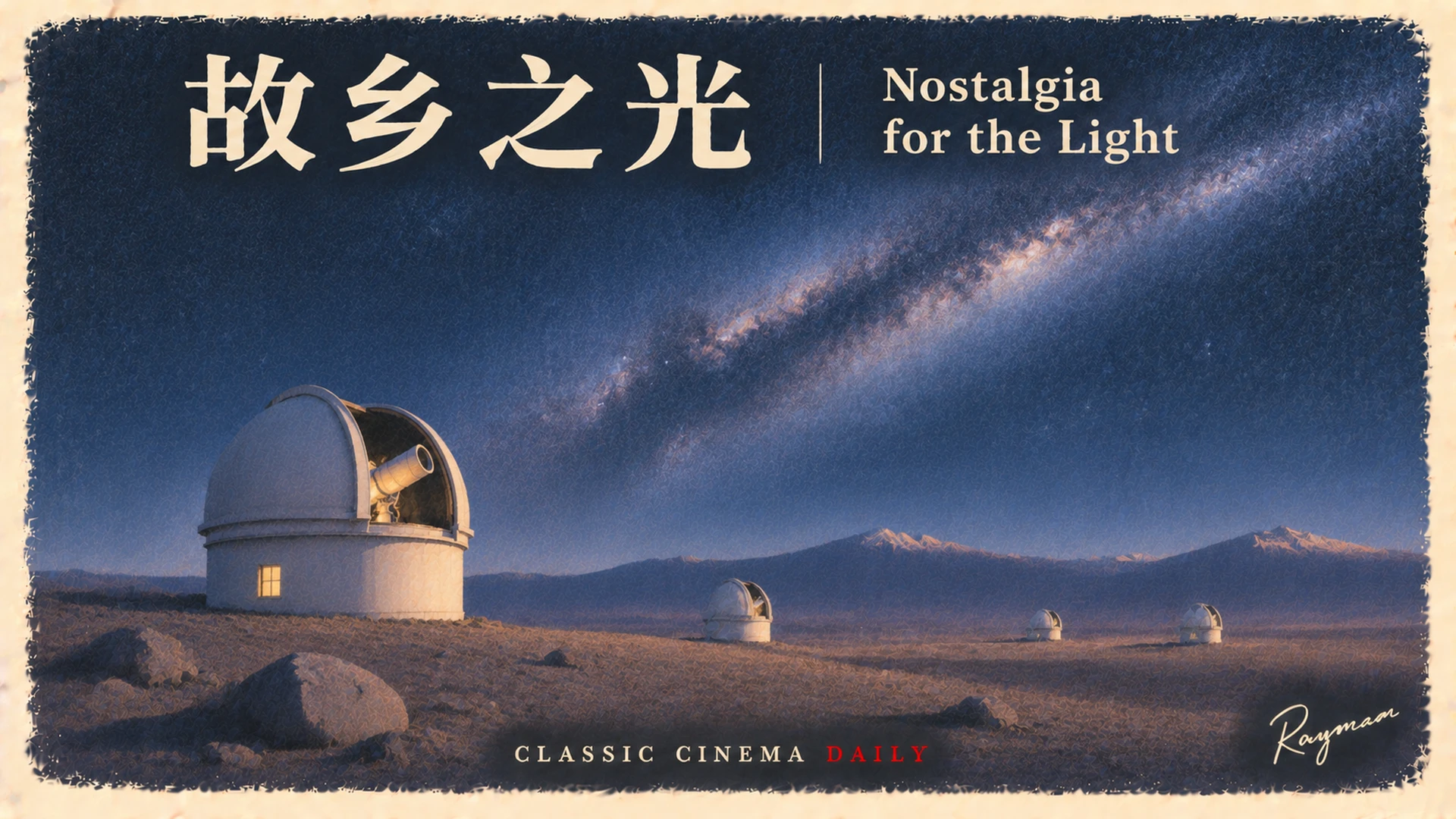
In Chile's Atacama Desert, astronomers study light emitted billions of years ago while a group of women sift the sand for the bone fragments of relatives who disappeared under the military regime. Guzmán sets the cosmic past beside the national one and asks who is entitled to remember.
01Why this film today
On the same day, another continent. The Atacama is one of the driest places on earth; its sky is thin and clear, which is why astronomers gather there to look at light emitted billions of years ago. And because it is so dry, the desert also preserves mummified remains, ancient shells — and, after 1973, people buried in secret. On All Souls' Day the film offers an almost cruel symmetry: the better a country becomes at seeing its past, the harder it becomes to pretend it has none.
02Film details
- Chinese title
- 故乡之光
- English title
- Nostalgia for the Light
- Director
- Patricio Guzmán / 帕特里西奥·古斯曼
- Year
- 2010
- Country
- Chile / France / 智利 / 法国
- Language
- Spanish, English
- Genre
- Documentary / 纪录片
- Runtime
- 90 min
03About the film
影片从一个很小的动作开始:导演帕特里西奥·古斯曼说他从小热爱天文学。然后他把镜头转向智利北部的阿塔卡马沙漠。 在那里,三组人同时在工作。天文学家在观测宇宙最古老的光;考古学家在沙层里读人类留下的痕迹;还有一群上了年纪的女性,拿着小铲和筛子,一寸一寸地找——她们找的是1973年军政时期被处决、被秘密掩埋的亲人,剩下的骨骼碎片。 影片没有把这三组人剪成三条平行线,而是让他们彼此照亮。它问的是一个简单的问题:过去到底在哪里?
04Why it is a classic
In 2010 it won the European Film Award for Best Documentary; in 2014 the BFI's Sight & Sound listed it among the fifty greatest documentaries ever made. Guzmán's method is not accusation but juxtaposition. He places astronomers searching for calcium as the residue of stars beside women searching for calcium as bone — the image cuts from meteorite to bone fragment until the two are nearly indistinguishable. That cut is the sharpest gesture in the film. Two survivors of the Chacabuco camp also appear: one learned constellations at night from a fellow prisoner who knew astronomy, and recalled that everyone felt enormously free; another paced out the camp and drew it to scale from memory, tearing up the paper each night and hiding it, then rushing to the toilet at dawn. The army later banned the astronomy classes, on the grounds that prisoners might navigate by the stars. The film's pivot is a paradox: Chile is the country where the past is most accessible, and Chileans still cannot acknowledge their own.
05What to notice
影片由法国、智利、德国、西班牙、美国五国联合出品,2010年5月在戛纳电影节首映,同年获欧洲电影奖最佳纪录片。
古斯曼同时担任导演、编剧、剪辑与旁白——这四个身份合在一起,才形成影片那种「第一人称的考古学」语气。
阿塔卡马的极端干燥既保存了远古的鱼类与软体动物遗骸,也保存了1973年之后被掩埋的人;同一个物理条件,同时服务于天文学、考古学与法医人类学。
钙是贯穿全片的意象:它既是恒星与宇宙大爆炸的遗迹,也是人体骨骼的主要成分。陨石与骨片在画面里被并置到几乎无法区分。
这也是古斯曼继《智利之战》三部曲之后再次处理同一段历史——只是这一次,他不再用新闻镜头,而是用星空。
06Before you watch
这不是一部靠信息量取胜的纪录片:没有档案影像的轰炸,也没有受访者的控诉特写。它的节奏接近冥想,大量固定镜头停留在沙漠、天空与人的手部动作上。 建议在安静的环境里看,允许自己走神——影片本身就是关于注意力被拉向远方这件事。 若对智利1973年政变一无所知,也不影响观看;但若先了解一点背景(人民团结阵线、皮诺切特军政时期、查卡布科集中营),片中许多细节会立刻变得沉重。
07In one line
The better a country becomes at seeing its past, the harder it becomes to pretend it has none.